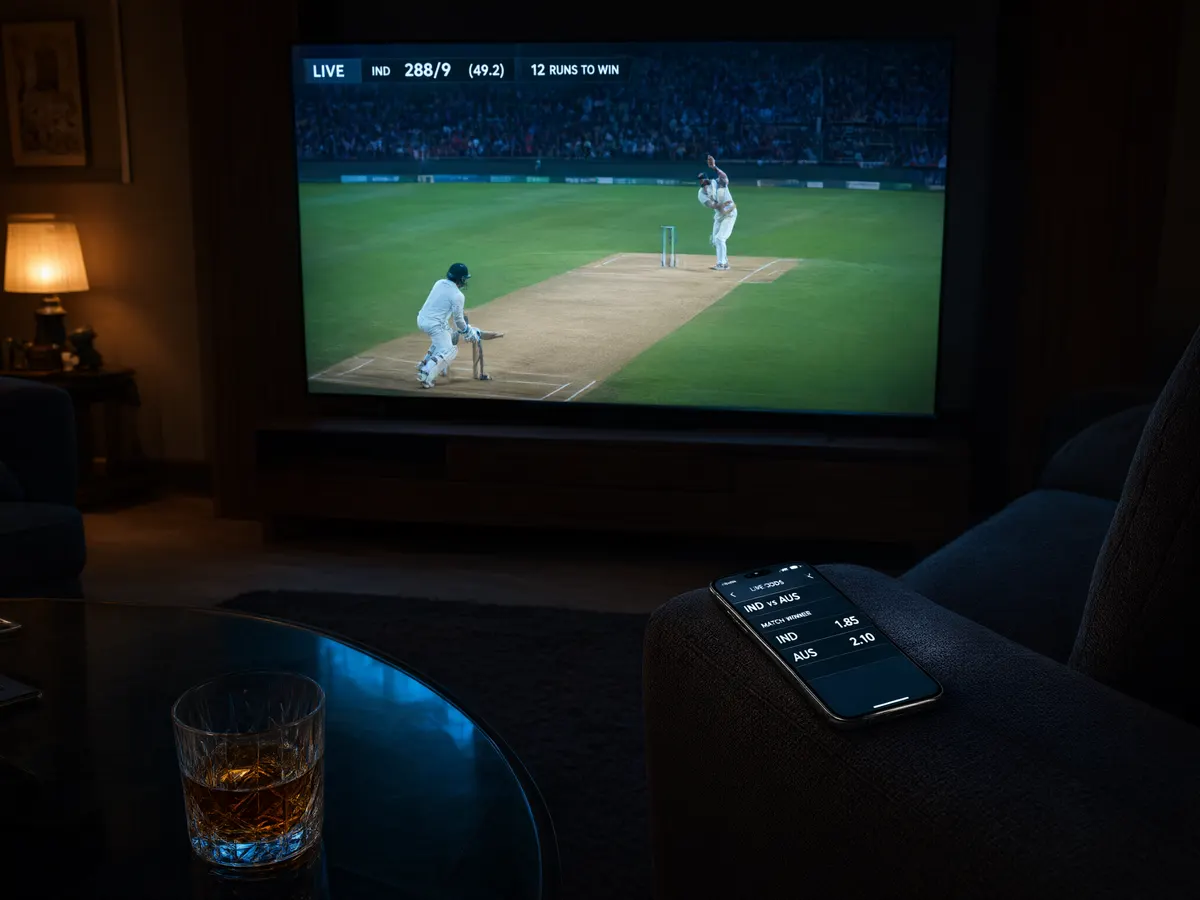
Two sides priced at 1.90 each imply a combined probability of about 105%. That extra five points is the bookmaker’s margin, and it sits in the price whether the fixture is a dead-rubber ODI in February or a World Cup semi-final. The maths does not soften because the match matters more. What changes on a big-match night is the person holding the phone.
The real reason sports betting excitement spikes on big-match nights
Big events spike betting activity because high-stakes uncertainty produces a physiological arousal response, and arousal shortens the gap between an urge and a tap. Heart rate rises, attention narrows, and the brain’s dopamine system responds to the anticipation of an uncertain reward. More bets get placed not because the odds improved but because the decision got faster.
The popular explanation is close to right, and it is usually given for the wrong reason. Most write-ups say fans bet more on big matches because they care more, follow the teams more closely, or know the squads better. Knowledge is not what moves the needle. A reader who can name every player in a Ranji Trophy side will still bet less on that game than on an IPL eliminator they know nothing about, because the eliminator supplies the arousal and the Ranji match does not. Interest follows the stakes; betting follows the arousal.
Worth saying plainly: the industry language around this is more confident than the evidence. “Adrenaline” gets used as though someone measured it in cricket fans. What is actually documented is a reward response to uncertain outcomes and a near-miss effect, mostly studied on slot machines and in laboratory gambling tasks. The transfer to a last-over chase is a reasonable inference. It is not a settled measurement, and anyone who tells you exactly how much a World Cup final raises your betting volume is guessing.
What your brain is doing during a tense final over
Dopamine release tracks anticipation more than outcome, and it peaks when the result is genuinely in doubt. A chase that needs 11 off the last over sits near the point of maximum uncertainty, which is also the point of maximum reward signalling. The feeling arrives before any money changes hands.
That matters because a bet placed inside that state is not the same decision as a bet placed two hours earlier. Calm, pre-match, you compare prices, you think about the stake, you might decide against it. Mid-over, the bet feels urgent and obvious. Nothing about the probability changed. Your assessment of it did.
Why almost winning feels like winning
Near-misses activate much of the same reward circuitry as actual wins, a finding that comes mainly from brain-imaging work on slot machine players who had just lost money. Applied to cricket, the equivalent is the over that goes for 14 when you needed 15, or the catch taken on the boundary rope off the ball you had backed for six. It registers as nearly successful rather than as a loss, and nearly successful is the most motivating outcome there is for placing the next bet.
This is also where the gambler’s fallacy creeps in. Each delivery, like each spin of an RNG-driven slot, is its own event. A bowler who has conceded three boundaries is not “due” a wicket, and a batter who has played out four dots has not earned a six. The scorecard has a memory; the next ball does not.
The crowd effect, and why FOMO does the rest
Social proof is the second lever. Watching with friends, following a group chat, seeing the stream of other people’s bets that many apps now display, you get a signal that everyone is doing this and that the price is about to move. Herd behaviour reduces the felt risk of a decision without reducing the actual risk of it at all.
FOMO sharpens it further during the one-off events. There will be another IPL league match on Tuesday. There will not be another final for a year. The scarcity is real; the implied conclusion, that you should therefore have money on it, does not follow.
In-play betting is the single riskiest window
Live markets compress a decision from minutes into seconds, and they do it precisely when arousal is highest. A pre-match bet lets you compare prices, check the team sheet, and sleep on it. An in-play bet on the next delivery is offered, suspended and settled inside one over, and the only way to take it is immediately.
Here is what actually differs between the two, stripped of the marketing:
| Factor | Pre-match bet | In-play bet |
|---|---|---|
| Time to decide | Hours or days | Seconds, between deliveries |
| Emotional state | Mostly calm | Peak arousal |
| Price comparison | Practical | Rarely happens |
| Number of decisions | One or two per match | Potentially dozens |
| Chance to reconsider | Yes | Almost none |
The volume column is the one people underestimate. A single pre-match punt is one exposure to the margin. Forty in-play bets across a tense T20 is forty exposures, each carrying the same built-in overround, compounded by variance across a short session. Cash-out buttons and auto cash-out settings do not fix this; they add two more decisions to make while your pulse is up.
India’s cricket calendar leaves barely a gap between triggers
A modern IPL season runs roughly two months and more than seventy matches, and the year around it is filled with bilateral series, ICC tournaments, domestic T20 leagues and overseas tours broadcast in Indian prime time. The psychological mechanism is no different from anywhere else. The frequency is.
That distinction matters. One high-excitement night a year is an event you recover from. A season where a tense finish lands three or four evenings a week turns the arousal state into a routine, and routines are what quietly reset a person’s sense of what a normal stake looks like. The pattern does not introduce a new psychology; it just stops the old one from ever cooling off. If you are new to the markets themselves, start with the mechanics in our cricket betting guide before the next series, not during it.
Decide before the toss, not during the chase
Pre-commitment is the one tactic with a straightforward logic behind it: you make the decision while calm and make it expensive to undo while excited. Specifically, before the match starts:
- Fix the total stake for the match in rupees, written down, and treat it as the whole budget rather than a starting figure.
- Set a deposit limit in the app itself, since an app-side limit survives the moment your judgement does not.
- Decide which markets you will bet, and accept that everything outside that list is off the table for the night.
- Turn off in-play push notifications. Every one of them is an invitation delivered at the worst possible moment.
- Keep betting funds in a separate account or wallet from household money, so the boundary is physical rather than mental.
Set the limit while you are bored
The useful version of this is counterintuitive: do the limit-setting on a quiet afternoon, not an hour before a final when the anticipation has already started. A figure chosen in a flat mood is a figure your calm self endorsed. Size it as a fixed share of a bankroll you can lose entirely without consequence, which is the same discipline covered in our bankroll management guide.
Holding the line once it gets tense
The in-the-moment tactic that works is a mandatory pause. Make yourself wait out one full over before placing any live bet, and most of the urge dissolves with the delivery that caused it.
Beyond that, three habits are worth building. Step away for a few minutes after any big swing, win or loss, because an unusually good result distorts judgement roughly as much as a bad one. Never raise a stake to recover a loss inside the same match, which is loss chasing in its purest form and the behaviour most consistently linked to harm. And notice the tell that you have stopped watching the cricket and started watching the bet slip.
Signs the excitement has tipped into a problem
- Increasing stake size after a losing bet to get even within the same match
- Exceeding a pre-set limit more often than you keep it
- Finding a match unwatchable without live money on it
- Hiding amounts from a partner or from the household budget
- Borrowing, or using money set aside for bills, to fund a session
- Betting on matches and leagues you have no interest in, purely for action
Any one of these is a reason to use the cooling-off or self-exclusion tools on the account. Licensed operators are required to offer them, they take minutes to activate, and they work precisely because they cannot be reversed on impulse. See our responsible gambling and self-exclusion page for how to switch them on, and treat India’s Tele-MANAS mental health helpline as a legitimate first call rather than a last resort.
What none of this settles is where your own line sits. The research describes a population; it cannot tell you whether your fourth bet of a tense chase was reasonable or the start of something. The one thing you can know in advance is the number you wrote down before the toss, which is why writing it down before the toss is the whole exercise. Decide it now, while nothing is at stake, because you will not be in a position to decide it fairly later.