Two exchanges, one order book
A betting exchange is a marketplace where bettors wager against each other rather than against a bookmaker, and the platform takes a commission on net winnings instead of building a profit margin into the odds. In October 2026, Matchbook confirmed it had completed its acquisition of Betdaq, bringing two of the sector’s longest-running exchanges under one roof, according to Focus Gaming News.
That deal is a useful teaching tool, because the whole argument for it rests on one word that newcomers almost always underestimate: liquidity. Below, the mechanics of back and lay betting, what an order book is actually showing you, why exchanges consolidate, and the point where the usual advice about exchanges offering “better prices” stops being true.
What is a betting exchange, and how is it structurally different from a sportsbook?
The structural difference is the counterparty. At a sportsbook, the house is on the other side of every bet, sets the price, and carries the risk. On an exchange, another customer is on the other side, the price is whatever two users agree on, and the platform only hosts the market and settles it.
That changes who decides the odds. A bookmaker publishes a number it is happy to accept action on. An exchange publishes whatever the crowd is currently willing to offer, which is why prices there move like a market rather than like a price list.
What back and lay bets mean
Backing is the familiar side: you bet that something will happen. Laying is the side a sportsbook normally takes: you bet that it will not happen, and you accept someone else’s back bet.
Say a horse is available at decimal odds of 3.00. If you back it for ₹1,000, you risk ₹1,000 to win ₹2,000. If instead you lay it for ₹1,000 at 3.00, you are taking the other side of exactly that bet: you collect ₹1,000 if the horse loses, and you owe ₹2,000 if it wins. Your liability as a layer is the stake multiplied by the odds minus one. Beginners who skim past that line are the ones who get a nasty surprise when a 10.00 lay goes wrong.
Laying is also what allows traders to close a position. Back at 4.00, watch the price shorten to 2.50, lay the same selection at 2.50, and you have locked a position across both outcomes before the event finishes. Nothing about that guarantees a profit. It just means an exchange lets you change your mind in a way a settled fixed-odds slip does not.
Why commission replaces bookmaker margin
An exchange cannot earn from a margin because it does not set the odds. A sportsbook prices a two-way market at something like 1.90 and 1.90 when the fair price is 2.00 and 2.00, and the gap, the overround, is its income whichever side wins. An exchange has no such gap to work with, so it charges a percentage, usually a low single-digit figure, on net winnings in each market.
Both are a cost. The difference is where it sits. Margin is invisible and paid on every bet, win or lose. Commission is visible and only bites when you win. Matchbook CEO Ronan McDonagh framed the exchange case as bettors getting “a better deal when prices are made by a market rather than a margin”, which is a fair description of the model, though whether it holds in a given market depends entirely on the next section.
What liquidity means on an exchange
Liquidity is the amount of money other users have already offered at each available price in a market, and it determines whether your bet gets matched at all. An exchange displays this as an order book: a list of the best back prices with the stakes available at each, alongside the best lay prices with theirs.
Two things follow from deep liquidity. First, the spread between the best back price and the best lay price narrows, because more competing offers fill in the gap. Second, you can place a larger bet without walking the price, because there is enough money sitting at the top of the book to absorb it.
In a thin market the opposite happens, and this is where the standard “exchanges beat bookmakers on price” advice breaks down. Suppose a lower-league market shows a best back price of 2.80 and a best lay price of 3.20. The fair price is probably somewhere near 3.00, but you cannot bet at 3.00. You can only take 2.80, and after 2% commission on a winning ₹1,000 stake your ₹1,800 profit becomes ₹1,764, an effective price of about 2.76. A sportsbook quoting a flat 2.90 on the same selection is simply the better bet. On liquid markets, the top football leagues, big racing, major tennis, the exchange price usually wins. On everything else, it often does not.
What Matchbook’s acquisition of Betdaq involved
Matchbook, based in the UK and Alderney, finalised its acquisition of Betdaq in a deal reported in October 2026. Matchbook said the agreement underlines its long-term commitment to exchange betting and will strengthen its liquidity offering as interest in peer-to-peer betting grows. The company’s stated expectation is that combining the two platforms creates a larger liquidity pool, giving customers tighter spreads and a better chance of getting larger wagers matched at their preferred odds. Those are the company’s claims about its own product, not independently measured results.
Why smaller exchanges merge or get acquired
Because thin liquidity is self-reinforcing. An exchange with fewer users shows wider spreads and smaller available stakes, which drives serious bettors to the deepest book available, which thins the smaller one further. Against a dominant rival such as Betfair, a mid-sized exchange is not competing on software or branding so much as on whether there is money in the market when a customer arrives. Pooling two user bases is the most direct answer to that problem.
Could pooling two liquidity pools actually change the prices you see?
Plausibly yes on depth, and plausibly no on cost, and those pull in different directions. Nothing here is a reported outcome; it is what the mechanics of exchange markets would suggest.
The optimistic reading is straightforward. Merge two order books and the same event has more competing offers, so the best back and best lay prices move closer together and larger stakes get matched nearer the top price. That effect would be most visible on popular events where both platforms already had activity, and barely noticeable on obscure markets that were thin on both.
The sceptical reading is about competition rather than mechanics. Every exchange that disappears is one fewer operator with a reason to undercut on commission, and commission is the actual price of using an exchange. Fewer independent venues could, over time, mean less downward pressure on those rates.
Weighing the two, the depth argument is the stronger one in the near term, because liquidity benefits show up immediately in a visible place, the order book, while commission competition in this sector has historically been sluggish anyway. That does not make the second reading silly. It makes commission the number worth watching once the integration settles, rather than the one to assume stays put.
Who exchange betting actually suits
Exchanges reward people who care about price to the second decimal and are comfortable with a little friction. They punish people who want to place a bet in ten seconds and never think about it again. A direct comparison:
| Factor | Betting exchange | Traditional sportsbook |
|---|---|---|
| Who sets the price | Other bettors, continuously | The operator, in advance |
| Cost structure | Commission on net winnings | Margin baked into the odds |
| Getting matched | Needs a counterparty at your price | Guaranteed at the quoted price |
| After placing | Can lay off or trade out before the event ends | Bet is fixed once accepted |
| Market coverage | Deep on major events, thin elsewhere | Broad, including niche markets and specials |
| Learning curve | Order books, liability, commission | Pick a price and stake |
If you bet mostly on accumulators, small stakes, or obscure competitions, an exchange will frustrate you and will not be cheaper. If you bet single outcomes on heavily traded markets, want to lay as well as back, or want the option of closing a position mid-event, the exchange model fits. Neither removes the basic reality that betting carries negative expected value over time once the cost of participating is paid.
How to read prices in an order book
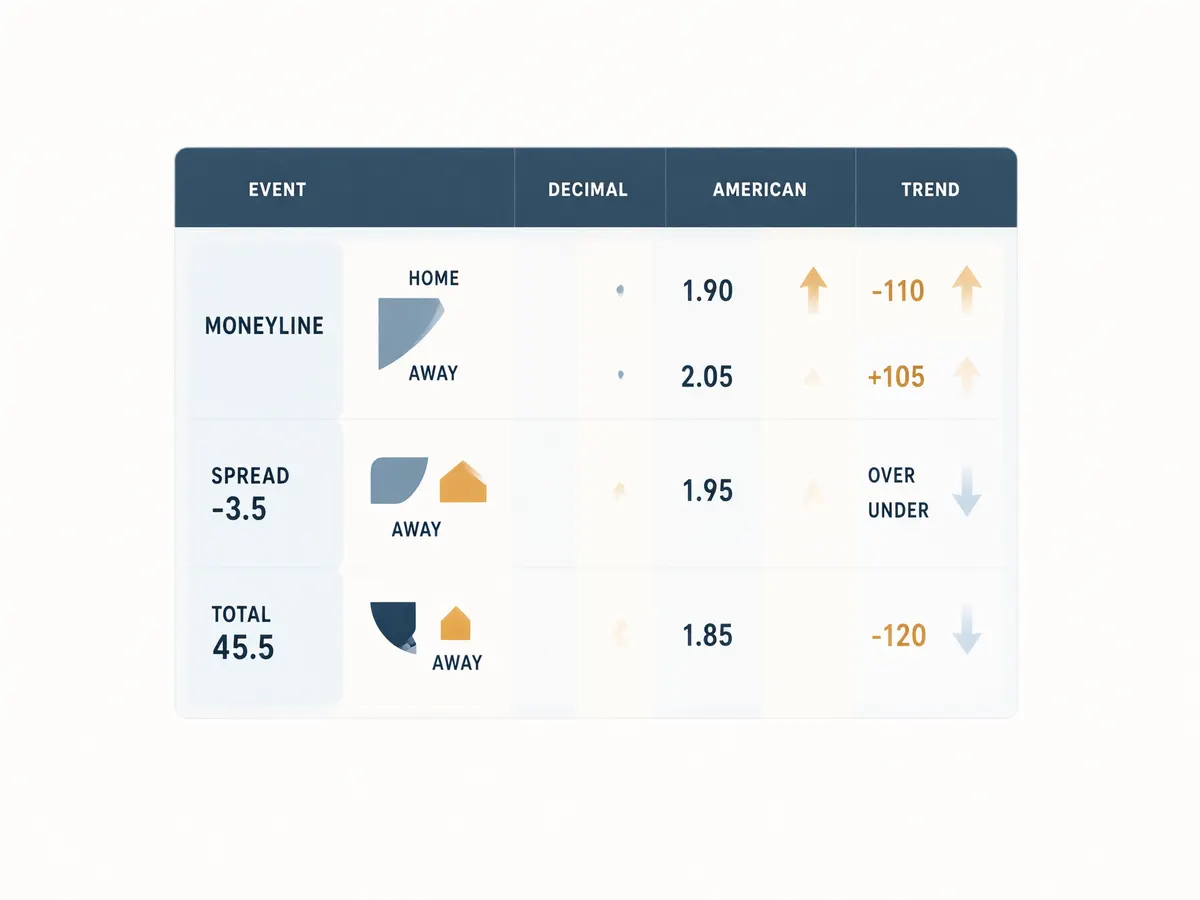
An exchange shows you several prices at once with a stake figure attached to each, and the stake figure matters as much as the price. A typical display might offer back prices of 2.80, 2.76 and 2.72 with ₹40,000, ₹150,000 and ₹300,000 available, and lay prices of 2.86, 2.90 and 2.94 with their own amounts.
Read it like this. The best back price, 2.80, is the highest price anyone is currently willing to lay to you, and only ₹40,000 of it exists. Ask for ₹200,000 and you will get ₹40,000 at 2.80 and the rest at worse prices, or you will sit partially matched waiting for someone to take the remainder. The best lay price, 2.86, is the lowest price at which someone wants to back. The gap between 2.80 and 2.86 is the spread, and a tight spread on big available stakes is what people mean when they call a market liquid.
You can also post your own price rather than take what is showing, by asking to back at 2.90 and waiting. That is the real difference from a sportsbook. At a bookmaker there is one number and you either accept it or you do not. On an exchange there is a queue, and you can join it.
What to watch as the integration plays out
Two numbers tell you whether the Matchbook–Betdaq combination delivers for bettors: the spread and available stakes on markets you actually bet, and the commission rate charged on net winnings. Company statements about larger liquidity pools are a stated intention, and the order book will confirm or contradict them faster than any press release.
One practical caveat before any of this becomes relevant to you. Exchange betting is not legally available everywhere, and in India the position depends on the state you are in and has been shifting at national level, so check the rules that apply where you live before assuming access. And whichever model you use, set deposit and loss limits in advance, treat betting as paid entertainment rather than a source of income, and use self-exclusion or cool-off tools if it stops feeling that way.