A running game falls apart, and a price changes somewhere
The Las Vegas Raiders went into a home game against the Buffalo Bills averaging 82 rushing yards per game, fifth-worst in the NFL, after managing 38 yards on the ground in a 45-17 loss at New England. Running back Ashton Jeanty carried 10 times for 27 yards while nursing an ankle sprain and a flare-up of plantar fasciitis. A Vegas sports report laid all of this out in detail and never quoted a single betting price.
That gap is the whole lesson. Betting odds are a translation of implied probability with the bookmaker’s margin added on top, not a forecast of what will happen. Reports like that one supply the raw material: the injuries, the yards per carry, the blitz rates. The sportsbook converts it into a number, and that number is what you actually bet into. Understanding how sports betting odds work means understanding that conversion, and the same conversion runs underneath the cricket and football markets Indian bettors follow every week.
What sports betting odds actually tell you
An odds figure tells you the probability a sportsbook has assigned to an outcome, expressed as a payout. It is not a prediction that something will happen, and it is not a measure of how confident anyone is. It is a price, and prices move for reasons that have nothing to do with certainty.
Decimal odds, the standard format on most sites Indian bettors use, make the conversion simple. Divide 1 by the decimal figure:
- Odds of 2.50 imply 1 ÷ 2.50 = 0.40, or 40%.
- Odds of 1.60 imply 1 ÷ 1.60 = 0.625, or 62.5%.
- Odds of 4.00 imply 1 ÷ 4.00 = 0.25, or 25%.
Decimal odds also include your stake in the return. A ₹100 bet at 2.50 returns ₹250 in total, which is ₹150 profit plus your original ₹100 back. Get that wrong and every calculation downstream is wrong too.
The useful habit is converting before you do anything else. “Odds of 1.45” means little on its own. “The book thinks this is about a 69% chance” is something you can argue with.
Favorites versus underdogs: reading the numbers
In decimal format, anything under 2.00 is the favorite and anything over 2.00 is the underdog. Exactly 2.00 is an even-money proposition, a notional 50%. That is the entire rule, and it works on cricket match winners, football 1X2 markets and NFL moneylines alike.
The lower the decimal number, the shorter the price and the more probability the book has assigned. A team at 1.30 is implied at roughly 77%. Its opponent might sit at 3.40, implied at roughly 29%. Those two numbers add up to more than 100%, which is not an error. More on that below.
Converting American (+/-) odds to decimal odds
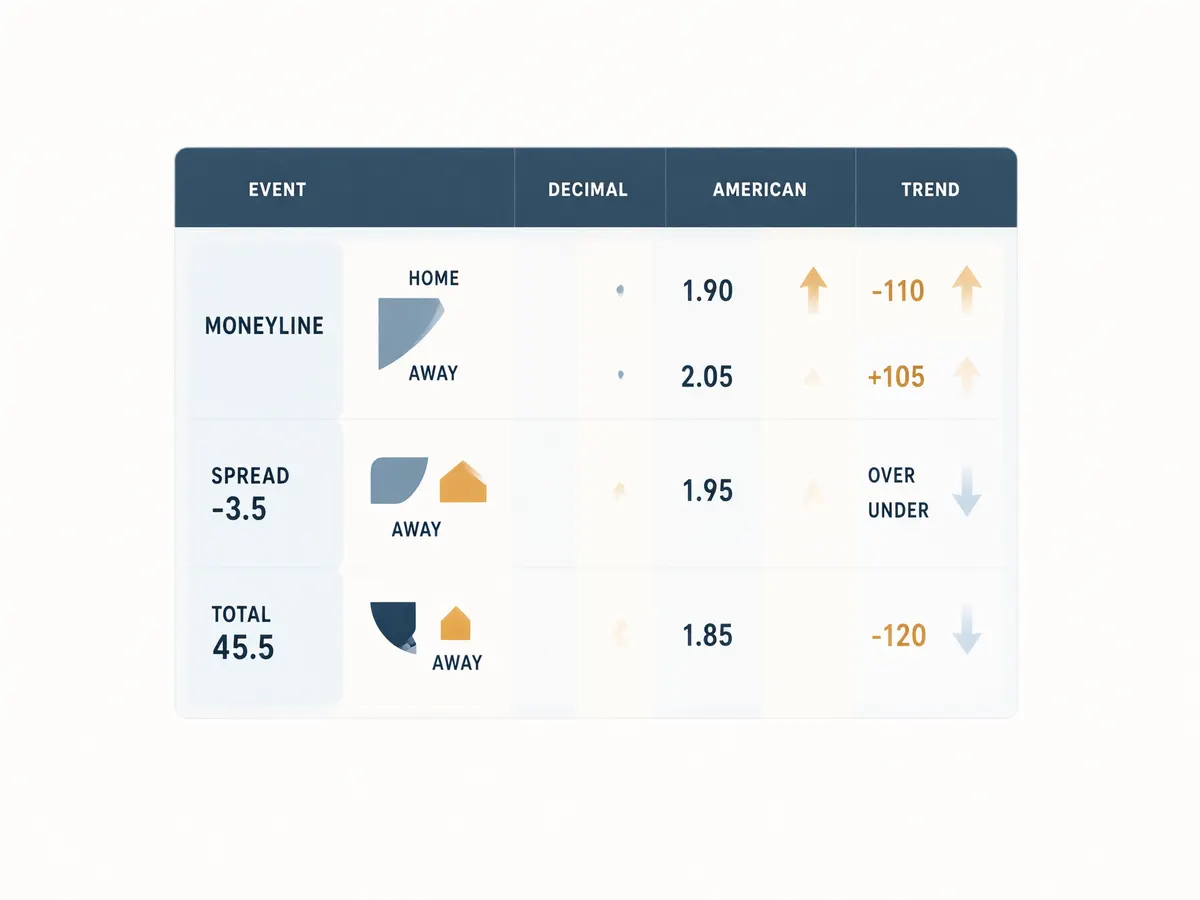
US coverage uses the American convention, so you will see it in any Vegas-based report. A minus sign marks the favorite and shows how much you must stake to win 100 units. A plus sign marks the underdog and shows how much you win from a 100-unit stake.
Two formulas handle the conversion. For negative odds, decimal = 1 + (100 ÷ the number without its sign). For positive odds, decimal = 1 + (the number ÷ 100).
| American odds | Decimal odds | Implied probability | Role |
|---|---|---|---|
| -200 | 1.50 | 66.7% | Favorite |
| -150 | 1.67 | 60.0% | Favorite |
| -110 | 1.91 | 52.4% | Slight favorite |
| +100 | 2.00 | 50.0% | Even money |
| +130 | 2.30 | 43.5% | Underdog |
| +200 | 3.00 | 33.3% | Underdog |
You will also meet the point spread and the moneyline in American coverage. The moneyline is a straight bet on who wins. The spread handicaps the favorite by a margin of victory, which is why spread prices cluster around -110 on both sides: the handicap is doing the work of balancing the two teams, so the prices stay close to even.
Why odds move: line movement explained
Odds move when the information behind them changes or when the money coming in forces the book to rebalance its liability. Those are two different causes that produce the same visible effect, and telling them apart is harder than most bettors assume.
The information side is straightforward. Team news, confirmed injuries, lineup changes, a manager resting players, weather at the venue. The money side is about exposure. A sportsbook would rather take balanced action and collect its margin than carry a large one-sided position, so heavy backing of one side tends to shorten that price and lengthen the other.
The distinction people draw between sharp money and public money is about whose stake is moving the line. A large, well-informed wager can shift a price immediately even when the public is betting the other way. A flood of small bets on a popular team can shift it too. From the outside you often see only the result: the number changed.
What the Raiders report illustrates about real-time odds
Read that Vegas report as a list of inputs. A rushing attack averaging 82 yards per game. A quarterback who turned 38 and has never relied on mobility, blitzed on 41.2% of his first-half drop-backs by New England. A lead back at 3.3 yards per carry, down from 3.7 as a rookie, playing hurt. Buffalo ranked 28th in blitz rate at 16.3% against a league average of 24.5%, with the obvious inference that Buffalo had just watched someone else have success doing more of it.
None of that is an odds figure. All of it is the sort of thing that nudges a total or a spread between Monday and Sunday. The same report covered the Golden Knights travelling to Nashville on the second night of a back-to-back, having conceded a 3-0 first-period deficit for the third time in seven games. Fatigue, goaltender rotation on back-to-backs, a Predators power play that had just been handed evidence it works: those are hockey inputs that sit behind a puck line.
The cost of misreading this is specific. By the time a well-reported injury appears in your news feed, the price has usually already absorbed it. Backing a shortened favorite because the news looks bad for the opponent is buying something you are no longer being paid for.
The same mechanics in cricket and football markets
Cricket odds move on inputs that are peculiar to cricket but behave identically. The toss is the clearest case: in a day-night match where the side batting second gets help from the dew, the winner of the toss can see its price shorten within moments of the coin landing, before a ball is bowled. A pitch report describing a dry, turning surface moves the odds in favour of the side with the stronger spin attack. A frontline fast bowler ruled out at the team sheet stage does the same work as an NFL injury report.
Football is mostly a lineup story. Confirmed XIs typically land about an hour before kickoff, and that window is when prices adjust hardest: a rested first-choice striker, a centre-back passed fit, a goalkeeper rotated for a cup tie. Heavy rain on a narrow pitch feeds into goals markets more than match-winner markets, because it changes how the game is likely to be played rather than who is likely to win it.
Legality for sports betting varies by Indian state, so check what applies where you are before you bet anything. This is an explainer on reading prices, not a guide to where you may place them.
The bookmaker’s margin: why odds are never a true 50/50
Add up the implied probabilities on both sides of a market and the total exceeds 100%. That excess is the bookmaker’s margin, also called the vig or the overround, and it is the built-in edge that makes the book’s business work.
Take a two-way market priced at 1.90 on each side. Each implies 1 ÷ 1.90 = 52.63%. Together they sum to 105.26%. A genuine coin flip would need prices of 2.00 and 2.00, summing to exactly 100%. The extra 5.26 percentage points is what you are paying for the privilege of the bet, roughly 5% of the money staked across both sides.
A cricket match winner at 1.80 and 2.10 works out at 55.56% plus 47.62%, or 103.18% — a tighter market, but still not free. Compare the totals across sites and you are comparing margins directly. Lower is better for you, and a 2% difference compounds across every bet you place in a season far more than any single result does.
This is the part most bettors nod at and then ignore. The margin is why sports betting carries a negative expected value over time, in the same way a casino game’s house edge does. No reading of a line changes that arithmetic; it only changes how much you pay for it.
Four things to check before you read any odds line
- Convert the price to implied probability first, using 1 ÷ decimal odds, so you know what the book is actually claiming.
- Identify the favorite and the underdog: under 2.00 versus over 2.00 in decimal, minus versus plus in American format.
- Note whether the line has moved since you last looked, and try to attribute the move to news or to money. Not all movement means new information.
- Sum the implied probabilities across the market to see the margin you are paying, then check whether another book is charging less.
Do all four and you still will not know what happens on Sunday. The honest position is that odds tell you what a sportsbook believes, inflated by what it charges, and that a moving line is ambiguous by design: you can almost never see whether it moved on a physio’s report or on one large bet. Treat the number as a price you are being quoted rather than a judgement you can trust, set a deposit limit, and stop when it stops being entertainment. The margin is patient.