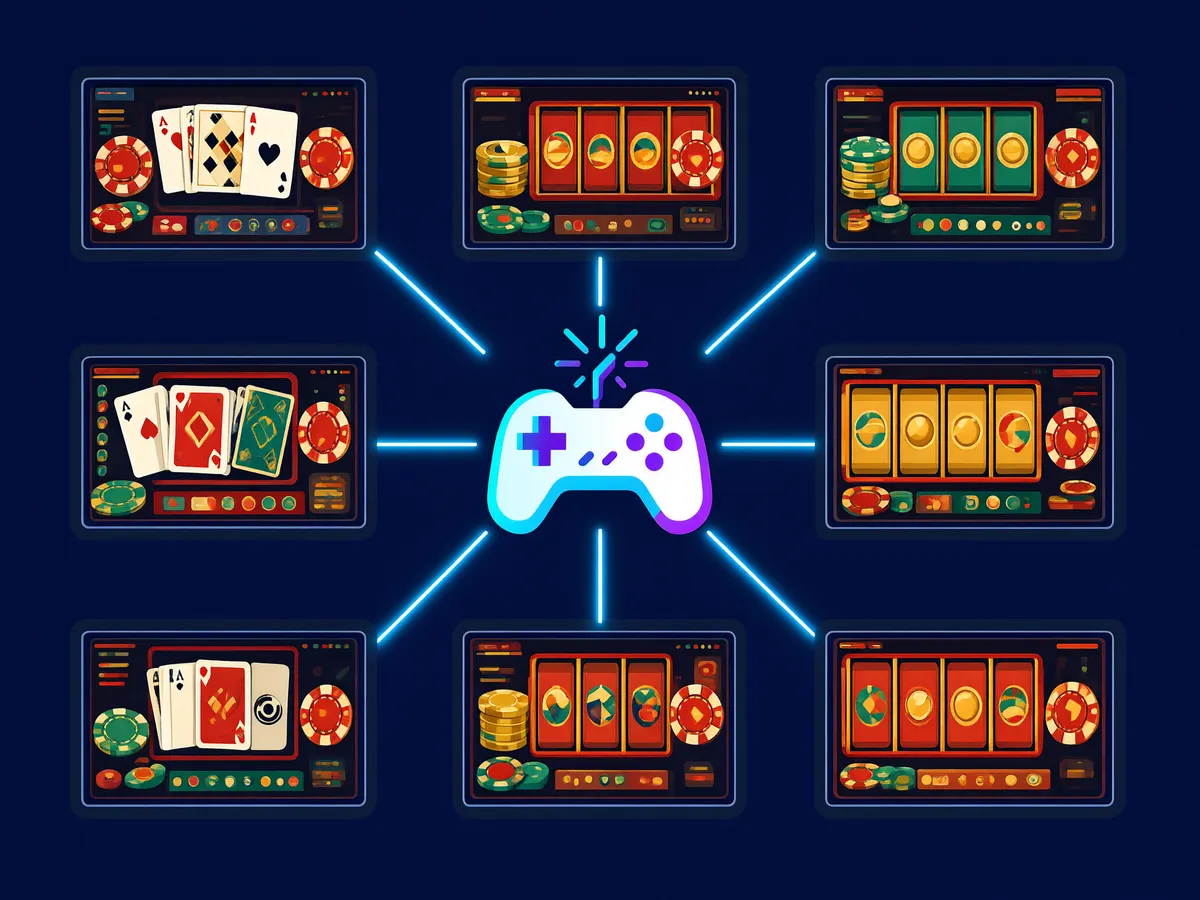

Ten Wazdan slots turned up in Hollywoodbets’ casino lobby, and Wazdan never built a single line of code pointing at Hollywoodbets. The games arrived through Light & Wonder’s platform. That middle layer is a casino game aggregation platform: a technical and commercial bridge that lets a studio integrate once and have its titles switched on by any operator already connected to the same platform. The Wazdan deal is a clean, recent example of the model, so it is the one worked through here.
It is also a useful corrective. Trade coverage describes announcements like this as a studio “entering” a market. The evidence in the announcement supports something narrower, and the gap between those two framings is where most readers get the wrong idea about how slot content actually travels.
What the announcement actually confirmed
Wazdan’s slots went live with Hollywoodbets in South Africa, with the operator integrating an initial ten titles through Light & Wonder’s aggregation platform. According to G3 Newswire, the launch covers 9 Coins, 9 Coins 1000 Edition, 9 Coins Grand Gold Edition, Burning Sun, Hot Slot: 777 Crown, Hot Slot Mystery Jackpot Joker, Magic Spins, Power of Gods: Valhalla, Power of Sun: Svarog and Sizzling Eggs. Hollywoodbets is described as one of South Africa’s most established betting and gaming brands.
That is the whole verified picture. The report does not state the commercial terms, the length of the agreement, whether any exclusivity applies, or when the remaining catalogue follows. The word “initial” in front of “ten releases” is doing real work, and nothing in the source says what comes next. Anyone telling you Wazdan’s full portfolio is now available in South Africa is filling in a blank the announcement left empty.
What is a casino game aggregation platform?
A casino game aggregation platform is a B2B layer that sits between game studios and casino operators. The studio connects its remote game server to the aggregator once, via a single API integration. The aggregator then makes that content available to every operator on its network, handling game delivery, session and wallet calls, and reporting through one connection instead of many.
Think of it as a distribution warehouse rather than a shop. The aggregator does not usually own the games it carries, and it does not sell to players. It holds the shelf space, the plumbing and the paperwork that let an operator add a studio’s catalogue with a configuration change rather than a six-month integration project.
One integration versus dozens: the distribution math
Without an aggregator, every studio-operator deal is a bespoke project. The studio negotiates commercial terms with each operator, builds or adapts an integration to that operator’s platform, tests it, certifies the games for that operator’s licence, and then maintains the connection forever. Ten operators means ten of everything.
With an aggregator, the heavy engineering happens once. The table below sets out where the work moves.
| Dimension | Direct studio-to-operator integration | Via an aggregation platform |
|---|---|---|
| Technical build | One integration per operator | One integration, reused across the network |
| Commercial contracts | Separate deal with each operator | One platform agreement, plus operator sign-off |
| Time to first launch | Longer; engineering queue on both sides | Shorter; mainly configuration and compliance |
| Adding new titles | Pushed operator by operator | Published once to the platform catalogue |
| Wallet and session handling | Studio matches each operator’s system | Single-wallet integration handled by the platform |
| Reporting and reconciliation | Fragmented across partners | Consolidated in the platform back office |
| Control over placement | Higher, negotiated directly | Lower; operator merchandises from a large catalogue |
That last row is the trade-off nobody puts in a press release. Aggregated distribution buys speed and reach at the cost of prominence. Your game arrives on the shelf alongside several thousand others, and whether anyone sees it depends on how the operator’s content management system ranks lobbies that week.
What Wazdan gets from going through a platform
Reach without rebuilding. A studio like Wazdan maintains one certified set of game clients and one server integration, then relies on distribution partners to carry that content into markets where it has no local presence, no commercial team and no existing operator relationships.
The cost logic is straightforward. Integration engineering is close to a fixed cost; spread over one operator it is expensive, spread over a network it is cheap. For a mid-sized studio competing with suppliers that release several titles a month, the alternative is hiring integration engineers instead of game designers, which is the wrong place to spend money.
There is a compliance benefit too. Multi-jurisdiction licensing is slow and document-heavy, and a platform that already operates in a market has much of the groundwork done. It does not remove the studio’s own obligations, but it shortens the path.
What Hollywoodbets gets from plugging in
A pre-vetted catalogue behind one technical connection. An operator that wants content from fifty studios can sign fifty contracts and run fifty integrations, or it can connect to an aggregation platform once and switch studios on as it needs them. Hollywoodbets took the second route for Wazdan’s titles.
The practical gain is refresh speed. Casino lobbies live or die on new releases, and an operator running direct integrations is always waiting on someone’s development queue. Through a platform, adding a studio becomes a commercial decision followed by compliance checks, not a build. Reconciliation, player session handling and game-level reporting also arrive in one format rather than fifty.
The cost is dependence. The operator’s content pipeline now runs through a third party’s roadmap, uptime and commercial priorities, and a slice of margin goes to the layer in the middle.
Light & Wonder is wearing two hats here
In this deal Light & Wonder is the distribution layer, not the game maker. Its aggregation platform is carrying another studio’s content to an operator. That is worth stating plainly because Light & Wonder is also a substantial game developer in its own right, and the two businesses are easy to confuse when the same name appears in an announcement about someone else’s slots.
Suppliers running both a studio and a platform is normal in this industry. It also creates an obvious question about how in-house content is positioned relative to third-party content on the same shelf. The announcement says nothing about that, and I am not going to speculate about it.
Why the same slot shows up on sites that look nothing alike
Because the brands differ while the backend does not. Two casinos with separate names, licences, owners and payment setups can both draw from the same aggregation platform, which means the same Wazdan title can appear in both lobbies, running from the same remote game server, with identical mechanics and identical RTP configuration.
One caveat that trips up players: some titles ship with more than one RTP setting, and the operator selects which version to run. Same artwork, same name, different maths. The game information panel in the title itself is the place to check, not the affiliate review.
The part aggregation does not solve
Licensing. Aggregation compresses the technical and commercial distance between a studio and an operator; it does nothing to the regulatory distance. A game still has to be certified against the technical standards that apply to the licence the operator holds, and the relevant authority still has to accept it before it can be offered to players in that jurisdiction. South Africa regulates gambling through national and provincial bodies, so the applicable requirements depend on the licence in question rather than on the platform delivering the content.
This is why “Wazdan enters South Africa” is a stronger claim than the facts carry. What happened is that ten certified titles reached one operator through one platform. Whether the rest of the catalogue follows, and whether other South African brands on the same platform switch the same games on, is unresolved by the announcement and will be decided by compliance timetables and operator merchandising decisions rather than by the integration itself.
So the practical advice is dull but correct: treat a distribution announcement as evidence that a pipe exists, not that a game is in your lobby. Open the casino, search the title, read the game info panel. And whatever the supply chain behind a slot looks like, the house edge built into it is unchanged by how many operators carry it, so set deposit and session limits before you play and use the operator’s cool-off tools if play stops being entertainment.