Eight decks. 416 cards. That is what loads into a standard baccarat shoe, and in Macau, where baccarat dominates the gaming floor, those cards get consumed and retired at industrial pace. So a factory switching on a line for new casino cards and shoes is not a curiosity. It is a supply-chain event for the busiest table-game market on earth.
What Bee Macau is putting on the line
GGRAsia reports that the Bee Macau factory will see new playing cards and a card shoe rolling off its production line. That is the extent of the confirmed news, and it is worth being precise about it: the report covers products entering production, not a claim about which operators will buy them, which regulators have signed off, or what the units cost. Anything beyond that is inference.
The original GGRAsia report is the primary record here. The interesting part, for anyone who plays table games, is what sits behind a sentence like that: an entire chain of casino playing cards manufacturing, testing and approval that players never see but constantly rely on.
There are two defensible ways to read where the integrity of a card game actually comes from. One says the card is the thing: the printing, the coatings, the anti-counterfeit features baked into every sheet. The other says the hardware and paperwork around the card matter more: the shoe, the procedures, the lab report, the licence. Both have a case. I think the second wins, and the first is the reason people get it wrong.
Casino-grade cards versus the deck in your kitchen drawer
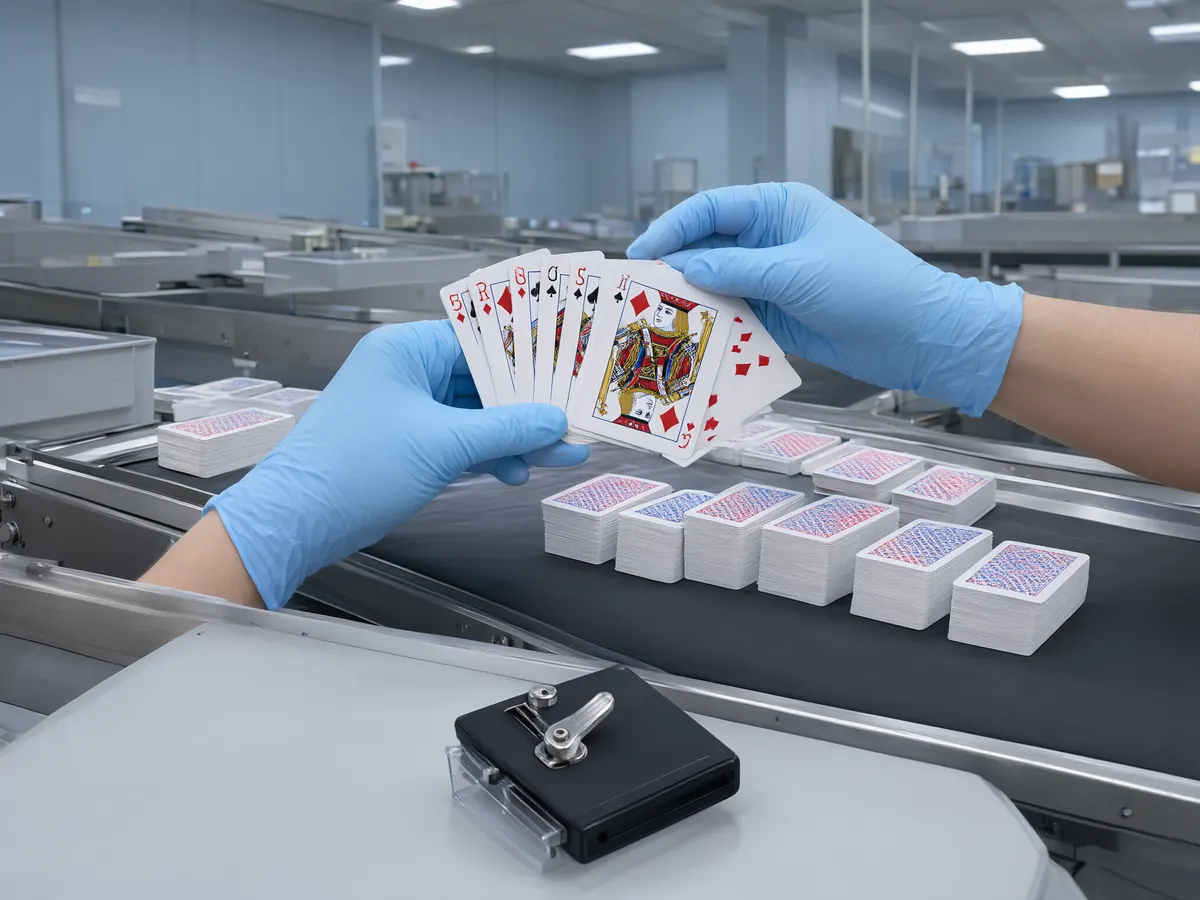
A casino-grade deck differs from a retail deck in stock, coating, cutting tolerance and traceability, not just branding. Retail cards are printed to look good on a shelf. Casino cards are printed to behave identically to every other card in the shoe, thousands of times, under a dealer’s hands and a surveillance camera.
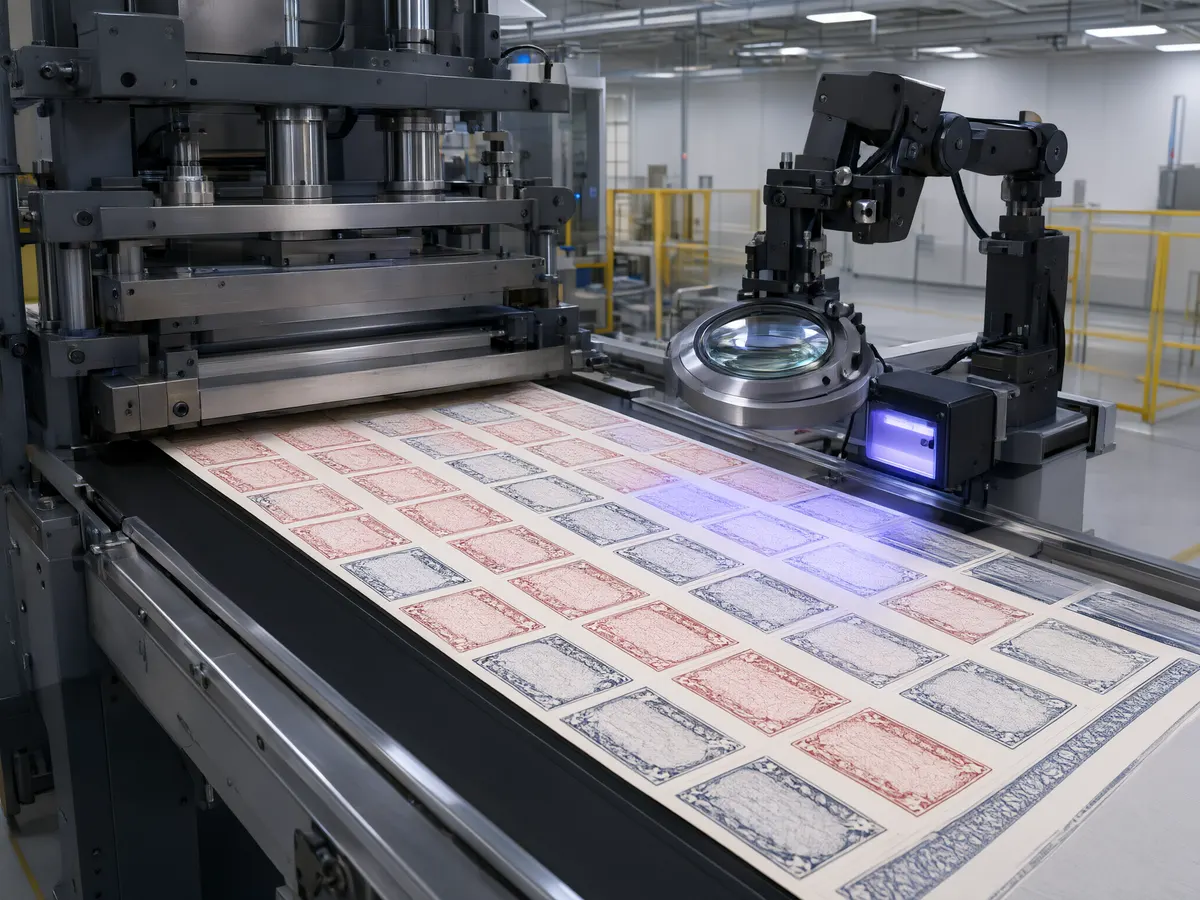
Production follows a recognisable sequence: security printing of faces and backs, lamination or coating of the card stock, precision cutting to tight tolerances, inspection and sorting, then packing in a fixed new-deck order and sealing. Quality control at each stage is the point, because a single card that is a fraction thicker, or has a nick on its edge, becomes identifiable from the back, and an identifiable card is an exploitable one.
| Attribute | Retail deck | Casino-grade deck |
|---|---|---|
| Stock and finish | Coated paper, plastic-coated or all-plastic | Typically plastic-coated paper for shoe games; all-plastic in some poker and Asian table use |
| Cutting tolerance | Loose; slight size variation acceptable | Tight and uniform, so no card is distinguishable face-down |
| Security features | Usually none beyond the back design | Fine-line back patterns, batch or serial coding, and on some decks markings readable only under UV light |
| Packing | Any order | Fixed new-deck order, sealed, so a dealer can verify completeness on opening |
| Service life | Years | Retired on a set schedule, then cancelled |
Security printing and counterfeit prevention
The anti-counterfeit layer exists to answer one question fast: did this card come from the casino’s own stock? Fine-line patterns in the back design are hard to reproduce cleanly on a desktop printer, batch coding ties a deck to a delivery, and UV-readable markings on some decks let staff check authenticity without stopping the game. None of this stops a determined cheat on its own. It makes card switching, the oldest trick at a card table, expensive and slow enough that procedure catches it.
Why decks get retired so fast
Casinos replace decks frequently because wear makes individual cards readable from the back. Bent corners, surface scuffs, a crimp from a player’s thumb, even moisture: each one is a signal that a sharp observer could use. Replacement cycles vary by property and by regulator, usually measured in shoes dealt or hours in play rather than days, and retired decks are cancelled by drilling, clipping a corner or marking them before they leave the floor or get sold as souvenirs. That cancellation step matters more than it sounds. It is what stops a used casino deck from ever coming back through the door looking new.
What a card shoe is, and what it is really there to stop
A card shoe is the box on the table that holds several shuffled decks and releases one card at a time, so the dealer never handles the undealt stack. That is the whole function, and the reason it exists is control: cards come out in one direction, one at a time, in an order fixed at the shuffle. A cut card placed near the back tells the dealer when the shoe is spent, and reserves a buffer of undealt cards so the final hands can’t be reconstructed with certainty.
Take the shoe away and you hand the dealer physical access to the stack. That is why hand-dealt games carry heavier procedural rules, and why high-volume baccarat and blackjack run from shoes almost universally.
Manual shoes compared with automated and RFID-enabled shoes
A manual shoe is a passive container. An automated or RFID-enabled shoe reads each card as it leaves, which lets the system log the exact sequence dealt, verify that the card on the layout matches the card the shoe released, and feed game data to the pit in real time. For catching a switched card or a misdeal, the reading shoe is simply better evidence than a human memory and a camera angle.
The trade-off is cost, maintenance and one more component that can fail mid-shoe. Plenty of well-run tables still use manual shoes with strict procedure and good surveillance, and they are not negligent for doing so. But if you are asking which single piece of equipment does more work for game integrity, it is the shoe, not the card stock.
Where the real guarantee sits: testing and approval
Gaming equipment generally reaches a regulated floor only after independent laboratory testing and approval by the jurisdiction’s gaming regulator. Independent test labs assess whether a device performs to its specification and to the technical standards the regulator has adopted; the regulator then approves the model for use, and the operator is responsible for using only approved equipment under documented procedures.
That is the structure. The specifics are where writers and marketers overreach. Which lab certified a given shoe, under which standard, and for which jurisdiction is a matter of record that should be checked against the lab’s or regulator’s own documentation rather than assumed. The GGRAsia report does not state certification details for the Bee Macau products, so neither will this article. Treat any claim about a named certification body or standard number as something to verify, not something to take on trust because it appeared next to a factory photograph.
What this changes for you at the table
Good equipment protects the fairness of the deal. It does not improve your odds. A perfectly manufactured eight-deck shoe still deals a game with a built-in house edge, and no amount of precision cutting moves that number in your favour. Certified cards and an RFID shoe tell you the game is the game it claims to be, which is exactly what you want and nothing more.
Here is the cost of getting this wrong. Branded cards are the cheapest part of the chain to imitate, and the part most visible in photographs and video streams. A certified shoe, an approved procedure and a real licence are the expensive parts, and the invisible ones. A player who reads “casino-grade deck” as proof of a fair game is anchoring their trust to the one signal that can be faked for the price of a printing run. The signal that actually carries weight is whether a regulator has approved the equipment and licensed the operator using it. Check that, not the card backs.
Macau as a supplier, not only a gaming floor
Macau is where the cards are consumed in enormous volume, and the Bee Macau line is a reminder that some of them are also made there. Beyond that, the source does not quantify Macau’s share of regional equipment production, and there is no reliable figure to offer. What the news does mark is a shift worth watching: equipment production sitting in the same jurisdiction as the demand, which shortens the chain between factory, regulator and table.
What the report leaves open is the part that would matter most to a player: which standard these products are being built to, and which floors will use them. Until that is on the record, the honest position is interest without conclusions. And if you play table games, the responsible frame still applies: set a deposit or loss limit before you sit down, and treat the equipment chain as a reason to choose licensed venues, never as a reason to bet more.