What the projected South Korea casino revenue loss actually measures
A study reported by GGRAsia puts the potential South Korea casino revenue loss at up to US$1.72 billion in gaming spend once MGM Osaka opens its doors. That is the number now circulating through investor notes and regional trade press, and it is being read, almost universally, as a forecast of money Korean operators will hand over to Japan.
Read the phrasing again. “Up to” is the load-bearing part. An upper bound in a modelled range is not a central case, and gaming spend by a travelling customer base is not the same thing as gross gaming revenue booked by any particular operator. The study, as reported, describes spend that could be redirected — not a line item deducted from Grand Korea Leisure’s next annual report. The published summary does not set out the modelling assumptions behind the top-end figure, and anyone treating US$1.72 billion as a settled deduction is importing certainty the source does not provide.
That distinction matters because of what believing the simpler version costs. If you read the figure as a cliff edge arriving on opening day, you brace for a single shock and miss the slower thing already happening: the repricing of Korea’s position in Asian casino tourism, which starts the moment capital decides the Osaka project is real.
Why one resort in Osaka Bay reroutes a whole region
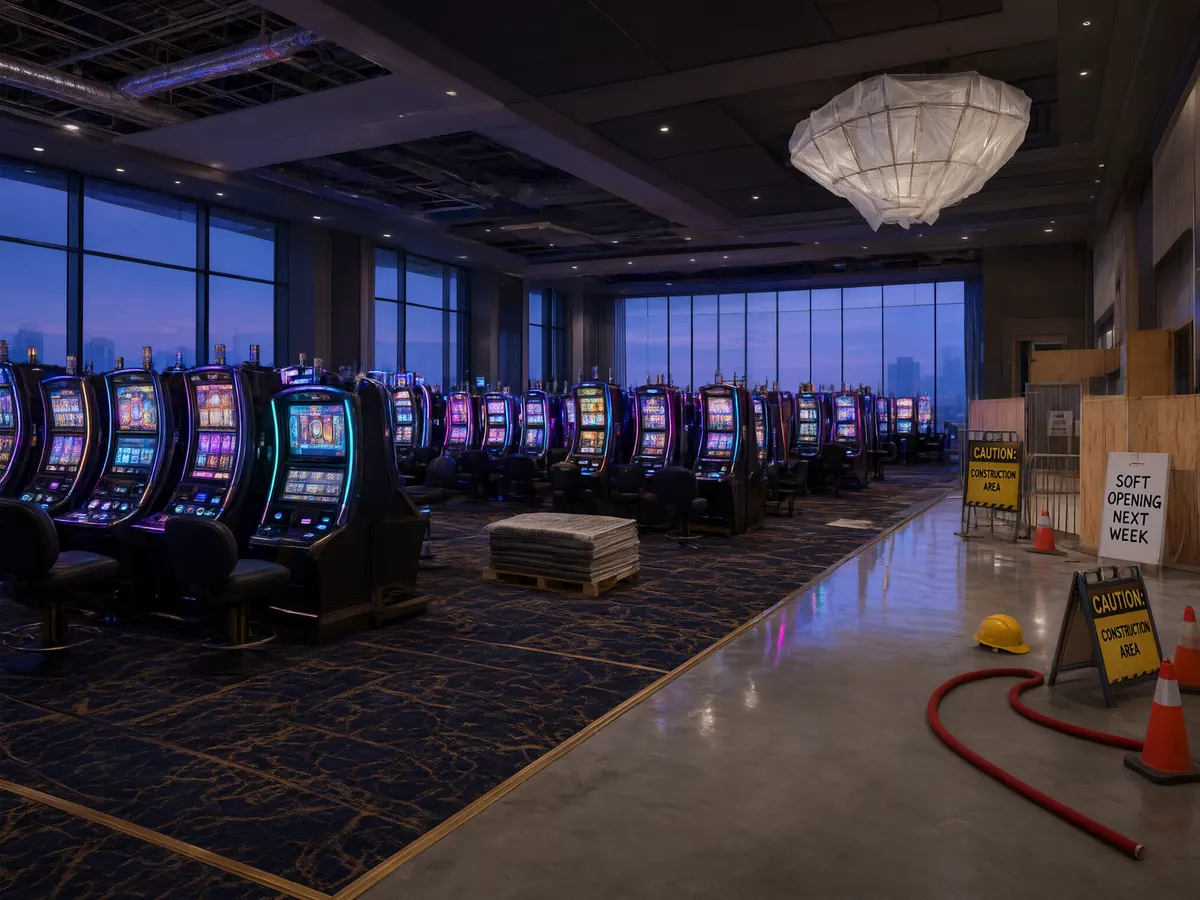
MGM Osaka is Japan’s first integrated resort, being developed by MGM Resorts International and Orix on Yumeshima, a man-made island in Osaka Bay, with an opening targeted around the end of this decade. It will combine a casino floor with hotel, convention and retail space under Japan’s integrated-resort framework — the same model Singapore used to turn two properties into a regional draw.
Scale is part of the story. Location is more of it. Osaka sits inside the same two-to-three-hour flight radius that Korea’s casinos have spent two decades mining: Japan, eastern China, Taiwan, Hong Kong. A new property there does not expand the regional pool of high-spending players so much as it adds a very well capitalised competitor to the middle of it, with a domestic tourism machine already feeding visitors into the same city.
The timeline nobody should round down
The opening is years out, which tempts people into filing this as a 2030 problem. It is not. Operators set marketing budgets, renovation cycles and junket relationships on multi-year horizons, and equity markets discount expected competition long before it arrives. Korea’s exposure gets priced first and felt later. The gap between those two moments is where management teams either reposition or get caught.
Follow the Osaka player who currently buys a flight
Here is the mechanism in one customer. A high-spending gambler living in western Japan has, until now, had no legal domestic casino to visit. If they want baccarat, they get on a plane. Incheon and Jeju are both roughly two hours away. They land, they play on a foreigner-only floor built partly for them, they fly home. Korean casinos did not win that customer by out-competing Japan. They won them because Japan had no product to sell.
Now give that same player a resort in their own prefecture. No passport, no flight, no weekend committed, no currency conversion. Even if they still travel to Korea occasionally, the frequency drops and the share of wallet shifts. Multiply that across a visitor segment that has been one of the more reliable contributors to Korea’s foreign gaming floors and the direction of the study’s figure becomes easy to understand, whatever you think of its magnitude.
This is the part of the story that gets lost when coverage frames the threat as a fight over Chinese VIP play. Chinese demand is contested everywhere, by Macau, by Singapore, by Manila. The Japanese outbound player was something closer to a captive market, and captivity is precisely what MGM Osaka ends.
Korea’s foreigner-only model is the exposure
Almost every casino in South Korea is foreigner-only. Korean nationals are barred from the gaming floors, with a single exception: Kangwon Land, the inland property where locals may play. Every other licence — the Seoul and Busan properties run by state-affiliated Grand Korea Leisure, Paradise Co’s Paradise City in Incheon, the Mohegan-developed Inspire resort nearby, and the cluster of casinos on Jeju — depends on visitors who arrived from somewhere else.
That structure has an obvious consequence. A Macau operator losing VIP volume can lean on local and Greater Bay mass play. A Korean foreigner-only operator has no domestic cushion to lean on, by law. When a competitor appears inside the source market, there is no second revenue base to absorb the hit.
Kangwon Land is the clean counter-example and it proves the point. It is insulated from MGM Osaka almost entirely, because its customers were never the ones boarding flights. Its protection comes from the exact permission the rest of the industry does not have.
Japan’s entry redraws more than one border
Korea is not the only market with something at stake in this realignment. Japan’s arrival in the integrated-resort business adds supply to a region that already contains Macau, Singapore, the Philippines and Korea, all chasing overlapping pools of travelling players. Every new licence in Northeast Asia is, in part, a claim on someone else’s visitor.
What the reported study does not do — and what nobody should pretend to do on its behalf — is quantify the knock-on effects beyond Korea. Whether Osaka primarily cannibalises Korean and Macau volume or genuinely stimulates new Japanese demand that had never gambled abroad is an open question, and the honest answer is that it will not be settled until the property trades for a few years. Singapore’s experience suggested a well-run IR can grow a market rather than just redistribute it. Osaka may do both, in proportions nobody can model yet.
Where the standard playbook runs out
The reflexive advice to a threatened casino market is diversify: push beyond VIP into mass play, build out non-gaming amenities, chase conferences and families, broaden source markets beyond the two or three that dominate. Sensible, and Korean operators have been doing versions of it for years — Paradise City and Inspire are both built as resorts, not gaming halls.
The advice stops working at the point where diversification runs into the licence. You cannot build a resilient mass-market gaming base out of a population you are legally forbidden from serving. Non-gaming revenue can grow; the gaming floor’s addressable market stays defined by inbound tourism, and inbound tourism is exactly the variable MGM Osaka attacks. That is why the policy conversation about local access keeps resurfacing in Seoul, and why it will get louder as the Osaka opening nears. Whether anything changes is a political question with a long history of going nowhere.
Analysis, not prediction: the plausible responses are a harder push into Southeast Asian and Taiwanese source markets, deeper investment in non-gaming differentiation that Osaka cannot replicate, and pressure for regulatory relief. None of these has been confirmed as a strategy by any operator. What has been established is a number, a trigger and a deadline. The useful question for anyone watching Korean casino equities is not whether US$1.72 billion disappears in a single year. It is which of the foreigner-only licences still has a reason for a Japanese player to buy a plane ticket in 2031.
Figures in this article are attributed to the study as reported by GGRAsia.