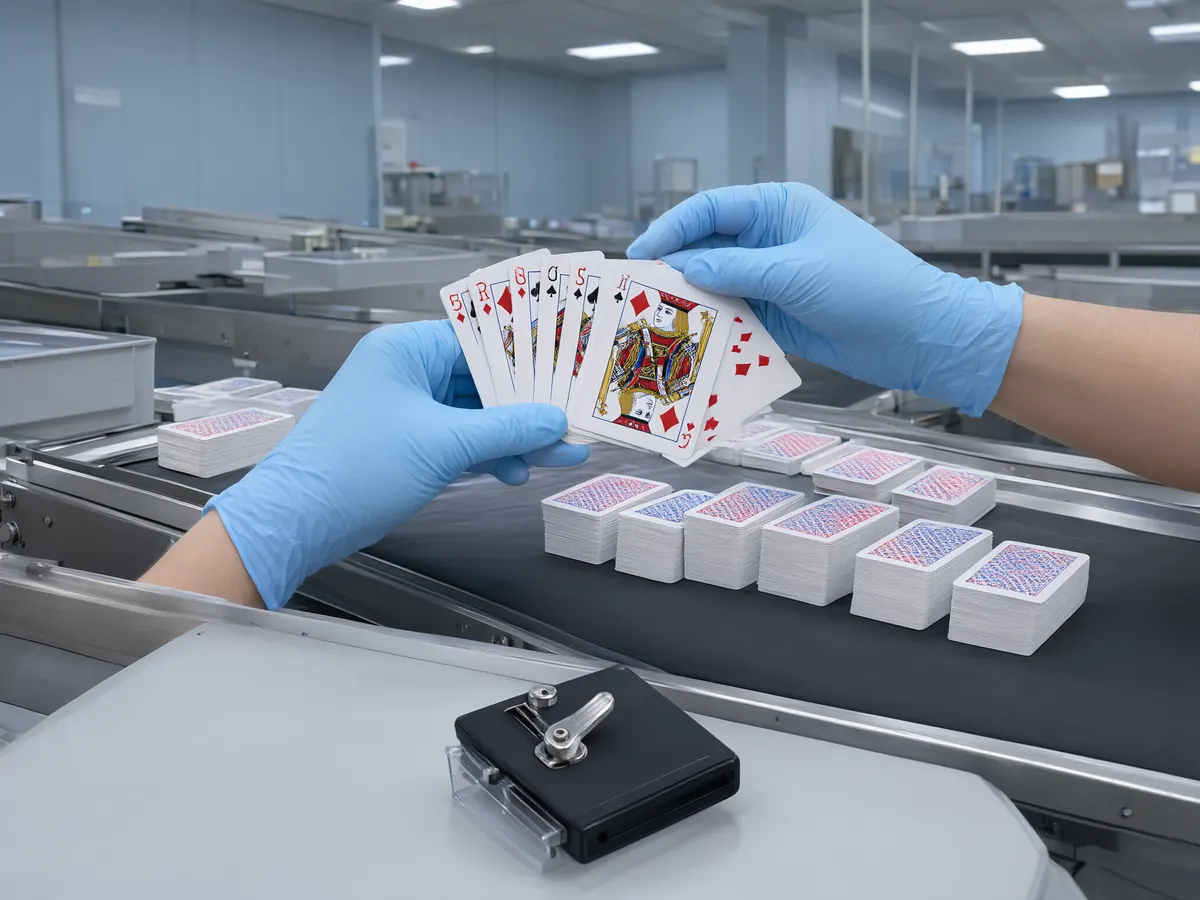
A casino playing card is a disposable industrial component manufactured to a tolerance, used for a few hours, then destroyed. That is the short definition, and almost every part of it complicates the next: the card has to be identical to the other 51 in the deck, identical to the millions of decks made before it, and carry markings a player must never see but a surveillance camera must read instantly. Those demands pull against each other, which is why casino playing card manufacturing happens in dedicated plants rather than on general printing presses.
Macau’s first playing card factory, and why a print works counts as gambling news
Bee Macau is Macau’s first casino-grade playing card production facility, a joint venture between Asia Pioneer Entertainment Holdings and the Belgian manufacturer Cartamundi, which has now officially commenced full operations. According to the announcement reported by G3 Newswire, the factory completed test production before launching full-scale manufacturing in May 2026, and has already exported to Asian markets.
The framing in the announcement is about economic diversification: Macau shifting from buying gaming products to making them. That is the business story. The more interesting story for anyone who sits at a baccarat table is what a card factory actually has to get right, because the integrity of every hand dealt from a shoe rests on manufacturing decisions made months earlier in a building the player will never see.
How are casino playing cards actually made?
Casino cards are produced in four stages: stock selection, printing, cutting, and inspection. A consumer deck can fail any of those stages mildly and still be perfectly good for a kitchen table. A casino deck cannot, because a single card that behaves differently from its neighbours is a card an observant player can identify from the back.
Choosing casino-grade card stock
Two broad material families dominate. Paper stock, typically a cotton and linen blend with a plastic or varnish coating, handles and peels the way dealers and players expect, and is cheap enough to throw away constantly. Fully plastic stock costs more per deck and lasts far longer, which is why it tends to appear in poker rooms and on tables where decks stay in play longer rather than in high-volume baccarat pits.
Thickness matters more than material. If one card in a shoe is measurably thicker or stiffer, it can be felt through a cut, spotted as a slight step in the edge of a stacked deck, or cause a misfeed in a shuffling machine. Consistency of the stock is the whole point of buying it from a specialist supplier.
Printing accuracy and cutting tolerances
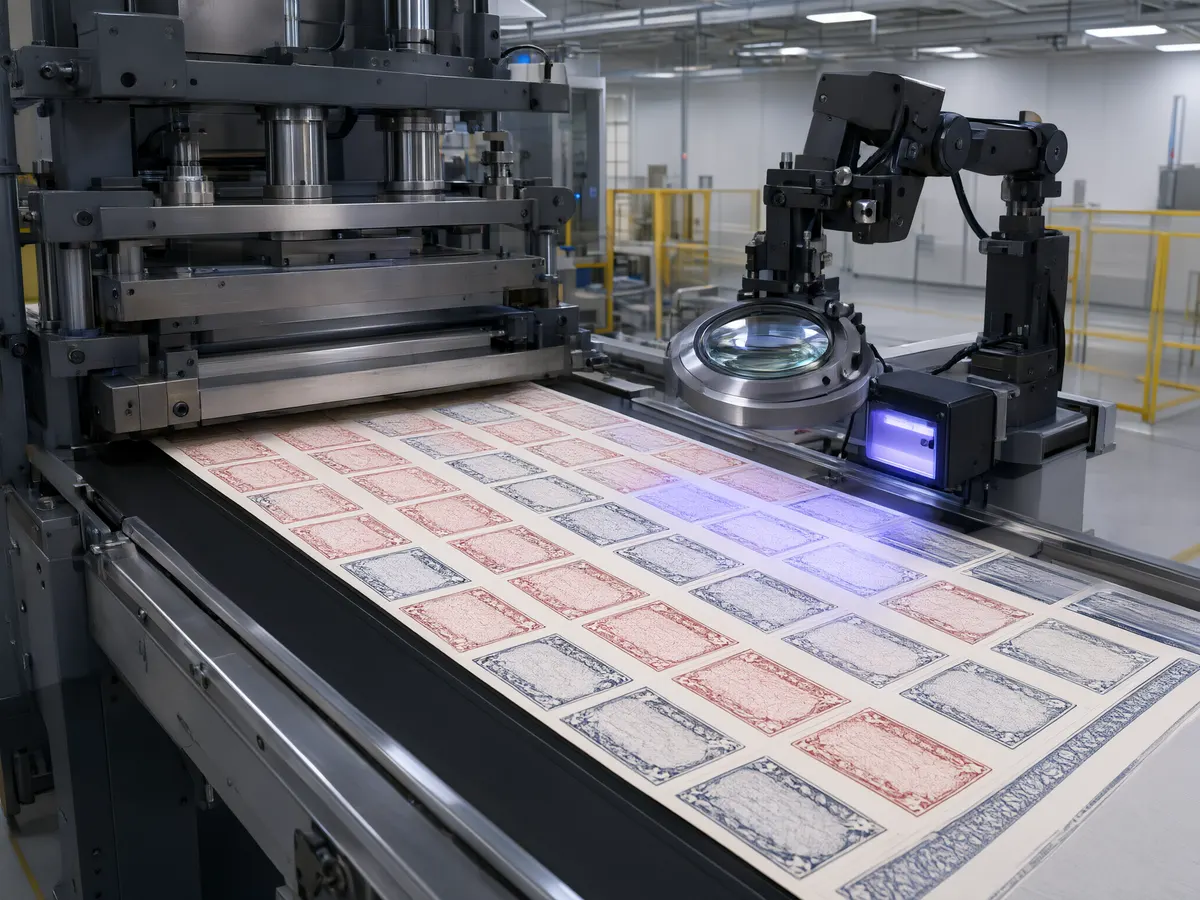
Registration is the technical word for whether the front and back images sit exactly where they should relative to the card’s edges. Poor registration produces asymmetric borders, and asymmetric borders are a readable mark: a player who notices that a card’s back border is a fraction wider on one side than another has information the house did not intend to give. The same applies to cutting. Cards are cut from large printed sheets, and the position of the cut relative to the printed back design has to repeat across every sheet in a run.
You will see articles that quote a specific tolerance in fractions of a millimetre. Treat those with suspicion unless the manufacturer is named, because specifications differ between suppliers and are usually set by contract with the operator rather than published. The principle is public; the numbers generally are not.
Quality control and batch testing
Finished decks are sampled and checked before they ship: card count, suit and rank completeness, print defects, edge quality, and the behaviour of the deck under the machines it will meet in the casino. Batch traceability matters as much as the inspection itself. If a problem surfaces at a table in month four, the operator and the manufacturer need to be able to trace that deck to a production run and pull everything related to it.
This is the practical argument for a dedicated factory over a general commercial printer. A printer optimises for appearance at low cost. A card plant optimises for repeatability across millions of units and for a documented chain of custody from sheet to sealed deck.
What security features do casino cards carry?
Casino decks commonly carry three layers of protection: covert markings visible only under particular light or filters, machine-readable identifiers, and sealed packaging designed to show interference. How many of these appear in any given deck depends on the operator’s specification and the regulator’s requirements, and the detail is intentionally not advertised.
UV and infrared marking
Some casino cards are printed with inks that respond to ultraviolet or infrared light, so that surveillance equipment or a handheld reader can confirm a card came from an authorised batch while the card looks ordinary to everyone at the table. The feature is a counterfeit check rather than a cheating deterrent on its own: it answers the question “did this card come out of our supply chain?” quickly and without stopping the game.
The obvious vulnerability is that the same technology, in the hands of someone with a filtered contact lens, is the classic marked-card attack. Operators treat the specification as confidential for exactly that reason, which means a player has no way to independently verify what is in the deck in front of them. That asymmetry does not go away.
Barcodes and RFID tracking
Barcodes printed on card edges let automatic shufflers and card readers identify each card as it leaves the shoe, which is what makes real-time game data possible on the casino floor and on streamed tables. RFID-enabled cards and chips extend the same idea by making items trackable without line of sight, and they are used in parts of the industry where tracking value through the pit is the priority.
Both depend entirely on manufacturing consistency. A reader calibrated for a precise card thickness and a precise barcode position will misread cards that drift outside it, and a misread shoe stops the game. The anti-cheating technology assumes the uniformity the factory supplies.
Tamper-evident packaging
Decks arrive sealed in a way that cannot be opened and convincingly reclosed, and opening them is a procedure: performed at the table, in view of cameras, often with the seal and the discarded wrapper retained. The packaging is not really protecting the cards from damage. It is creating a point in time where everyone watching can agree the deck was untouched.
Why manufacturing quality is a fair-play issue, not just a cost line
Precision manufacturing reduces the risk of marked, substituted or counterfeit cards reaching a table, and it is what the detection equipment relies on. It does not eliminate the risk. Every documented card-cheating case in casino history happened inside a system that already had controls, and the honest framing is layered risk reduction, not a guarantee.
Preventing marked or altered decks
A counterfeit deck has to match the authentic one on stock, weight, finish, print registration, cut, any covert marking and any machine-readable code. Each specification added is another thing a forger has to reproduce. Here is the uncomfortable part of that logic: tight, consistent specifications also give a forger a fixed target. Standardisation is what makes anomalies detectable and what makes a successful copy repeatable. There is no version of this where the house gets one effect without the other, which is why secrecy around the specification does as much work as the specification itself.
Uniform stock is what the machines assume
Automatic shufflers, continuous shuffling machines and card readers are mechanical systems tuned to a card of known dimensions and stiffness. Uniform stock keeps them accurate, and their accuracy is part of the integrity story: a shuffler that randomises consistently removes the ordering information a card-sorting attack depends on.
Why casinos rotate decks regularly
Decks are retired because wear creates identifiable cards. Repeated handling leaves nicks, bends, soft corners and surface marks, and any of those turns a card into a card that can be recognised from the back. Replacing decks resets that to zero, and it also limits the window in which a tampered deck could be in play.
How often is often enough? Replacement schedules are set by the operator, vary by game and table volume, and are not generally published, so any specific number you read should be treated as an example rather than a standard. The trade-off underneath it is real and unresolved: rotating more frequently reduces wear risk but increases cost, handling, and the number of occasions on which a deck changes hands. More changeovers means more procedural moments to supervise. Nobody has published the optimum, and it probably differs table to table.
Does this reach live dealer games too?
Yes, for the physical layer. Live dealer card games are dealt from real decks on real tables in a studio or a licensed casino floor, so the same casino-grade stock, the same card readers and the same sealing and rotation procedures apply. The barcode or reader that identifies each card is also what drives the results you see on screen, which makes manufacturing consistency a direct dependency of the stream.
Two things worth separating. First, the camera and the human supervisor sit on top of the physical controls, not instead of them: you can watch a shoe being loaded, which is a genuine transparency advantage over a card game you cannot see. Second, none of this applies to RNG-based online card games, where there is no deck and fairness rests on the random number generator and its testing instead.
And none of it changes the odds. A perfectly manufactured, perfectly supervised baccarat shoe still carries the house edge built into the rules of the game. Card integrity is about the game being the game it claims to be, not about the game being winnable over time. If you play, set a deposit or loss limit before you sit down and use the operator’s self-exclusion and cool-off tools if play stops being entertainment.
What a local factory changes for Macau’s supply chain
Making casino-grade decks in Macau shortens the distance between the operator specifying them and the plant producing them, which is a control argument as much as a logistics one. A regional factory can be inspected, audited and visited more easily than a plant on another continent, and the chain of custody between factory gate and casino floor involves fewer intermediaries. Asia Pioneer and Cartamundi have positioned Bee Macau as part of the city’s shift from importing gaming products to producing them, and the facility has already shipped to Asian markets.
Concentration cuts the other way as well, and that part is not yet testable. A single local supplier becomes a single point of dependency for operators that use it, and the consistency gained from one production line is also consistency a determined counterfeiter only has to solve once. Whether the net effect on card integrity in the region is positive will show up in regulatory findings and incident records over years, not in an opening announcement. For now the measurable change is narrower and worth stating plainly: Macau’s casinos can buy a security-critical consumable from a factory in their own jurisdiction.