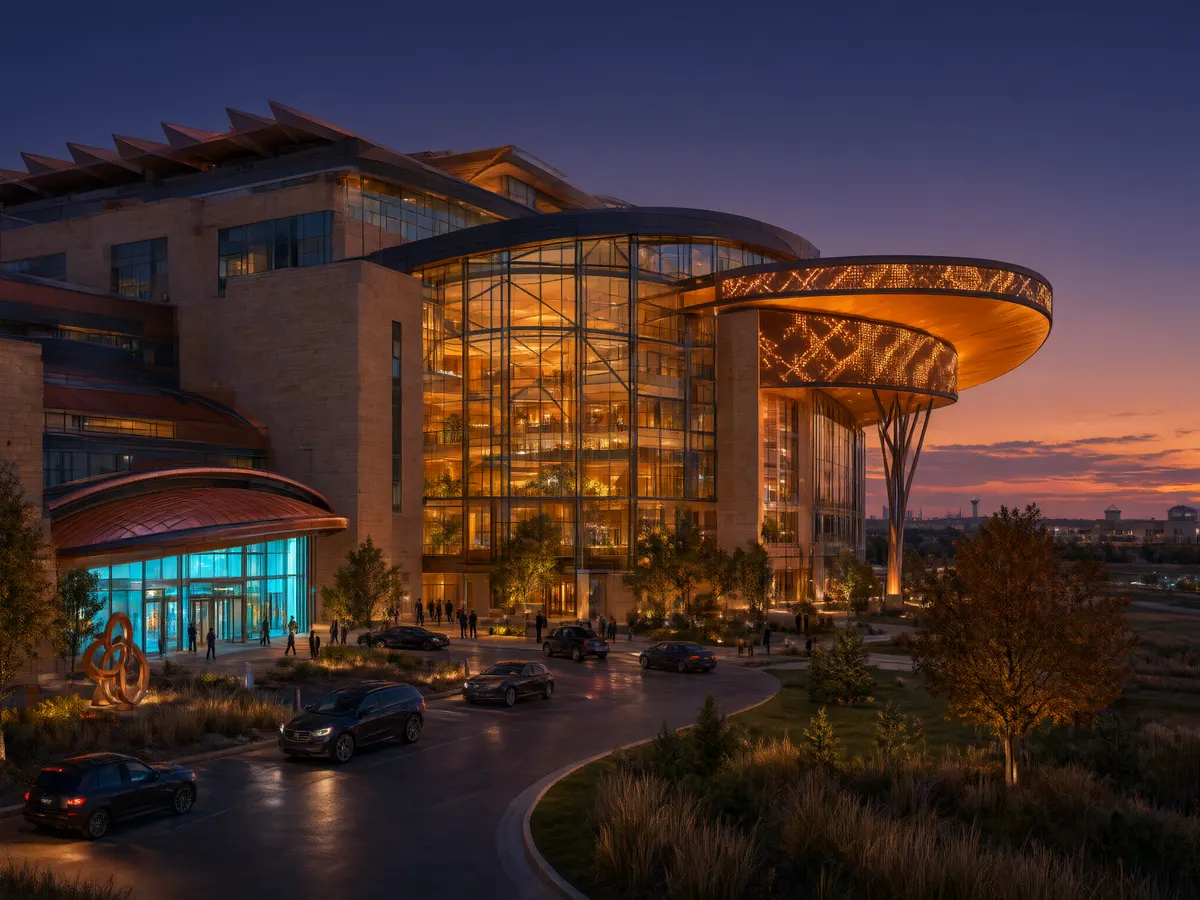
A $275 million casino is not a $275 million gaming floor
Cedar Crossing Casino & Entertainment Center in Cedar Rapids, Iowa, opens with roughly 700 slot machines, 22 live dealer table games and a retail sportsbook. That is the entire gambling product. Everything else in the $275 million build is something you can do without a wager, and that split is the single most useful thing to understand about new land-based casino features in 2025.
Peninsula Pacific Entertainment, the Los Angeles developer behind the property, confirmed to the Iowa Racing and Gaming Commission on Thursday, October 15 that construction finished ahead of its original New Year’s Eve target. The soft opening is set for Thursday, November 19, a week before Thanksgiving and Black Friday. Table games were still being delivered and interiors finished when the date was announced.
Run the crude arithmetic and you get about $393,000 of project capital per slot machine. Nobody pays that for a slot cabinet. The number is a signal, not a cost: most of the money went into rooms where no one gambles.
The popular answer is right, and the usual reason is wrong
Ask why new casinos look like this and you will hear that online gambling ate the floor, so operators pivoted to experiences a phone cannot deliver. The conclusion holds up. The causation is lazy.
Cedar Crossing’s amenity mix was shaped first by the condition almost nobody checks before writing about a new casino: what the operator had to promise to get the licence and keep the town onside. In Iowa, casino proceeds flow to local charitable causes through nonprofit gaming associations, and state law requires operators to submit 0.75% of gross gaming revenue for charitable causes, according to the American Gaming Association’s Iowa regulatory fact sheet. Cedar Crossing committed 8%, more than ten times the mandate, routed through the Linn County Gaming Association. Projections put that at more than $6 million a year going out to local charities and initiatives.
That is not a marketing line bolted on after the fact. It is a structural cost of doing business, written into the pro forma before a single cabinet was ordered, and it changes what the rest of the building has to do. A property giving away 8% of GGR needs volume, repeat visits and non-gaming revenue in a way a property giving away 0.75% does not. “We want to be the fabric of Cedar Rapids,” general manager Kim Pang told the commission. Read that as a business model, not sentiment.
What 700 machines and 22 tables actually mean
Slots carry the floor; tables carry the room. That trade-off explains almost every floor plan you will see at a new regional casino.
Slot machines run themselves. One attendant covers a bank of them, the hold is predictable, and the house edge is baked into the RTP of each title, typically somewhere around 94% to 97% on modern games. A live dealer table needs a dealer, a relief dealer, a floor supervisor and surveillance, which makes 22 tables a genuine labour commitment rather than a rounding error. Blackjack and baccarat also carry thinner house edges than slots, so each table earns less per dollar wagered even when it is busy.
Operators keep tables anyway because they do something slots cannot: they hold groups in place, they create the noise and movement that make a room feel alive, and they anchor the higher-spending carded player. Twenty-two tables at a property this size reads as a deliberate decision to be a social floor rather than a machine warehouse.
The retail sportsbook follows the same logic. Sportsbook margins are thin, and the mobile market has long since taken the bulk of handle. A physical book exists to bring people through the doors on a Sunday afternoon and hand them a reason to stay for food, drinks and whatever is on the floor.
| Element | What Cedar Crossing is opening with |
|---|---|
| Slot machines | Approximately 700 |
| Live dealer table games | 22 |
| Sportsbook | Retail book on site |
| Bars and dining concepts | Five planned, including Clubhouse by Zach Johnson |
| Live entertainment | The Event Center, 1,500 seats |
| Non-gaming attraction | Compass Center STEM lab, 5,000 sq ft, separate entrance |
| Charitable commitment | 8% of annual GGR, against Iowa’s 0.75% mandate |
| Total project cost | $275 million |
A STEM lab with its own front door
The Compass Center is a 5,000-square-foot educational facility inside the casino complex with a dedicated entrance, so children and parents reach it without crossing the gaming floor. It opens with “Astronaut”, a hands-on exhibition about the physical and mental demands of space travel, presented by Cedar Rapids Bank & Trust and running through February 2027. Ticket pricing has not been announced.
That separate entrance is the most honest piece of design in the whole building. It is an architectural admission that a gaming floor is an adults-only environment and that no amount of family branding changes it. Compare it with the online equivalent, where age verification is a KYC check and a tick box, and you can see what a physical operator can do that a site cannot: build the restriction into the walls.
It is also, pragmatically, a visitor magnet that generates goodwill and footfall from people who will never place a bet. Whether a science centre inside a casino is a good idea is a fair question. Whether it is a politically useful one is not really in doubt.
Steak, concerts and the economics of keeping people in the building
Five bars and dining concepts are planned, headlined by Clubhouse by Zach Johnson, a relaxed steakhouse branded with the Iowa-born professional golfer. The Event Center seats 1,500 and has already booked Old Dominion, Trace Adkins, Carlos Mencia, Carrot Top and Tyler Henry.
A 1,500-seat room is the sweet spot for regional casinos: large enough to attract touring mid-tier acts, small enough to fill on a Friday without discounting into oblivion. Each show is an evening when the floor gets several hundred people who came for something else, which is the entire point.
What has not been detailed publicly is the loyalty technology underneath all of it, and that is the part worth watching. The amenity strategy only pays off if the operator can connect a concert ticket, a steakhouse bill and carded play on the floor into one view of a customer. Modern floors are tracked floors. Without that plumbing, the restaurants and the venue are just expensive hospitality with a casino attached.
Why P2E built this one at all
Cedar Crossing is the flagship of a company that sold nearly everything and started again. In 2022, Peninsula Pacific sold the bulk of its gaming assets to Churchill Downs Inc. for $2.75 billion, a deal that included Colonial Downs Racetrack in Virginia, six Rosie’s Gaming Emporium venues, The Rose Gaming Resort in Dumfries, del Lago Resort & Casino in New York and the Hard Rock Hotel & Casino in Sioux City, Iowa.
What it kept and has since built out is smaller and more regional: Cedar Crossing, Kansas Crossing Casino in Pittsburg, Kansas, and five properties under the Revo brand in New Hampshire, in Manchester, Dover, Lebanon, Keene and Conway. That is a portfolio strategy, not a trophy strategy. It targets markets where a single licence creates a local monopoly on legal, in-person gambling and where the operator can make itself difficult to dislodge by becoming civically useful.
The condition that changes the answer
The next time a new casino announces its features, check the licence terms before you read the press release. Floor size, table count, charitable percentage and whether there is a non-gaming attraction with its own entrance are usually downstream of what a regulator and a local community demanded, not of a focus group.
For anyone who plays online, the comparison cuts both ways. Cedar Crossing’s 8% revenue pledge and $6 million a year in local distributions are what a jurisdiction can extract when there is a building to tax and a licence to withhold. That leverage is harder to apply to a site. The maths at the machine, though, does not change in either venue: the house edge is the house edge whether the reels spin in Cedar Rapids or on your phone, and no amenity on that list alters it. Set a budget before you walk in, treat the steakhouse and the concert as the thing you are buying, and use deposit or session limits if you gamble online. If play stops feeling like entertainment, stop.
What remains genuinely open is whether this template holds. A property that hands over 8% of gross gaming revenue has thinner room for error than one handing over 0.75%, and the first full year of results in Cedar Rapids will say more about the model than any rendering ever could.