
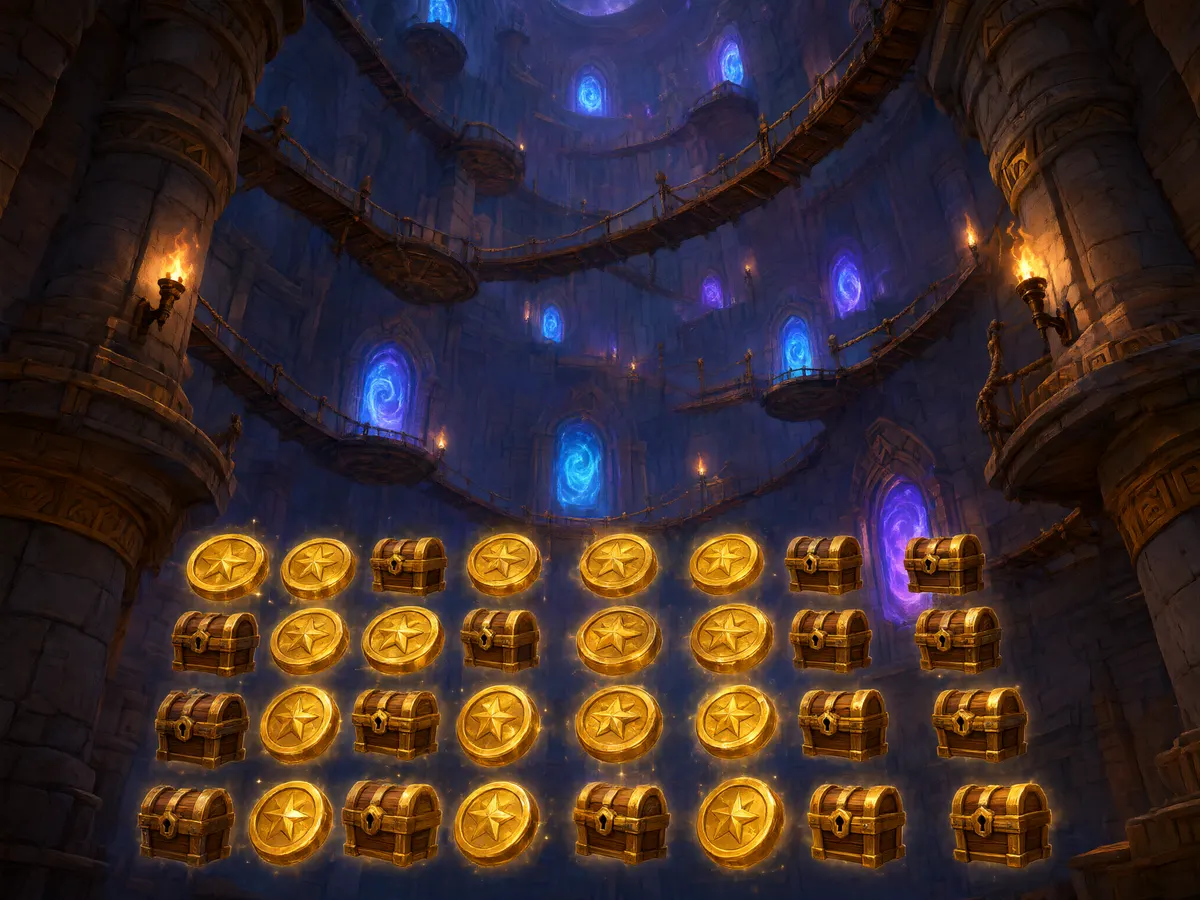
A 5×5 cascading grid with a nine-win gate
The Tower Run Treasure Steps slot is a fantasy-themed Play’n GO release built on a 5×5 pay-anywhere grid, cascading wins, and a Hold & Spin bonus called the Treasure Room, which opens only after nine separate wins land in a single spin. It went live in mid-October 2026.
That last clause is where most readers skim past the important part. The cascade is the surface mechanic, the thing you watch. The nine-win requirement is the thing that actually decides how the game pays, because it determines how much of the game’s return sits in the base game and how much is locked behind a door that stays shut on the overwhelming majority of spins.
The dressing: an aspiring knight named Bob climbing the Treasure Tower, suspended walkways, portals, looming stonework, and a giant floating eye watching the whole thing. A progression mechanic tracks his ascent. None of that changes the maths, but the progression display is the element players are most likely to misread, so it is worth separating what the game does from what it looks like it is doing.
Myth: nine wins in a spin is an easy target because cascades keep paying
Nine wins means nine paying clusters resolved within one spin’s complete cascade chain, not nine wins across nine spins and not nine symbols. The Treasure Room is awarded after all cascades have finished, so the count has to be reached inside a single uninterrupted sequence before the grid settles.
Here is why that matters mechanically. On a pay-anywhere grid, a win removes the paying symbols and new ones drop in to fill the gaps. Each drop can produce another win, and each win is counted. But the chain only continues while wins keep appearing, and the probability of extending a chain falls with every step, because you need another qualifying combination from a partially refilled grid. Reaching nine is not nine coin flips. It is one long conditional run, and every link has to hold.
The cost of misreading this is specific and expensive: a player who sees “nine wins” and thinks “that happens most sessions” will size their stake for a feature they expect to see, rather than for the long stretches where the grid produces two or three cascades and stops. In practice that means staking too high per spin and running out of bankroll before the structure has had a chance to behave like its long-run average. There is no bet size that makes a rare trigger less rare.
What the Treasure Room actually does
The Treasure Room is a Hold & Spin bonus in which Coins land sticky and Mimic Chests hide their values behind a countdown. A Chest reveals what it holds when its countdown expires, or earlier if a Key opens it.
Hold & Spin formats work on a simple principle: symbols that land stay locked in place, and the round continues while new symbols keep arriving. The variation Play’n GO has added here is the delayed reveal. A Mimic Chest occupies a position and shows you nothing, so the visible value on the grid understates what the round is actually worth until the countdowns run down. Keys accelerate that.
From a design standpoint, hidden values are a tension device. From a player standpoint they are neutral: the outcome of each chest is determined by the RNG at the point the round resolves, and watching a countdown does not influence what is inside. The information is withheld from you, not from the maths.
Myth: the climb means you are getting closer to something
Progression displays in slots fall into two categories, and they behave completely differently. Some are persistent state, where a counter carries across spins and genuinely moves you toward a reward. Others are cosmetic, resetting each spin and illustrating what just happened rather than storing anything.
The announcement describes the mechanic as tracking Bob’s ascent. It does not state whether that ascent persists between spins or between sessions, and that single detail is the difference between a meaningful counter and a nice animation. The game’s own information screen answers it. Nothing else will.
What is settled, regardless of which type it turns out to be: each spin’s outcome is produced independently by the random number generator. A tall climb does not make the next spin more likely to extend a cascade chain, and a short one does not make it less likely. If the counter resets, the climb is scenery. If it persists, it is a rule you can read in the paytable and plan around. Guessing between the two is how players talk themselves into “I’m close, one more” at a raised stake.
RTP and volatility: what the launch coverage published
Launch coverage, including iGamingBusiness, published an RTP range of 84.2% to 96.2% together with a variance figure; no maximum win multiplier was given. A range that wide is the signature of a configurable build, so the return on the version in front of you depends on the operator, not on the game’s name. At the bottom of that range the house edge is 15.8%; at the top it is 3.8%, which is a gap no player should wave away. Play’n GO titles carry their RTP and volatility indicator in the client, which is reason enough to check the screen in the casino you actually play at rather than a review elsewhere.
What the design does tell you is how the wins are likely to be distributed, which is the part volatility actually describes. Volatility is the shape of the payout distribution, not the size of the return. A high-volatility game and a low-volatility game can share an identical RTP and feel nothing alike.
| Design element | Effect on hit pattern | What it implies for variance |
|---|---|---|
| 5×5 pay-anywhere grid | Wins can form in any position, not on fixed lines | Raises hit frequency; individual hits tend to be small |
| Cascading wins | One spin can produce a chain of consecutive wins | Occasional large single-spin totals on top of a low baseline |
| Nine-win Treasure Room gate | Feature triggers only on long cascade chains | Rare trigger, which concentrates return in the bonus |
| Sticky Coins and hidden-value Chests | Bonus value accumulates and reveals late | Wide spread of outcomes within the feature itself |
Read together, those point toward a game where small base-game hits arrive often enough to keep the reels moving, while a meaningful share of the total return is parked behind a trigger you will not see on most spins. That is a description of the structure; which end of the 84.2% to 96.2% range your operator runs is on the info screen.
The trade-off you cannot solve
Two ways to approach a bonus-concentrated cascading slot, and neither is correct.
Play it small and treat the base game as the entertainment, accepting that the Treasure Room may not appear at all in a short session. Your money lasts, the swings are survivable, and you may finish having never seen the feature the game is built around. Or stake up to make the feature worth reaching when it does arrive, and accept deeper, longer losing stretches while you wait, with a real chance the bankroll ends before the trigger does.
The RTP is the same either way. Stake size changes variance, never expected value, and the house edge (100% minus RTP) applies to every spin regardless of how you sequence them. So the choice is genuinely a preference about which kind of session you would rather sit through, and anyone presenting it as an optimisation is selling something. My own view, for what it is worth as a reading of the structure rather than advice: on a game where the feature gate is this specific, the small-stake, long-session approach is the only one where the published long-run number has any chance to mean anything for you, and even then it is an average over millions of rounds, not a forecast for your evening.
Before the first spin, check the screen
Three things are worth two minutes in the information panel, and all three are answerable there rather than from any announcement:
- The RTP shown in your operator’s version of the game, since the published range runs from 84.2% to 96.2% and the figure in a review may not be the figure in front of you.
- Whether the ascent progression persists across spins or resets, because that determines whether the counter is a rule or a decoration.
- How Keys are awarded in the Treasure Room, and whether the round can be extended, which is what sets the ceiling on the bonus.
Play’n GO has built the game so that the most visible element, Bob climbing, is the one carrying the least information, while the element that governs the payout shape, a nine-win chain inside one spin, is stated once and easy to skip. That asymmetry is not unique to this release, but it is unusually clean here. Until the paytable tells you whether the climb is state or scenery, treat it as scenery and stake accordingly. If any of this stops feeling like entertainment and starts feeling like a target you need to hit, the deposit and session limits in your account are the tool for that, and they work better set in advance than mid-session.