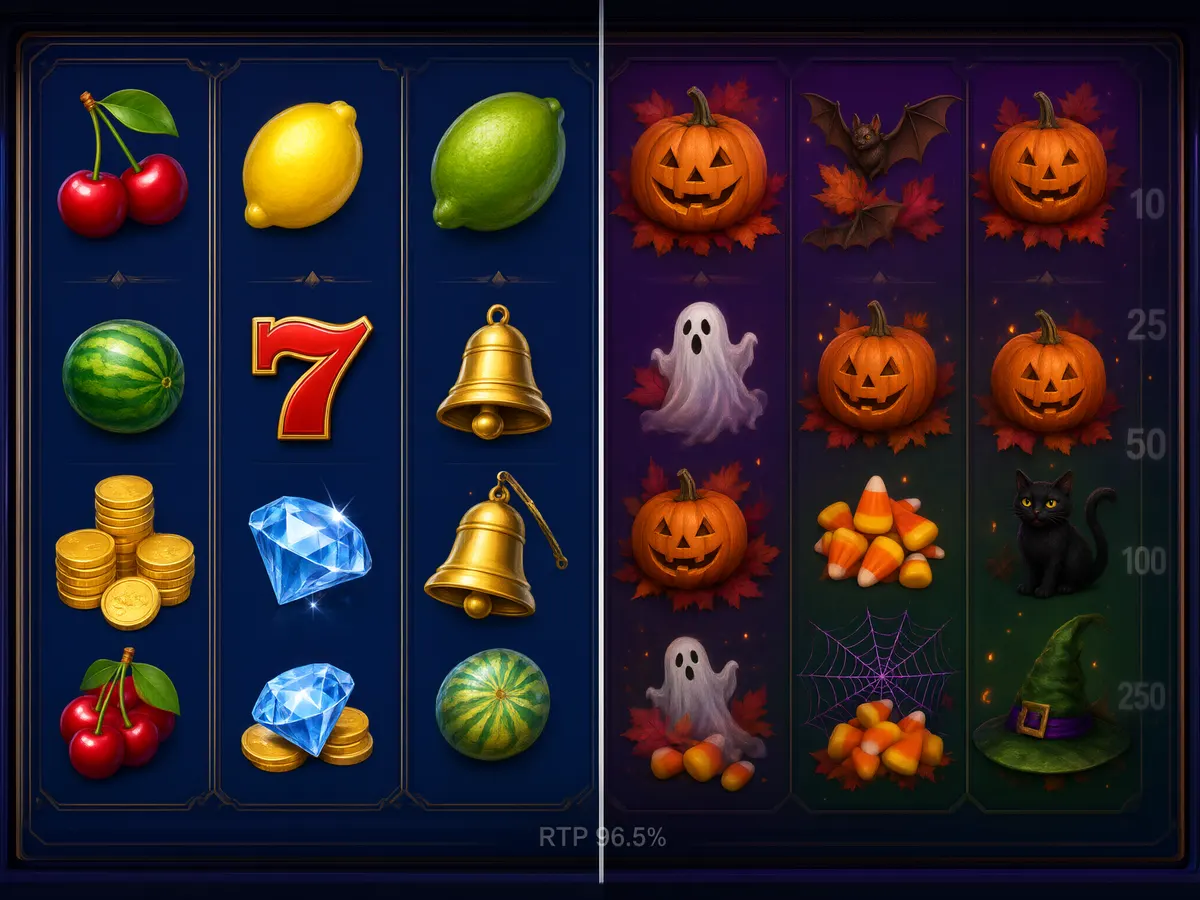
Has your favourite slot turned up wearing pumpkins, snowflakes or Diwali lamps this month, and did you wonder for a second whether the refresh came with friendlier odds? Short answer: no. Seasonal slot game updates change what you look at and listen to. They do not change the return to player, the volatility, or the chance of any individual spin landing. The artwork sits on top of a certified math model, and the model does not care what season it is.
The myth persists because change is change. A game that looked one way last week looks different today, so the brain assumes something under the hood moved too. Usually nothing did. Below, what a refresh actually involves, where the one real exception hides, and how to check the numbers for yourself in about thirty seconds.
What a seasonal makeover actually involves
A seasonal refresh is an asset swap: new background art, new symbol designs, new music and sound effects, often a new name or sub-title, and a promotional campaign built around the launch date. The reel layout, the random number generator, the paytable and the certified return figure stay exactly where they were.
The live casino side of the industry makes this visible in a way slots never can. Stanislav Kriuk, Production Director at ICONIC21, described how studios handle seasonal set changes for events like Halloween: the work is planned weeks ahead to avoid disrupting live tables, decorations are camera-tested so the lighting and colours read correctly to players watching remotely, installation happens table by table during maintenance windows, and fire safety, emergency access and ventilation stay fully operational throughout. Every item on that list is production work. Not one of them touches how a roulette wheel is weighted or how a shoe of cards is dealt.
Slot reskins follow the same logic in software. A studio already has a build that has passed testing, performs predictably and has an audience. Dressing it for a season costs a fraction of building a new game, carries almost no technical risk, and gives the operator something to market. That is the whole business case.
Cosmetic layer versus math model, side by side
Here is what typically moves in a seasonal refresh, and what only moves when a studio ships a genuinely different game.
| Element | Seasonal reskin | Genuinely new release |
|---|---|---|
| Background art and symbols | Replaced | Replaced |
| Music and sound effects | Replaced | Replaced |
| Game name and branding | Often changed | Changed |
| Promotional tie-in | Usually added | Usually added |
| RNG and spin outcomes | Unchanged | New build |
| RTP percentage | Unchanged | Can differ |
| Paytable and reel maths | Unchanged | Can differ |
| Volatility and hit frequency | Unchanged | Can differ |
| Lab certification | Existing math model still applies | Certified separately |
Do slot themes affect RTP?
No. RTP, or return to player, is the percentage of all money wagered that a game returns to players on average across millions of spins. A 96% RTP means roughly ₹96 returned per ₹100 staked over the long run, not per session and never as a promise. That figure comes from the paytable and reel mathematics compiled into the game build, not from its artwork.
Independent testing laboratories such as GLI and eCOGRA verify that a game’s random number generator produces genuinely independent outcomes and that the simulated return matches what the studio declares. Regulators in licensed markets require that certification before a game goes live. Swapping the picture files on a certified build does not create a new set of odds, because none of the inputs to the return calculation have moved. If a studio did alter the paytable, the reel strips or the feature triggers, that is no longer a reskin, and the maths would need to be verified again.
The other half of the sum is worth saying plainly. House edge is 100% minus RTP, so 96% RTP means a 4% edge to the operator. That edge is constant. A seasonal skin cannot shave a single basis point off it.
Why a refreshed slot feels hotter than it is
Each spin on a certified RNG slot is an independent event, so a freshly skinned or heavily promoted game is never “due” and never “running hot”. The generator has no memory of yesterday’s session, no awareness of the promotion, and no record of what the last player did on that seat.
What does change is the feel. New win animations, a louder celebration sound, a reworked anticipation effect on the final reel, a brighter palette: these alter how a sequence of identical mathematical outcomes is experienced. A win that previously passed with a quiet chime now gets a three-second flourish, and a run of small wins reads as a hot streak. The pattern you notice is in the presentation layer, not the results.
Volatility and hit frequency deserve separating here, because players blur them constantly. Volatility describes how payouts are distributed: high volatility means rarer, larger wins, low volatility means more frequent, smaller ones. Hit frequency is simply how often any win lands, regardless of size. Both are properties of the same reel maths. A reskin that shares the original build shares both figures exactly, which is why a “new” seasonal version cannot be the steadier or swingier cousin of the original. It is the original.
Why operators keep doing it
Seasonal casino promotions need a hook, and a refreshed skin is the cheapest credible one available. Studios get to extend the life of a proven math model instead of gambling a development budget on an untested release. Operators get fresh lobby artwork, a themed tournament or free spins campaign, and a reason to email players in a quiet week. Players get variety on a game they already like.
None of that is dishonest in itself. Where it tips over is when marketing copy implies something mathematical has improved. Phrases like “better than ever” or “upgraded” describe presentation, and a careful reader should treat them as describing exactly that until the info screen says otherwise.
The condition almost nobody checks
Before you accept that a seasonal version is the same game, confirm that it actually is the same game. This is the one place where the “nothing changes” rule breaks, and it breaks in two different ways.
First, some releases sold as a seasonal edition are genuinely separate builds with their own math model, their own volatility and their own certified return. The tells: a distinct entry in the lobby rather than a reskinned tile on the old one, a different RTP printed in the information screen, and the provider describing it as a new title rather than an update.
Second, and more easily missed, a number of studios supply a single game with more than one certified RTP configuration, and the operator selects which one it deploys. The game looks identical in every lobby. The declared return in the paytable screen does not. This is the condition worth checking, because it means two players spinning what appears to be the same slot at two different casinos may not be facing the same house edge, with no seasonal artwork involved at all.
Checking a slot’s real RTP and volatility
Everything you need is in the game itself, before you place a bet.
- Open the information or paytable screen from the menu icon, usually bottom-left or in the settings panel.
- Find the stated RTP percentage. If the game offers multiple configurations, this screen shows the one active at that casino.
- Note the volatility rating, often given as low, medium or high, sometimes on a five-point scale.
- Cross-check against the provider’s own game page or a regulator’s published game list where one is available in your market.
- Compare the game name and ID against the original title if you suspect a reskin, so you know whether you are reading one game’s numbers or two.
If a lobby makes the RTP genuinely hard to find, that is information too. Treat any “this is the new seasonal version” claim as a prompt to open the paytable rather than a reason to skip it.
Play the maths, not the marketing
The skin is a costume. The house edge underneath it is the same in December as it was in June, and the same after a Halloween refresh as before one. The only variable genuinely worth your attention is the declared RTP on the screen in front of you, and that is set by the build and the operator’s configuration, not by the season.
Set a deposit limit before you start, decide what a session is worth to you, and stop when you reach it. Slots are entertainment with a built-in cost over time, never a way to make money. If play stops feeling like a choice, use the deposit limits, cool-off and self-exclusion tools your casino is required to provide, or contact a local support service.