
Why a 24-year ESPN producer resigned
Nicole Noren, an ESPN producer of 24 years and a winner of multiple Emmy, Murrow and Peabody awards, resigned over the network’s move into sports betting, telling the Columbia Journalism Review that the breaking point was ESPN licensing its name to the ESPN Bet app in 2023. Her brother died homeless on a downtown Las Vegas sidewalk at 36 after years of gambling addiction.
The detail that sticks is smaller than the resignation. A colleague showed Noren an ESPN interactive explainer on sports wagering built with bright, cartoonish animations. “It literally made me sick to my stomach,” she said, according to Casino.org’s report on the interview. “We’re helping kids and young people figure out how to do something that could be incredibly detrimental to their health.”
Noren’s account is personal in a way most industry criticism is not. She described gambling addiction running through three generations of her family, her grandfather, her father and her brother, and a childhood spent in sportsbooks rather than living rooms: “dragged to Las Vegas in the ’80s and hanging out in the Hilton and Caesars sportsbooks.” Her conclusion about ESPN was blunt. “I’m not going to work for a gambling company and have blood on my hands.”
She also made editorial allegations, saying pitches that examined gambling addiction or scrutinised major operators were never greenlit, and that one accountability project was “neutered” before it aired. ESPN disputes that characterisation. The network told Awful Announcing it “remains committed to journalism that serves sports fans, holds powerful interests accountable and earns our audience’s trust,” and ESPN gambling reporter David Payne Purdum said publicly that he has covered problem gambling and industry scandals with support from senior editors. Both things can be partly true: a newsroom can publish critical reporting and still sell the category it reports on.
How betting ads became part of the broadcast itself
Sports betting ads expanded because the legal market expanded. The US Supreme Court struck down the federal sports betting ban in 2018, states began authorising sportsbooks one by one, and operators entering new markets spent heavily to acquire customers in a short window. ESPN kept gambling at arm’s length for years after that ruling, then licensed its brand to ESPN Bet, and later dropped it in favour of a partnership with DraftKings.
Sponsorship deals and odds inside the picture
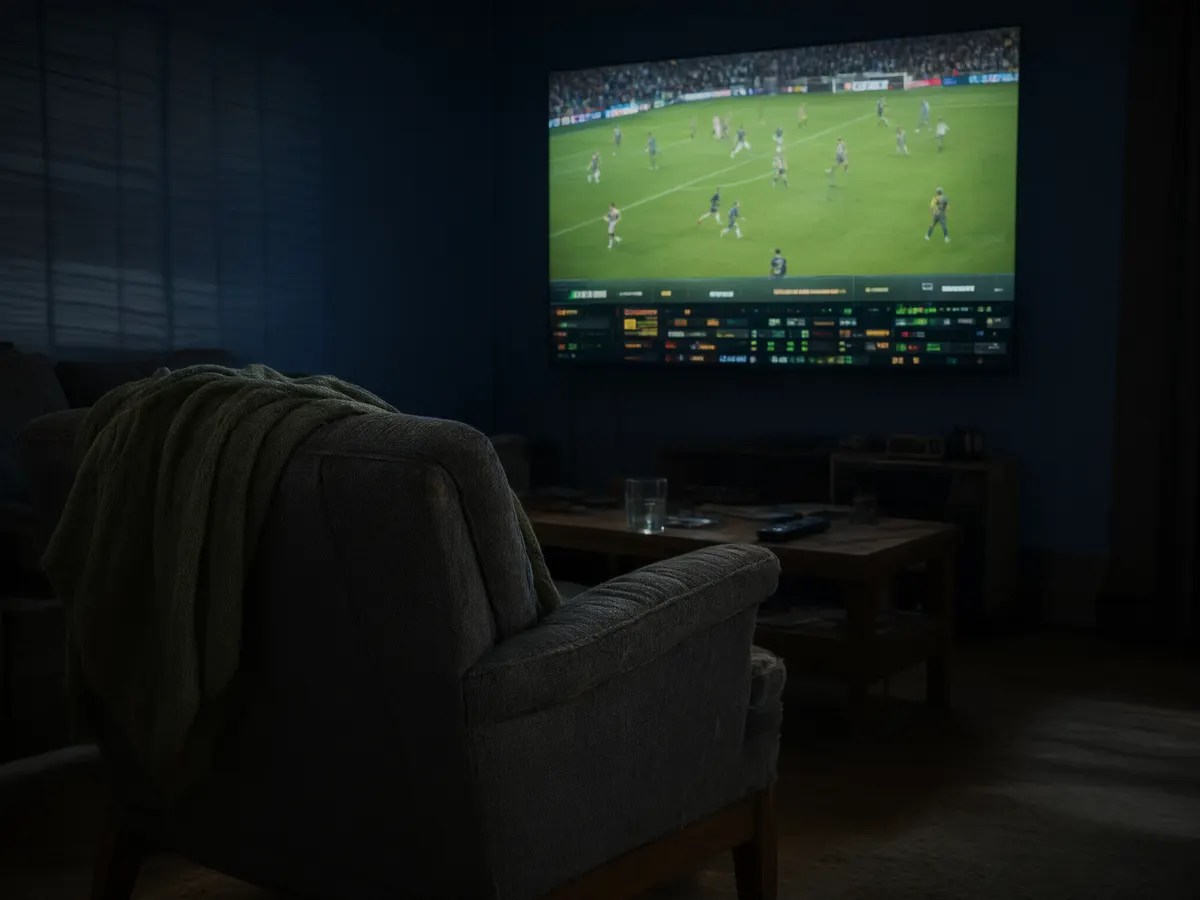
The shift that matters most is not the commercial break. It is the integration: odds overlays on screen during play, sportsbook-branded segments, betting language threaded into commentary, and in-play promotions timed to moments in the game. An ad you can leave the room for is one thing. A spread quoted as part of the score graphic is the broadcast telling you that the number is simply part of how the sport is now described.
Why volume rose with legalisation
Reports indicate betting advertising climbed sharply as each new state opened, with acquisition spend concentrated around launches and major events. Precise national figures vary by who is counting and what they count, and I am not going to quote a number I cannot stand behind. The direction is not in dispute by anyone, including the operators themselves.
What the evidence on sports betting advertising and addiction actually supports
The honest position is narrower than either side’s headline: heavy advertising exposure is consistently associated with more frequent betting and with greater difficulty for people trying to stop, but no study can show that a given ad caused a given person’s addiction. Three misreadings cause most of the confusion.
Misreading one: ads only shift market share between sportsbooks
The industry argument is that marketing moves existing bettors from one app to another rather than creating new ones. That is partly true and incomplete. Acquisition campaigns are built around first-deposit offers, which by definition target people who have not bet with that operator before, and often people who have not bet at all. Promotional framing does work on the margin: boosted odds, “bonus bet” credit and same-game parlay pushes are designed to prompt an immediate stake on a game already in progress. That urgency is the point of in-play promotion.
It is also where the cost lands quietly. A “free” or “risk-free” bet usually returns winnings without the stake, or arrives as site credit carrying playthrough conditions, and the specifics differ by operator. Someone who takes the offer at face value and reloads to chase the shortfall has paid real money for a promise they misread.
Misreading two: the risk sits only with people who already have a problem
Addiction clinicians and advocates have been consistent that saturation exposure is hardest on two groups: people in recovery, for whom betting cues act as triggers in the same way other addiction cues do, and young audiences who absorb betting as a normal feature of watching sport before they are old enough to open an account. Underage gambling exposure is the concern Noren named directly, and it is the reason she is now working with journalists, nonprofits and public-health groups on an initiative to educate young audiences about gambling addiction.
Misreading three: the research settles it
It does not. Most of what exists is survey and observational work showing correlation between exposure, positive attitudes to betting and self-reported problems, plus clinical reasoning about cue-induced craving. You cannot randomly assign a population to years of ad exposure, so the causal link is inferred rather than demonstrated. Anyone citing a clean percentage for how many problem gamblers were “caused by advertising” is inventing it. What the gap means in practice is that the argument will stay unresolved for years while exposure continues, which is an argument for caution rather than a reason to wait.
The gambling addiction signs worth noticing
Problem gambling shows up as loss of control over time and money, not as a single dramatic event. Common warning signs include:
- Chasing losses, placing larger or faster bets to recover money already lost
- Betting more than was set aside, or dipping into money meant for rent, bills or savings
- Borrowing, selling possessions or hiding transactions to fund betting
- Lying about how much is being staked, or hiding the activity from family
- Restlessness or irritability when trying to cut back or stop
- Betting to escape stress, low mood or boredom rather than for entertainment
- Needing bigger stakes to get the same level of interest
- Missing work, study or commitments because of betting or watching to bet
One sign in isolation is not a diagnosis. A pattern of several, especially chasing and concealment together, is the point at which outside help is worth seeking rather than postponing.
What responsible gambling looks like in practice
Responsible gambling means treating betting as paid entertainment with pre-set limits on money and time, and using the controls that exist before they are needed. The tools are not hidden, but almost nobody opens them on day one.
- Deposit and loss limits set inside the account, ideally daily or weekly rather than monthly
- Session time limits and reality checks that interrupt play with a reminder of time and spend
- Time-outs or cool-off periods that lock the account for a fixed stretch
- Self-exclusion, which blocks access for a longer term, offered both by individual operators and by state or national registers covering multiple sites
- Device-level blocking software for people who find app access itself the trigger
Limits only work when they are set while calm and treated as fixed. Raising a deposit cap mid-session is the behaviour the cap existed to prevent. In the US, the National Council on Problem Gambling runs the confidential National Problem Gambling Helpline on 1-800-522-4700 or 1-800-MY-RESET and lists state resources at ncpgambling.org; the separate 1-800-GAMBLER line is operated by the New Jersey Council on Compulsive Gambling. Other countries have their own national gambling helpline and self-exclusion schemes. Support is also there for family members, which matters given how often the people closest to a gambler notice the pattern first.
Is anyone pushing back on ad volume?
Yes, unevenly, and mostly through codes rather than statutes. The American Gaming Association maintains a responsible marketing code for its members covering age-targeting and advertising language, including restrictions on calling an offer risk-free. In the UK, the betting industry adopted a voluntary whistle-to-whistle ban on betting ads around live sport before the watershed. Italy went furthest, banning gambling advertising and sponsorship outright through its 2018 decree. Some US state regulators have penalised operators over advertising claims and over ads reaching audiences under the legal age.
The gap is enforcement and scope. Voluntary codes bind members who agree to them, apply to commercials more readily than to odds integrated into the broadcast, and carry penalties that are small relative to acquisition budgets. Problem gambling awareness campaigns are frequently funded by the same industry they scrutinise, which is not automatically disqualifying but is worth knowing when a responsible-gambling message appears inside a sportsbook ad.
Noren is no longer arguing this from inside a newsroom; she is making films and building education programmes for young audiences instead. The regulatory question she walked out over is still open, and the people most exposed to the answer are the ones watching the broadcast tonight, not reading the eventual study.