What “licensed and regulated” actually certifies
Online casino compliance by region comes down to one fact: the rules an operator follows are written by the authority that issued its licence, not by the country you are sitting in when you log on. There is no global standard, no shared minimum, and no regulator with authority over all of them.
That sentence is also where the trouble starts. The badge in a site’s footer saying “licensed and regulated” is true and almost useless on its own. It tells you some government body somewhere audits that operator’s games, finances and anti-money-laundering procedures. It does not tell you whether that body will read a complaint from you, whether your state recognises the licence, or whether the self-exclusion you set last month applies to the site you opened today. India, where gambling law is written state by state, is the clearest example of how far apart those two things can sit.
Why one rulebook for every market falls apart
A single global set of iGaming compliance standards would either over-reach in one market or leave gaps in another, because markets do not share a definition of gambling. Industry compliance specialists make this argument constantly, and they are mostly right about the mechanics even if the conclusion suits them commercially.
Their case runs like this. Building every product to the strictest jurisdiction sounds cautious, but it exports rules designed for one population’s risk profile onto another’s. Restrictions that make sense where a regulated market already has high participation can strip features, limits and payment options out of a market where the real risk is something else entirely. Push restrictions too far in a licensed market and you do not remove the demand, you move it to sites nobody supervises, which is the outcome player protection was meant to prevent.
Then there are the definitions. English common law tradition separates “games of mere skill” from games of chance; several European systems do not draw that line the same way; the United States layers federal wire and funding statutes over state law. Payment rails differ too, which changes how KYC and source-of-funds checks are even possible. A rule that works through UPI tracing has nothing to grip onto elsewhere.
Flip the argument to your side of the screen and it reads differently. If tailoring is legitimate for operators, then the protections you get are an accident of which licence the company chose to buy.
Three regulatory models, three different answers
Most of the world’s online gambling regulation falls into one of three shapes: a single national regulator, a licensing hub that other countries do not have to honour, or a sub-national patchwork.
| Market | Who licenses | Scope of the licence | The qualifier players miss |
|---|---|---|---|
| Great Britain | Gambling Commission | National; a remote licence is required to serve GB customers | Its rules bind only GB-licensed operators, including the requirement to join GAMSTOP, the independent national self-exclusion scheme |
| Malta | Malta Gaming Authority | A Maltese licence held by many operators serving several countries | It is not an EU-wide permission; each member state licenses its own market |
| United States | Individual state regulators | One state at a time, player must usually be within state borders | Online casino gaming is legal in only a small number of states |
| India | States, plus central legislation | Varies by state; some license, some prohibit | Offshore sites accepting Indian players often hold no Indian licence at all |
The UK and Malta: national licences dressed up as regional ones
Britain runs the tidy version. The Gambling Commission licenses operators under the Gambling Act 2005, sets conditions on advertising, verification and customer interaction, and requires its licensees to participate in GAMSTOP, the independent national self-exclusion scheme, which the Commission does not itself operate. One regulator, one standard, enforceable against anyone wanting British customers.
Malta is where the misreading happens. An MGA licence is a Maltese licence. Gambling was left outside the EU’s general freedom-to-provide-services framework, so there is no passport that makes a Maltese permission valid in Germany, Italy or anywhere else; those countries license separately. When a site advertises itself as “EU licensed”, that phrase is marketing, not a legal status.
The United States: fifty answers to one question
After the Supreme Court struck down the federal sports-betting prohibition in 2018, each state decided for itself. Sports betting spread widely; online casino gaming did not, and remains legal in only a handful of states, New Jersey, Pennsylvania and Michigan among them. A player crossing a state line can lose access mid-session. India’s fragmentation is often described as uniquely messy. It is not. It is the American pattern with more states and more litigation.
Why gambling is a state subject in India
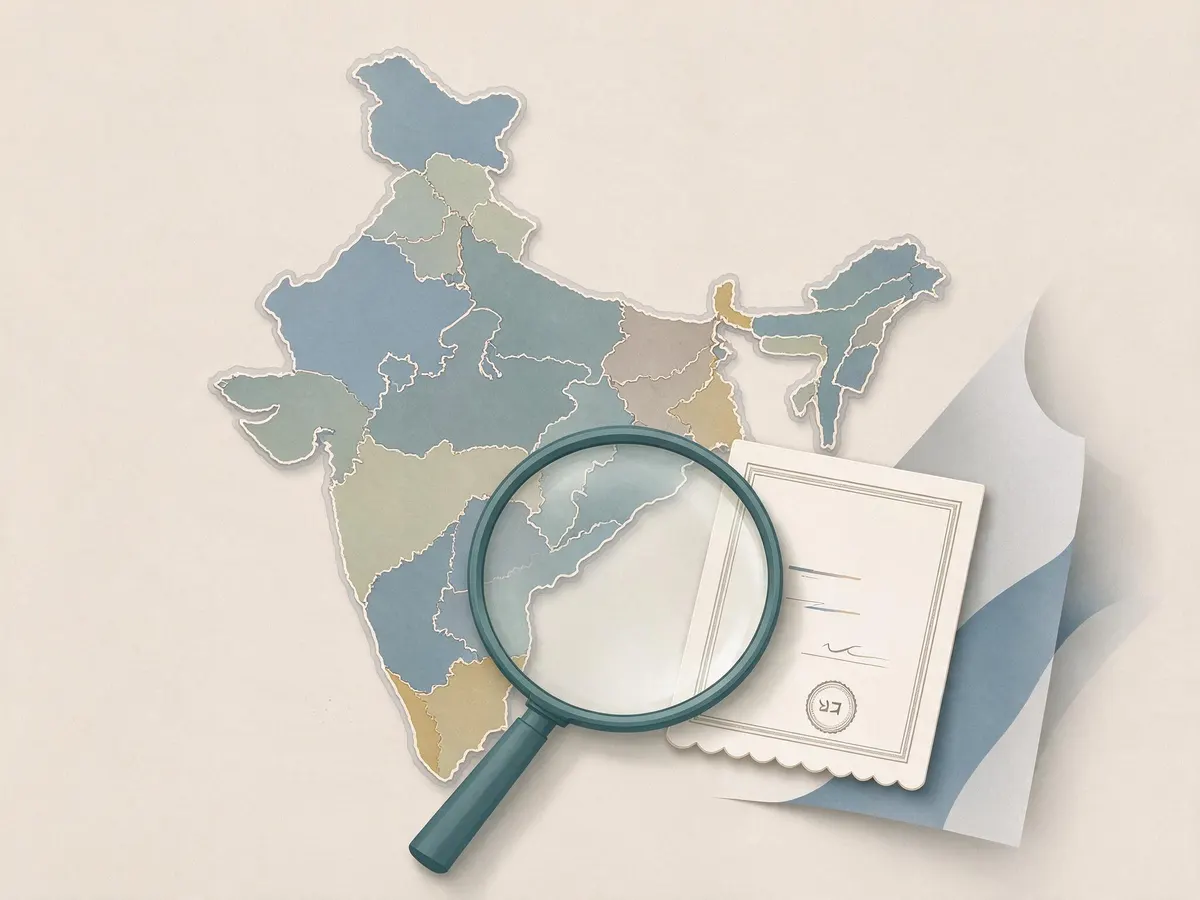
Gambling and betting sit in Entry 34 of the State List in the Seventh Schedule of the Constitution, which gives state legislatures the power to make law on the subject. That is the whole constitutional basis for the patchwork.
The base text most states started from is the Public Gambling Act, 1867, a colonial-era statute that criminalises keeping or visiting a common gaming house and carves out an exception for games of mere skill. States adopted it, amended it, or replaced it with their own gaming acts, and because it was drafted around physical premises, courts and legislatures have spent two decades arguing about how it maps onto an app.
The situation is no longer purely state-level. Parliament enacted central legislation on online gaming in 2025 aimed at prohibiting online money gaming services and their advertising while supporting e-sports and social games, and that law has drawn constitutional challenges. Its scope, implementation and litigation status are moving, so treat anything you read about it, here included, as a prompt to check the current position rather than a settled description.
The patchwork, state by state
States that have licensed or permitted gaming
A small number of states built licensing regimes instead of prohibitions. Sikkim enacted an online gaming law in 2008 that allowed licensed online games and sports betting, with the practical limit that play was confined to the state via intranet terminals. Nagaland created a licensing framework in 2016 for online games of skill, which is why some skill-gaming platforms cite a Nagaland licence. Goa and Daman permit land-based casinos under a 1976 statute, restricted to five-star hotels and offshore vessels. None of these is a national permission.
States that restrict or ban online real-money play
Several states moved the other way. Telangana amended its gaming law in 2017 to cover online games played for stakes, and Andhra Pradesh followed in 2020. Tamil Nadu’s 2021 prohibition was struck down by the Madras High Court, after which the state legislated again in 2022 and that law was itself challenged. Karnataka’s 2021 amendment was struck down by its High Court. The pattern is prohibition, judicial review, redraft, repeat, and the status of any given state can change between the day this is published and the day you read it.
What the patchwork does to your protections
Every consumer protection you might rely on is a licence condition, which means it exists only where a regulator imposed it. KYC and AML checks, deposit and loss limits, time-outs, self-exclusion, advertising restrictions and a grievance redress mechanism are not inherent features of an online casino. They are obligations attached to a specific permission in a specific jurisdiction.
So an operator licensed offshore and accepting deposits from Indian players is generally not bound by any Indian consumer-protection standard. Its complaints process is whatever its terms say it is, usually arbitration under the law of the licensing territory. Self-exclusion does not travel: excluding yourself from one operator, or from a national scheme in another country, has no effect on a site outside that scheme. And cross-border enforcement is the weakest link in the chain. When a payout stalls, a regulator thousands of kilometres away has no duty to you, and an Indian authority may have no jurisdiction over the company.
How much money moves through those channels from India is genuinely unknown. Estimates circulate; they rest on assumptions nobody publishes, and I am not going to repeat a number I cannot stand behind.
How to work out which rules apply to you
- Find the licence number in the footer and verify it on the regulator’s own public register. The badge image proves nothing; the register entry does, and it will also show whether the licence is current.
- Check what the licence covers. Some permissions are restricted to players physically inside the issuing territory, which means a licence can be real and still not cover you.
- Check your own state’s current position on online real-money gaming, and the status of the central law, against a primary source such as a state gazette notification or a court judgment rather than an operator’s blog.
- Read the terms for the dispute process: who adjudicates, under which country’s law, within what time limit, and whether there is an independent adjudicator or only internal review.
- Set deposit and session limits yourself, whatever the jurisdiction. Tools you control do not depend on a regulator enforcing them.
None of this makes a game safer in the mathematical sense. The house edge is identical under every licence. What regulation changes is whether anyone is obliged to answer when something goes wrong, and right now in India that answer is being rewritten in several courtrooms at once. If play stops being entertainment, use the operator’s self-exclusion and cool-off tools and talk to a qualified professional. That part does not vary by region.