
The next phase of Las Vegas casino resort expansion is a building nobody has broken ground on
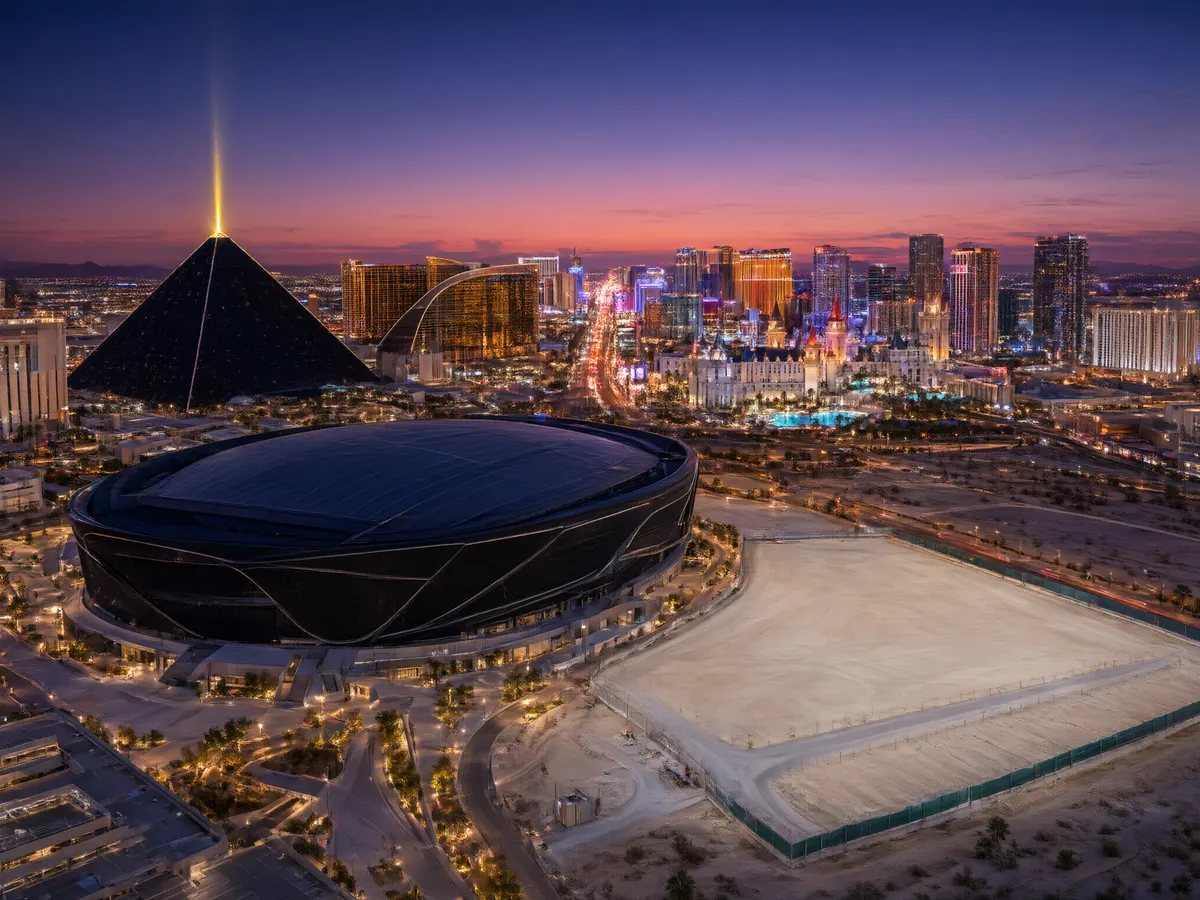
Las Vegas casino resort expansion is no longer measured in hotel towers. The most consequential construction project on the southern Strip right now is an arena that does not exist, for a basketball team that does not exist, bid on by three ownership groups whose combined proposals start at roughly $12 billion. Per a Sports Business Journal report, Silver Lake co-CEO Egon Durban, already a 22% stakeholder in the Raiders, has joined the Nancy Walton Laurie and Bill Laurie bid for an NBA franchise, and that group has finally said where it wants to play: a new arena built near Allegiant Stadium.
That last detail is the actual news. Money joining a bid is routine. A site selection, even a preliminary one, is the first time any of the finalists has committed to a geography, and geography is what decides which resorts benefit and which ones watch the traffic drive past.
The price of entry, and how fast it is moving
The three finalist groups have submitted initial proposals valued at approximately $9 billion for the franchise and $3 billion for arena construction, putting the baseline investment requirement around $12 billion. League officials are reportedly encouraging higher bids, which is a polite way of saying the $12 billion number is a floor rather than a price.
The benchmark everyone is working from is the $12.5 billion valuation set by the Josh Kushner and Bob Iger transaction for the Lakers. Sources cited by SBJ suggest the Laurie-Durban group holds the deepest capital reserves of the three and could push toward $13 billion. Durban’s estimated $2.5 billion net worth is not the point on its own; the point is that his arrival signals a group preparing to outbid rather than negotiate.
Investment bank PJT Partners is evaluating the finalists. Nothing has been awarded.
Three bids, three different theories about where Vegas money goes
Each finalist is proposing a materially different relationship between the arena and the casino floor. That is the comparison worth making, because the site determines whether a Vegas arena feeds the resorts or competes with them.
| Group | Financial position | Preferred venue | The complication |
|---|---|---|---|
| Nancy Walton Laurie and Bill Laurie, with Egon Durban | Reportedly deepest reserves; could reach $13bn | New arena near Allegiant Stadium, south end of the Strip | Creates a sports district slightly removed from the main resort corridor |
| Marc Lasry and Steve Apostolopoulos | Viable if Laurie-Durban declines to raise terms | On or adjacent to the Strip | Strip land is scarce and expensive; strong appeal to NBA executives |
| Bill Foley and Jerry Colangelo | Less pure liquidity; pitching investors on stakes | Renovate T-Mobile Arena, or build near the Strip with Marquee Development | Foley holds 15% of T-Mobile Arena, so the renovation route is partly a self-deal |
Lasry built Milwaukee’s Deer District, which is the template the NBA tends to admire: an arena with a walkable spend zone wrapped around it. Apostolopoulos brings real estate, private equity and fintech holdings. The Foley-Colangelo group has gained ground in league discussions through its alignment with Marquee Development, the Ricketts family’s real estate arm, which handled the Wrigley Field renovation and is running the San Antonio Spurs’ $1.3 billion downtown venue project. Marquee knows how to build a district around a ballpark. Whether Las Vegas needs one built for it is a different question.
The frontrunner label is doing more work than the evidence supports
The Laurie-Durban group is described as the frontrunner, and on capital alone that is defensible. But “frontrunner in a sealed-bid process being run by an investment bank” is a thinner claim than it sounds. The Lasry-Apostolopoulos bid remains live precisely because the Laurie group may decline to escalate, and the NBA has shown in previous site decisions that proximity to existing tourist flow matters to it.
There is a stronger reason for scepticism. A new arena near Allegiant Stadium would, as the reporting notes, establish a year-round sports-driven entertainment district at the southern end of the Strip and effectively bypass the dozen or so alternative arena projects floated across the market. That is framed as a win for the city. For the owners, it almost certainly is: they capture the parking, the concessions, the adjacent development rights and the cross-promotion with Raiders dates.
For the resorts, it is less obvious. Two readings are available, and both are serious. The first is that a dedicated district deepens the whole Las Vegas gaming economy by giving the market a second anchor and 41 guaranteed home dates of midweek demand, which the resorts then absorb through room nights and sportsbook handle. The second is that a self-contained district south of the main corridor captures spend inside its own footprint, the way stadium districts elsewhere are specifically designed to do, and the properties on the central Strip see the hotel bookings without the floor traffic.
I lean toward the first reading, but narrowly, and for an unglamorous reason: Las Vegas visitors do not stay in one place. The Golden Knights at T-Mobile Arena did not drain the Strip; they gave it a reason to fill rooms on Tuesdays. The calendar matters more than the postcode. Still, anyone claiming confidently that an Allegiant-adjacent arena is straightforwardly better for the casino entertainment industry than a Strip-adjacent one is asserting something that has not been tested in this market.
What a home team changes for the betting side
A resident NBA franchise would give Nevada’s regulated sportsbooks a local team to price, which reliably lifts handle through year-round local interest rather than event spikes. Vegas already proved the model with the Raiders at Allegiant Stadium and hockey at T-Mobile Arena: a home team converts a tourism market into a habitual betting market, with in-venue wagering, app sign-ups tied to game nights, and a schedule that fills the dead weeks between fight cards and conventions.
That has practical consequences for readers who follow this market. Sportsbook promotions in Nevada tend to cluster around home-team fixtures, and more local inventory means more of them. It also means more of the usual terms attached: wagering requirements on bonus bets, minimum odds restrictions, and caps that are easy to miss when a promotion is framed around a marquee tip-off. Read the conditions before the hype, not after. Betting should stay recreational spending you can afford to lose, and deposit limits and cool-off tools exist for a reason.
The quieter implication is competitive. An arena district with its own sportsbook, restaurants and retail is a rival to the resort floor as much as a feeder to it. Whichever group wins, the operators on the Strip will be watching where the foot traffic settles.
What has not been decided
No franchise has been awarded, no arena site has been secured, and no timeline has been published. PJT Partners is still evaluating three groups whose bids are expected to rise. The Foley-Colangelo route, which includes simply renovating T-Mobile Arena with premium suites and additional seating, is the only proposal that does not require a new building at all, and it is the cheapest path to a team playing basketball in Las Vegas. It is also the one that changes the city’s physical footprint least, which may be why it attracts the least excitement and deserves more.
The question facing the league is not whether Las Vegas can support a team. That argument ended with the Golden Knights. It is whether the next phase of Las Vegas casino resort expansion should be bolted onto the existing Strip or built as a parallel district a mile south of it. Those are different cities ten years from now, and $13 billion buys the right to decide which one gets built.