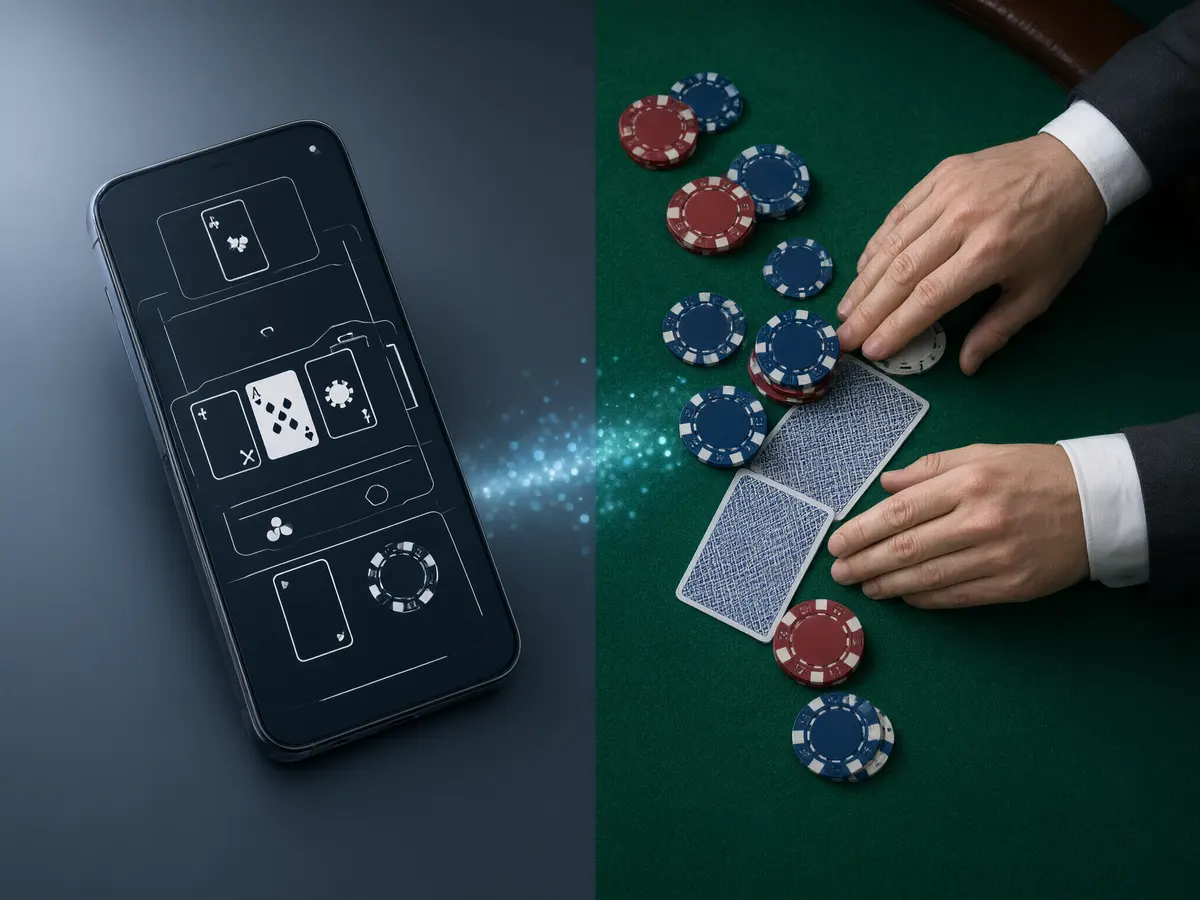
Does putting blackjack on a phone pull players off the casino floor? AGS’s interactive division argues the opposite, and the company’s position is that online table games and land-based casino play reinforce each other rather than compete. That is the claim reported by CDC Gaming, and it is a reasonable one. But read the reporting closely and what AGS actually describes is product crossover and a changing player demographic, not a published study of casino visits. Those are different things, and the gap between them is where most of the interesting argument sits.
What AGS’s interactive division actually said
AGS Interactive (AGSi) is using digital channels to extend games already proven on the casino floor to new players, new experiences and new verticals, according to Zoe Ebling, vice president of the company’s interactive division. The specific evidence she offered is about who plays and where the content lives, not about footfall. “The addition of Bonus Spin Xtreme to our table products has actually changed the demographic of who’s playing our table games,” Ebling said, framing the strategy as broadening how players encounter AGS games and how operators can offer them.
The supporting detail is portfolio data rather than visitation data. AGS has developed more than 100 real-money online themes, and more than 50 of its online games are also available in land-based casinos. Bonus Spin Xtreme, described as the first concentric wheel progressive released for online table games, went live online in four US states and two Canadian provinces under an exclusive partnership with Rush Street Interactive, with a rollout to additional partners planned for 2027. The same product has had more than 1,000 units installed in land-based casinos since its 2020 debut. AGSi’s Single Deck Blackjack took the Eilers & Krejcik Gaming award this year for top-performing new online table game.
| Figure | What it covers |
|---|---|
| 100+ real-money online themes | AGS’s developed online game catalogue |
| 50+ online games | Also available in land-based casinos |
| 1,000+ units | Bonus Spin Xtreme land-based installs since 2020 |
| 4 states, 2 provinces | Online availability of Bonus Spin Xtreme at launch |
| 300+ games a month | Slot launches by AGSi and its partners, per Ebling |
One more operational point is worth noting because it explains the commercial logic. Ebling said the online placements have performed well even with iGaming table minimums often under $1, and that AGS sees “a really high hold on table products,” with Bonus Spin Xtreme functioning as a side bet that helps the economics of table games. Hold is the operator’s side of the equation. Side bets as a category typically carry a higher house edge than the base game they attach to, which is precisely why they improve table economics, and players should treat the progressive opt-in as an entertainment cost rather than a value play.
Why online table games plausibly push players toward the floor
The crossover mechanism that holds up best under scrutiny is learning. Table games have a barrier that slots do not: rules, etiquette, and a dealer and six strangers watching you make a decision. Online casino table games remove all three. A player can learn when to split, how a side bet pays, or what a dealer upcard means at a stake measured in cents, then walk up to a floor minimum many times higher already knowing what to do with their hands.
Demographic broadening fits the same pattern. If a wheel progressive attached to a table game attracts people who previously only played slots, the online version is functioning as a recruiting channel for a product category that retail casinos have historically struggled to refresh. That is the claim Ebling is actually making, and it is supported by her own observation of who is playing.
How loyalty programs link online and in-person play
Operators running both channels increasingly stitch them together with a single account, a shared wallet and one loyalty tier, so online play earns the same credits that unlock comps, hotel offers and event access at a physical property. That design makes a visit the natural next step for an engaged online player, and it gives the operator the only thing that can eventually test the crossover claim properly: carded activity on both sides of the same player ID. Cross-channel marketing does the rest, with online promotions pointed at retail events and floor signage pointing back at the app.
Hybrid casino play is a strategy, not yet a measurement
Hybrid, or omnichannel, casino play means designing online and land-based products as one system rather than two competing businesses. AGS’s pipeline runs in both directions, which is the clearest expression of that approach in the reporting: land-based-tested slot titles move online, land-based table games get online versions, and 3 Dice Football, a craps alternative built around American football that launched first as a physical table game, is being prepared for online and land-based operators at the same time, described as AGSi’s first proprietary game to make its digital debut.
This matters because of what the industry spent a decade worrying about. Cannibalization fears shaped regulatory arguments and boardroom caution in every market that debated legal iGaming: the assumption that every online hand was a hand not played on the floor. Suppliers and operators now largely build on the opposite assumption. The strategy has changed. The proof has not caught up with it.
What it would change for land-based casino trends
If online table games genuinely support retail visits, the practical consequence is content diversification. Operators would treat their online lobby as a discovery funnel and an acquisition channel for the floor, which justifies carrying more table variants, more side bets and more progressive mechanics in both places rather than keeping the digital catalogue deliberately thin. It also makes online a cheap test bed: a game that finds an audience at sub-dollar stakes online is a lower-risk candidate for a floor install, and the reverse route, land-based first then online, is already how AGS describes its slot pipeline.
Where the evidence stops
This is one supplier’s read of its own product performance, reported in a partner-focused trade feature. No visitation figures, no sample, no methodology and no independent verification were published, and nothing here has been through academic or third-party review. It should be read as a directionally interesting signal from a company with commercial reasons to prefer that direction.
The harder problem is selection. The players most likely to engage with online table games are already the most engaged gamblers, and engaged gamblers visit casinos. A correlation between online table play and floor visits could reflect who those players already were rather than anything the online product caused. Separating the two needs matched carded play, a control group, or a before-and-after comparison in a market where iGaming launched mid-period, and none of that is on offer. I would use this finding to justify broadening a table-game catalogue, which is cheap and reversible. I would not use it to underwrite a capital case for floor expansion.
The useful question for the next two years is no longer whether online cannibalizes retail. It is whether any operator will publish cross-channel numbers solid enough to settle it, and whether the 2027 widening of progressive table content beyond a single exclusive partner produces something closer to evidence than observation.