
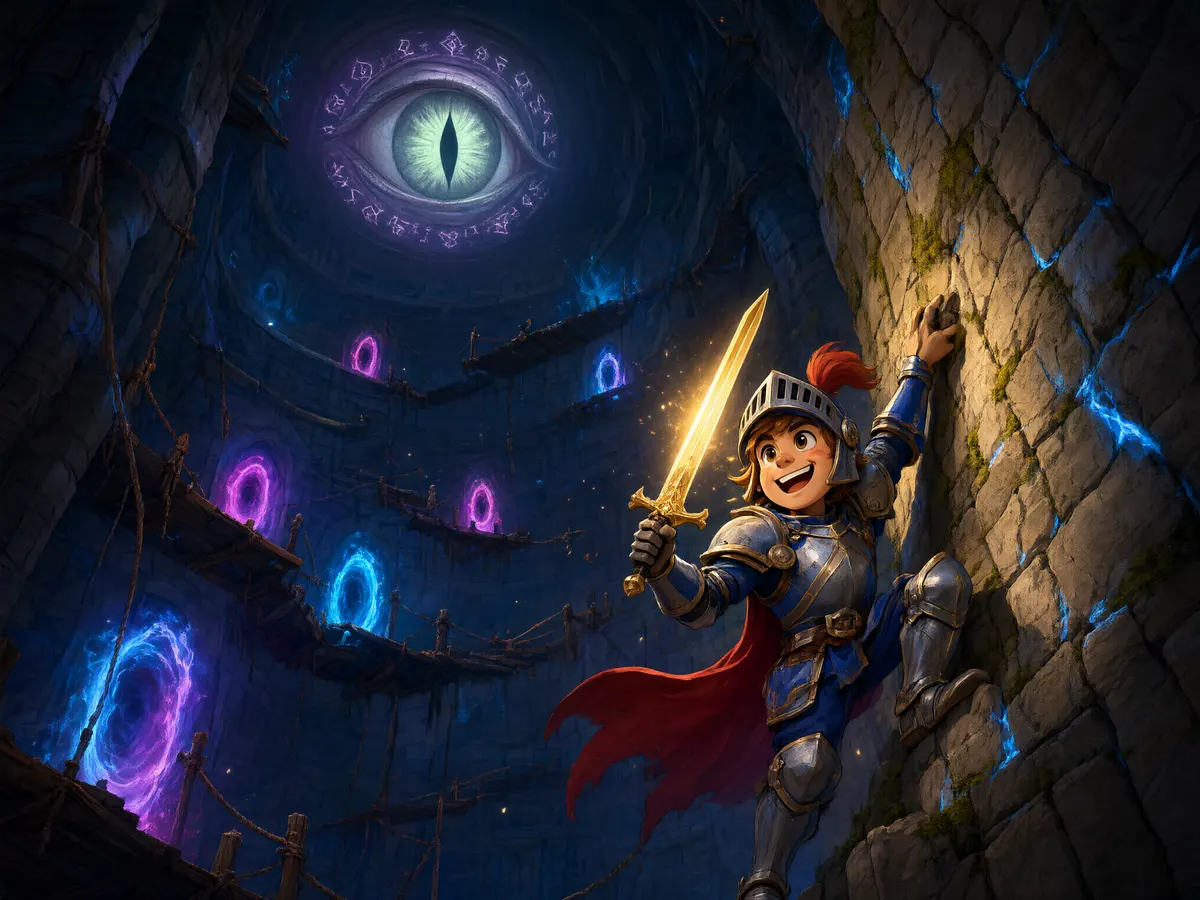
Bob has a glowing sword, no real experience, and a tower full of monsters above him. A giant floating eye watches him go. It is a good setup, and if you have spent any time on Aviator you will assume you know what comes next: a value that rises as he climbs, a crash somewhere above, and your thumb hovering over a cash-out button.
That is not what Tower Run: Treasure Steps is. The climb is the theme, not the mechanic. Play’n GO’s launch announcement describes a 5×5 cascading grid where matching symbols pay anywhere and wins charge a meter, which puts it on the slot side of the fence, not the crash side. Anyone filing it next to Aviator in a casino lobby is going by the artwork. I would not go in expecting a cash-out decision, because there isn’t one.
What Play’n GO has actually built
Tower Run: Treasure Steps is a cascading grid game from Play’n GO built around Bob, an aspiring knight climbing the mysterious Treasure Tower in search of the Treasure Room. The playing field is a 5×5 grid with pay-anywhere symbol wins, and the climb is tracked by an on-screen meter rather than by a rising multiplier you can bail out of.
The setting does a lot of work: suspended walkways, strange portals, heavy stonework, and that floating eye supervising the whole thing. The monsters, as Play’n GO puts it, are unlikely to make the journey comfortable. All of that is presentation. The maths underneath is spin-based.
How the climb works, step by step
Progress is driven by wins within a single spin, not by time elapsed. Each win cascades, each cascade can produce another win, and the count of wins feeds a progression meter that unlocks stronger features as it fills. Based on the details Play’n GO has confirmed, the sequence runs like this:
- Symbols land on the 5×5 grid and matching symbols pay anywhere, regardless of position or line.
- Winning symbols clear and new ones cascade in, so one paid combination can lead to several more in the same spin.
- Every win charges the Win-O-Meter of Destiny. Its earlier stages are marked by Wild Rift and the Dimensional Multiplier.
- Reach nine wins in a single spin and the Treasure Room unlocks once all cascades have finished.
- Inside the Treasure Room, sticky symbols come into play for the bonus round itself.
Notice what is missing from that list. There is no point at which you choose to stop. The spin resolves itself, the meter either fills or it doesn’t, and the round ends. The tension is in whether the cascades keep coming, which is a tension the game controls and you watch.
Where the Aviator comparison falls apart
The one thing that defines a crash game is absent: you do not time your exit. In Aviator and its imitators, a multiplier climbs from 1.00x and crashes at a random point, and the entire game is the gap between your nerve and that point. Cash out at 1.80x and you keep your stake times 1.80. Wait for 5x and crash at 4.30x and you keep nothing. Tower Run has no equivalent of that button.
| Feature | Tower Run: Treasure Steps | Aviator-style crash games |
|---|---|---|
| Core format | 5×5 cascading grid, pay anywhere | Single rising multiplier curve |
| Who ends the round | The game, when cascades stop | The player, by cashing out, or the crash |
| What rises | A win counter charging a feature meter | A live multiplier applied to your stake |
| Decision during play | None after the spin starts | Continuous, until you exit or bust |
| Pacing | Spin, cascade sequence, resolve | Rounds of a few seconds to a minute |
| Social layer | Single player | Shared round, visible bets and cash-outs |
| Fairness check | Certified RNG, as with other slots | Often provably fair seed verification |
What the two genuinely share is the shape of the feeling: something ascends, something threatens it, and you want it to go one step further. Play’n GO has borrowed the climb-towards-trouble framing that crash games made popular. The engine beneath is the studio’s usual cascading grid work.
Why the climb keeps showing up on casino lobbies
Crash games earned their place in India by offering something slots structurally cannot: a decision. Aviator, JetX and the rest let you act mid-round, watch other players act, and feel responsible for the outcome. That feeling is the product. The underlying curve is still random, and the operator’s margin still sits in the payout structure, but the sense of agency is powerful enough that every provider has looked for a way to borrow it.
Borrowing the look is far cheaper than borrowing the format. A studio with a mature slot engine can put a character on a ladder, call the progression a climb, and keep its certified maths, its feature meters and its bonus rounds intact. That is a reasonable thing to do, and Tower Run looks like a competent version of it. It just means the word “climb” in a game title now tells you almost nothing about whether you will be making decisions.
Which raises an awkward question I don’t think the category has settled. Crash games hand you a button, but the button only lets you choose where on a random distribution you step off; it is control over your exposure, not over the result. Grid slots take the button away and make no pretence. One of those is more honest and the other feels better, and I am not convinced that feeling better is harmless.
If you came for cash-out timing
No cash-out method changes the expected result of a crash game, and in Tower Run there is nothing to time at all. What timing does change is distribution. Cashing out at a low multiplier wins more often and wins smaller; holding for high multipliers wins rarely and pays bigger. Both sit under the same house edge. Neither is a strategy for profit, and anyone selling you one is selling you a story.
The practical version of risk management, in a crash game or a grid game, is boring and it works: decide your stake and your stop before you start, treat the balance you brought as the cost of the session, and don’t chase a lost round with a larger one. Auto cash-out settings are useful for exactly one reason, which is that they remove your reflexes from the decision. Sequences of past results tell you nothing about the next round, because each round is independently generated.
If a session stops being entertainment and starts being recovery, use the deposit limits, loss limits and cool-off tools your operator is required to offer. Play with money you can afford to lose, and nothing here is an income plan.
What is confirmed and what is still blank
Play’n GO’s announcement covers the theme and the feature set and nothing else. There is no published RTP, no stated volatility rating and no maximum win or multiplier cap in the launch material, so any figure you see quoted for Tower Run: Treasure Steps right now has come from somewhere other than the provider. Treat it as unverified until the paytable is in front of you; the in-game information screen is the only version that counts.
Availability is similarly thin. The game has been announced as a launch title, and Play’n GO distributes through licensed operators market by market, which means its appearance in any Indian-facing lobby depends on that operator’s own agreements and the regulatory position where you are. Nothing in the launch announcement states India-specific access, and I am not going to assume it.
The thing worth watching is not the rollout date. It is whether the paytable, once published, justifies the climb framing with a genuinely steep risk curve, or whether Bob is a nicely drawn knight bolted to a grid game that would have played the same way with any other skin. One of those is a new idea. The other is good art direction, which is fine, as long as nobody tells you it is Aviator.