
What responsible gambling habits actually are
Responsible gambling habits are the fixed routines you put in place before a session that cap what it can cost you in money and time, and that keep working when you stop feeling sensible. They are mechanical, not motivational. A deposit limit filed on Sunday is a habit. Telling yourself you will know when to stop is not.
That distinction matters because of how the industry talks about this. Alec Thomson, Executive Director of the Arizona Lottery, described responsible gaming as something that “isn’t just a focus for one month out of the year, it is an ongoing operational commitment,” speaking about a statewide campaign run with the Arizona Department of Gaming that pushes players to set time and money limits before playing, widens access to treatment, and frames gambling as entertainment rather than a way to make money. He was talking about how an operator runs itself. The point transfers almost perfectly to players, and almost nobody makes that transfer.
The awareness-month trap, and what it costs
Campaign season is good at one thing and oversold at another. It reliably reduces stigma, which is why people who would never have called a helpline eventually do. Whether a poster, a banner on a betting site or a month of social posts changes what a given player does at 1am on a losing night is a much weaker claim than the volume of campaign material suggests. I would treat it as unproven rather than false.
The cost of not noticing that gap is specific. You absorb the vocabulary, you learn what RTP and house edge mean, you can explain why chasing losses is irrational, and you come away feeling informed. Feeling informed is the problem. It substitutes for the one step with a real mechanism behind it: setting a binding limit in advance, in a place where your later self can’t quietly undo it. Knowledge is not a control. A cap enforced by software is.
So treat responsible gaming commitment the way the operator side is being asked to: as something that runs in the background every week of the year, reviewed occasionally, not switched on when a campaign reminds you it exists.
Setting betting limits that actually stick
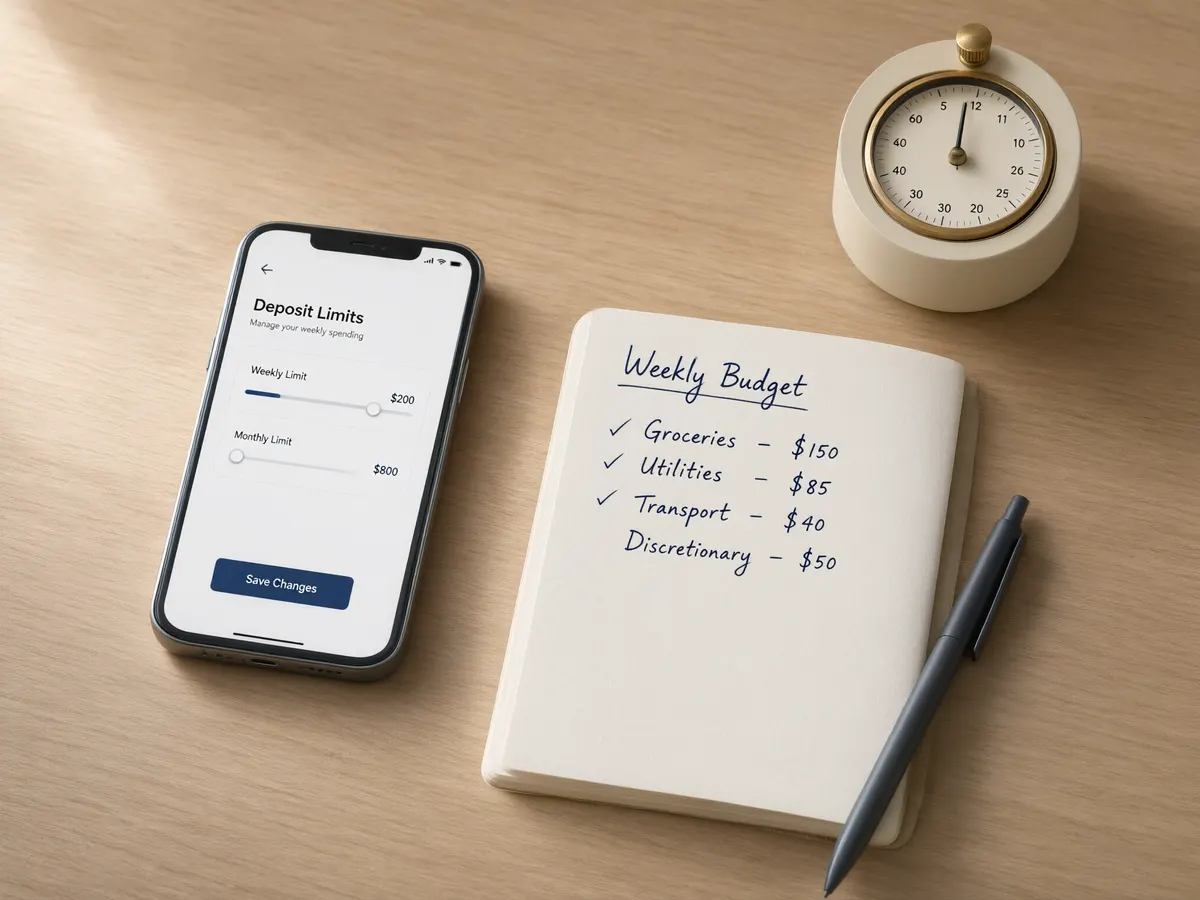
A limit sticks when you set it while nothing is at stake and when reversing it takes longer than the urge lasts. That second half is the part most guides skip. Many licensed platforms apply a delay before a limit increase takes effect, while a decrease is usually immediate. That asymmetry is the whole point, and it is the reason an account-level limit beats a number you wrote in a notebook.
Deposit limits, loss limits and time limits do different jobs
People use these interchangeably and then wonder why the cap didn’t hold. They control different things.
| Limit type | What it caps | Best at | Where it fails |
|---|---|---|---|
| Deposit limit | Money moved into the account per day, week or month | Capping total exposure, the single most useful control | Does nothing once a big balance is already sitting there |
| Loss limit | Net losses over a set period | Stopping a long grinding session from eating the whole bankroll | Not offered by every operator; can be reset at period rollover |
| Wager or spend limit | Total amount staked, win or lose | Slowing down high-turnover play where the same money recycles | Can feel restrictive on low-stake sessions and gets raised |
| Session time limit | Minutes or hours logged in | Fatigue, which is when decisions get worst | Says nothing about stake size; you can lose fast in 20 minutes |
If you only ever set one, set the deposit limit. It is the only cap that works on the money before it reaches the part of your brain that treats a balance as play chips rather than wages.
How to pick a number you can actually afford
- Work out your monthly entertainment money after rent, bills, food, debt payments and savings. Gambling comes out of that line, not any other.
- Take a share of it you would not miss if it vanished entirely, because over time it will. A game returning 96% leaves a 4% edge against you on every unit staked, and European roulette holds 2.7% on every spin. The long-run direction is settled.
- Divide it into weekly allowances rather than one monthly figure. Monthly budgets get spent in the first week.
- Enter that weekly figure as a deposit limit in your account settings, today, before the next session.
- Move gambling money into a separate account or wallet funded once a week, and keep the card that touches savings out of the gambling account entirely.
- Diarise a review date, roughly quarterly. Reviewing is allowed. Raising a limit mid-session is not.
One rule worth holding to without exception: never top up after hitting the week’s limit. If you have ever found yourself three deposits past a number you set, the number was never the problem, the reversal route was. Good bankroll management is mostly plumbing.
The habits that do the work
Limits handle the ceiling. Habits handle everything underneath it, and they are the part you repeat hundreds of times a year.
Before you play
- Decide the stop point for the session in advance, both a loss figure and a time, and say it out loud or write it down.
- Check your state honestly. Tired, angry, drunk, lonely or recently paid are all conditions under which your own rules get negotiated away.
- Don’t open an account or a session while waiting on money you need. Playing with rent attached to the outcome changes every decision you will make.
- Know the game before staking on it. Volatility decides how swingy the ride feels; RTP decides the long-run cost. Neither predicts your night.
During play
- Take a scheduled break, not a break when it feels natural. It never feels natural mid-session.
- Keep the stake flat. Raising stakes to recover a deficit is the single most expensive habit in gambling and it has no mathematical basis, because each round is independent.
- Watch the clock as closely as the balance. Time lost is the quieter cost and the one people underreport.
- Cash out at the level you set rather than the level that would feel satisfying. On crash games especially, auto cash-out removes the decision from the moment it is hardest to make.
After a losing session
- Close the app and leave it closed for the rest of the day. No “one small spin to end on a win”.
- Log what you actually deposited and lost, not your impression of it. Impressions drift towards break-even.
- Don’t fund the next session early. If the week’s allowance is gone, the week is over.
- If the loss genuinely hurt, that’s information about the size of the stake, and the stake should come down next week.
None of this makes you a winning player. It makes the cost predictable, which is the only control available in a game with a built-in edge.
Red flags worth taking seriously
The early signs are behavioural, not financial, and they show up before the money does. This is informational, not a diagnostic tool, and nothing here tells you whether you have a gambling problem. Patterns to be honest with yourself about:
- Needing bigger stakes to feel the same interest or excitement as before.
- Borrowing, selling things or using credit to fund play, or moving money from bills.
- Hiding how much you play, deleting history, lying about losses or playing where nobody can see.
- Returning the same day specifically to win back what you lost.
- Missing work, sleep, commitments or family time because of sessions.
- Feeling restless or irritable when you can’t play, or relief only when a session starts.
- Having promised yourself to stop or cut down and not managed it.
One item on that list is worth sitting with: the gap between intending to cut down and doing it. People read it as a willpower failure and resolve to try harder. Trying harder has a poor record here. Structural changes, blocking software, a limit someone else controls, a conversation with a professional, have a far better one.
The tools already sitting in your account settings
Licensed operators are required to offer safer gambling practices tools, and almost all of them are free, instant and buried two menus deep. Use them before anything goes wrong, not after.
- Limit setting for deposits, losses, stakes and session length, usually under account or responsible gaming settings.
- Reality checks, pop-up reminders at a chosen interval telling you how long you have played and what you are down.
- Time-outs or cooling-off periods, short self-imposed locks of a day up to several weeks, with no questions asked.
- Self-exclusion, a longer block that closes access for months or years and, in many regulated markets, applies across every licensed operator through a central scheme.
- Marketing opt-outs, which stop the free-bet emails and push notifications aimed at dormant accounts. Underrated.
- Device-level blocking software, which covers the sites your operator’s scheme does not.
Here is where I disagree with the standard framing. Self-exclusion is presented as the last resort, something for people in trouble. A three-day time-out is a perfectly ordinary thing for a perfectly ordinary player to use after a bad week, and using it early is cheap. Waiting until it is the only option left is what makes it expensive.
Getting help early rather than last
Support exists before crisis point, and the people answering have heard your situation hundreds of times. Reputable, free and confidential starting points include the National Council on Problem Gambling in the US, which operates the National Problem Gambling Helpline on 1-800-MY-RESET, formerly 1-800-522-4700; GamCare in the UK, which operates the National Gambling Helpline on 0808 8020 133; Gambling Therapy, which offers online support internationally; and Gamblers Anonymous, with meetings in many countries. The 1-800-GAMBLER line you may have seen on US betting adverts is a separate network, not the NCPG helpline. Elsewhere, your national regulator’s site will list the services funded in your jurisdiction. Check current contact details before relying on any of them, since numbers and hours change.
If the money is already a problem, a free debt advice service is the other call to make, and it is a separate one.
What none of this settles is the decision in front of you tonight. The habits above only work if they are in place before the session that tests them, and the limit you set on a quiet Tuesday is the only version of you that your 1am self has to argue with. Set it now, while the stakes are zero. Gambling is entertainment you pay for, priced by the house edge, and the aim is to keep the price something you chose in advance.