
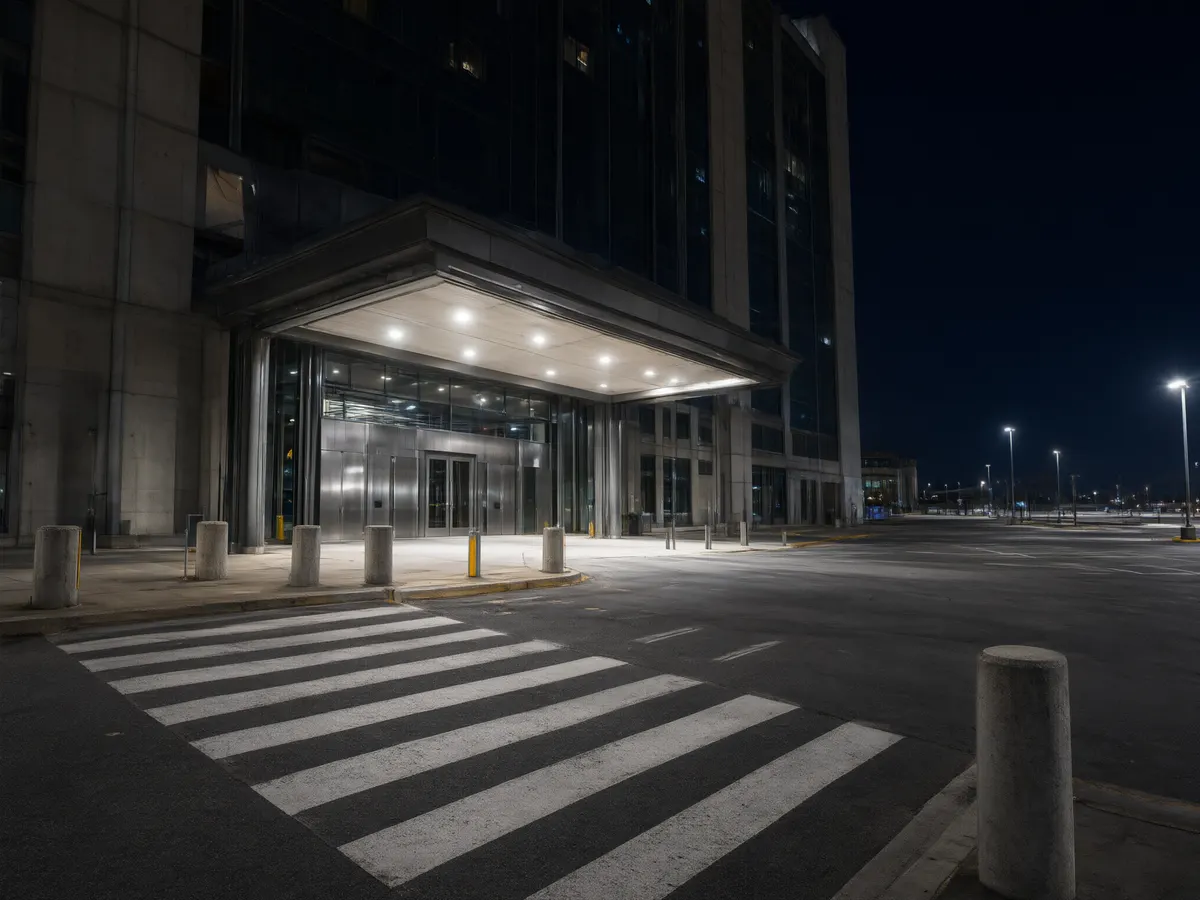
When you cash out and walk to your car, who is actually watching? Inside the building the answer is easy: cameras, a surveillance room, trained floor staff and a regulator that audits all of it. Outside, in the crosswalk between the door and the parking space, the answer gets much thinner. That gap is the reason a newly scheduled Texas murder trial has put casino security standards back into conversation, and it is worth understanding before anyone draws a neat lesson from it.
What the court has set, and what it has not
Keryan Rashad Jones, 35, of San Antonio, is scheduled to stand trial on February 8, 2027, in Maverick County, Texas, roughly 17 months after the shooting outside Kickapoo Lucky Eagle Casino in Eagle Pass. He is charged with capital murder of multiple persons, murder, and aggravated assault with a deadly weapon over the September 27, 2025 attack. He has pleaded not guilty and remains in custody on $5.1 million bail.
Seven people were shot, two fatally. The dead were Alicia “Daniela” Sanchez, 32, a mother of five from Carrizo Springs, who had been walking to her car with her longtime partner after an evening of gambling, and Marcus “Mark” Antley, 66, a retired U.S. Customs and Border Protection officer known locally for years of public service. Five more people were wounded and taken to hospitals in Eagle Pass and San Antonio.
The procedural history matters for how long this will take. Jones was arraigned by video link in January, when his attorney requested psychological evaluations on two separate questions: competency to stand trial, and legal insanity at the time of the offences. In May, 293rd District Court Judge Maribel Flores ruled him competent and ordered a separate sanity evaluation. Prosecutors have said they will not seek the death penalty, which under Texas law means a capital murder conviction would carry a mandatory life sentence without parole.
What the court has not set is any finding of fact about the casino itself. No regulatory determination, no published security review, nothing that tells a reader whether anything at the property could have been done differently. Anyone presenting this case as proof that casino safety protocols failed is going beyond the record.
Casino security is built around money, not crosswalks
Land based casino security is densest where the assets are: the gaming floor, the cage, the count room and the back-of-house money path. That is where continuous camera coverage, chip handling procedures, dual control over cash, dispute review and anti-money-laundering reporting all concentrate. It is also what gaming regulators actually inspect, because their statutory interest is in game integrity, licensing of staff and the auditability of money.
Those controls are genuinely strong, and they are the reason disputes over a hand or a payout can be resolved from recorded footage. They were also designed to answer a specific set of threats: cheating, card counting teams, chip theft, internal fraud, intoxicated patrons on the floor.
Gunfire near an exterior crosswalk is not in that threat model. It is closer to a policing problem at a large public venue than to anything a surveillance operator watching a baccarat table is trained or positioned to prevent. The Kickapoo case shows the asymmetry plainly: the investigation that followed relied on license plate recognition technology to track a black Nissan Frontier pickup across southwest Texas, and on Texas Department of Public Safety troopers who intercepted it in Wilson County the next morning after a pursuit. The tools that resolved it were law enforcement tools, not casino tools.
Crowd density was part of the context
The property was unusually busy that Saturday night because of a promotional raffle offering a Mercedes-Benz E350 and cash prizes, and the gunfire began shortly before midnight near a crosswalk outside one of the entrances. Witnesses described patrons diving under tables and running for exits.
Promotions do what they are designed to do: they concentrate people in one place at one time. Any venue running a prize draw with a car on the floor knows it will draw a bigger crowd than a normal Saturday. Whether staffing or perimeter coverage was scaled to match that night is not something the available record answers, and I am not going to estimate it. The honest position is that crowd size and the location of the incident are established facts; the adequacy of the response to them is not.
“Heightened security” is an announcement, not a specification
The casino reopened six days after the shooting with what was described as heightened security, and subsequently installed a concrete barrier. That is the extent of what has been made public, and the gap between the phrase and the detail is the whole problem with assessing casino security standards from the outside.
Consider what a concrete barrier does. It is effective against a vehicle entering a pedestrian area. It does nothing about a person on foot with a firearm. That is not a criticism of the decision, barriers are a reasonable hardening measure for any venue with foot traffic beside a roadway, but it illustrates why “heightened security” tells a prospective visitor almost nothing. Additional officers? Metal detection at entrances? Lighting and camera coverage extended into the lots? Changed closing-time procedures? None of that has been published, and inventing a plausible-sounding list would be worse than admitting the blank.
There is also no public dataset I am aware of that would let anyone calculate how often violent incidents occur at casino perimeters, in the United States or anywhere else. Readers will see confident-sounding comparisons after cases like this. Treat any specific figure with suspicion unless the source behind it is named.
Online vs land casino safety: different risks, not fewer
A licensed online casino removes the physical dimension entirely and replaces it with a financial and digital one. That is a real difference, and it is also where a lot of lazy marketing starts, so it is worth laying the categories side by side rather than declaring a winner.
| Risk category | Licensed land-based venue | Licensed online casino |
|---|---|---|
| Physical harm, theft, car park incidents | Present; managed by venue security and local policing | None |
| Game fairness | Regulated; physical equipment and floor surveillance | Regulated; certified RNG and published RTP |
| Identity and funds | Cash on your person; KYC at larger thresholds | KYC before withdrawal; account and payment security is the exposure |
| Unlicensed operators | Hard to fake a building | Easy to fake a website; licence verification is on the player |
| Pace of loss | Limited by travel, queues, table speed | Faster; no friction between rounds |
| Self-control tools | Self-exclusion where offered | Deposit, loss and session limits, cool-off, reality checks |
Anyone who tells you online is simply safer is selling something. You trade a physical risk you cannot control for a financial one you largely can, provided you check the licence, use a payment method you can trace, and complete verification before you have money sitting in a balance you want out.
What a licence actually promises, and what the small print qualifies
Licensed casino safety covers money handling, identity verification, game certification and complaint routes; it does not cover the arithmetic of the games themselves. That distinction is where most player disappointment lives, and it has the same shape as the “heightened security” problem: an advertised number, and a term that qualifies it.
A slot advertising 96% RTP returns roughly 96 units per 100 wagered, averaged across millions of rounds. The qualifying term is “averaged across millions of rounds”. It is not a session forecast, and the other 4% is the house edge, which is exactly how the operator makes money. A “100% up to” welcome bonus is qualified by its wagering requirement: at 30x, a 1,000-unit bonus means 30,000 wagered before withdrawal, with game weighting deciding how fast that clears and max bet and max cashout clauses capping what you can do while it is active. Both numbers are true. Both are useless without the clause attached to them.
The habit worth building is the same in both settings. Read what the number is actually measuring, and notice when the specific claim has been replaced by a reassuring adjective.
What is still unresolved
Two things remain genuinely open. The sanity evaluation ordered alongside the competency ruling has not produced a public outcome, and a jury in Maverick County will not begin hearing the case until February 2027. Until then, the factual account of that night is an allegation being tested, not a settled finding.
The second is broader and less likely to be answered. Game integrity has published standards, audit trails and regulators who enforce them. Perimeter security at gaming venues largely does not, which is why the public record here amounts to a reopening date, a phrase, and a concrete barrier. If you want to know what a venue does outside its doors, you will have to ask it directly, and accept that the answer may not be specific.
If gambling has stopped feeling like entertainment, set a deposit or loss limit, use the cool-off and self-exclusion tools your operator provides, or contact a national gambling support service in your country. Play with money you can afford to lose, and never treat it as income.