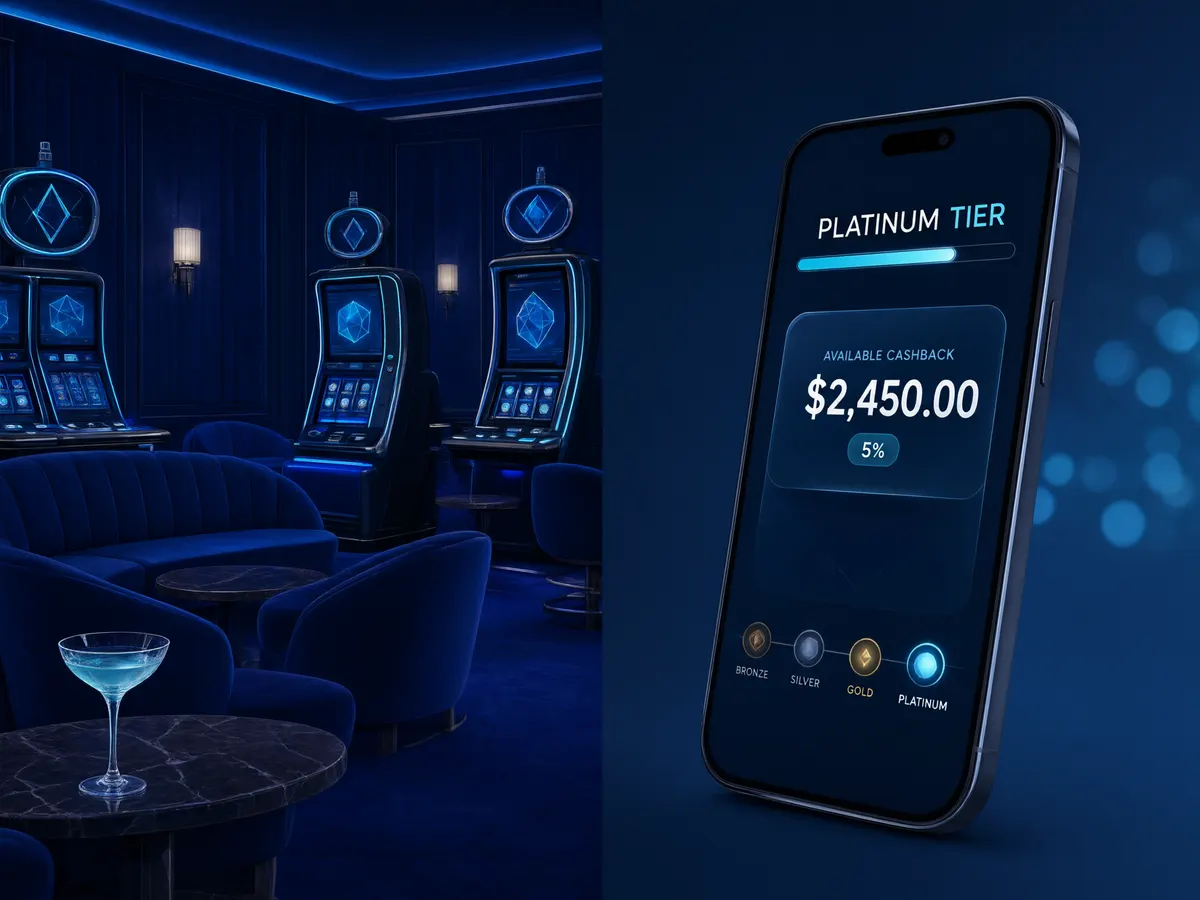
A slots player in Atlantic City hits a jackpot just under $40,000 and doesn’t leave the chair. No attendant walk-over, no paperwork pause, no stranger counting out bills in front of the machine. The money lands back in the bankroll on the same unit and play continues. That single piece of plumbing, Ocean Casino Resort’s “Self-Pay” feature inside its high-limit lounge, tells you more about what VIP treatment actually is than any amount of marketing copy about red carpets.
What a casino VIP program actually is
A casino VIP program is a tiered rewards structure that returns part of your wagering back to you as perks, with the size of the return and the level of personal service rising as your recorded play rises. That is the whole mechanism, land-based or online. Everything else, the lounges, the hosts, the branded tiers, is packaging around a loyalty calculation the operator runs on your account.
The reason to look at it now is that Ocean Casino Resort announced a $14 million rebuild of its members-only high-limit slot lounge, which gives a rare public number for what a property is willing to spend on its best customers. Online operators are selling you the same promise at a fraction of the cost. Whether that promise holds up depends on one condition most players never check, and we’ll get to it.
What $14 million buys at Ocean Casino Resort
Ocean is relocating and enlarging The Cove, its high-limit slot lounge, into an 11,935-square-foot space between the Asian Table Games area and the High-Limit Table Games room, with capacity rising from roughly 140 slots to 192 machines. According to Casino.org’s reporting on the announcement, the new room is slated to open in early 2027 with dedicated seating areas and an interior themed on the ocean beyond the Boardwalk. General Manager Bill Callahan described it as a significant investment in the experiences the resort delivers to guests.
Access is the interesting part. The Cove is restricted to Reserve, Prime and Preferred Ocean Rewards cardholders from Sunday through Thursday, and narrows to Reserve and Prime members on Friday and Saturday. Above it, 44 floors up, sits The Loft, a 2,000-square-foot private gaming suite available by invitation only, with a complimentary full-service bar, butler service and a personal security detail. Ocean reported $329.9 million in gross gaming revenue from slots and tables through August, up 5.4% year on year. The high-limit spend is not charity; it is a return-on-investment decision.
What do high rollers actually get on the casino floor?
Land-based high-roller perks fall into two buckets: comps, which are discounts paid back in kind, and access, which is space and service other guests can’t buy. Comps cover food, drinks, hotel rooms, show tickets, airport transfers and sometimes flights. Access means private gaming salons, separate cages, higher table limits and a personal host who handles your bookings and problems directly.
Qualification almost never works the way players assume. Casinos don’t reward how much you win or even how much you deposit; they reward theoretical loss, calculated from your average bet, the game’s house edge and how long you play. Two guests who each put $50,000 through a machine can earn very different treatment if one grinds low-volatility slots for ten hours and the other plays blackjack with a thin edge against them. Properties rarely publish the thresholds, which is precisely why hosts phone you rather than letting you apply.
How online loyalty programs copy the model
An online casino loyalty program replaces the host and the lounge with account-level mechanics: points earned per unit wagered, tiers unlocked by points or turnover, and benefits delivered as cashback, rakeback, bonus multipliers, raised withdrawal limits and a dedicated account manager reachable on a priority chat or email line. The economics are identical to comps, the delivery is software.
The common components look like this. Point-based tiers convert wagering into a status level, usually with monthly or lifetime qualification. Cashback returns a percentage of net losses over a period, sometimes as withdrawable cash, more often as bonus credit. Rakeback does the same thing in poker and some live-table formats. Faster or larger withdrawals mean your cashout cap moves up and your request jumps the review queue, which for an Indian player usually shows up as a quicker UPI payout once KYC is cleared. Birthday and reload offers round it out.
None of this changes the game. A platinum tier does not alter RTP, volatility or the house edge on any title in the lobby. It only changes how much of your wagering comes back to you outside the game, and under what conditions.
Land-based and online VIP, side by side
The two models share a logic but differ sharply on who can reach them and how much you can verify in advance.
| Factor | Land-based high-limit VIP | Online VIP tier |
|---|---|---|
| Entry threshold | High, based on theoretical loss; usually unpublished | Low entry tiers common; top tiers invite-only |
| How you qualify | Tracked play, host discretion, invitation | Points or turnover, often automatic |
| Personalisation | Named host, face-to-face | Account manager by chat or email |
| Main perks | Comps, suites, travel, private salons | Cashback, rakeback, higher withdrawal caps, bonuses |
| Transparency of terms | Low; negotiated case by case | Variable; best operators publish tier criteria |
| Practical accessibility | Travel and large bankroll required | Reachable from your phone at modest stakes |
Entry thresholds
Online wins on access and loses on ceiling. Most online programs hand you a bronze or equivalent tier from your first deposit, while the genuinely useful levels sit behind turnover most recreational players will never post. A land-based high-limit room has no entry-level version at all.
Perk types
Land-based perks are experiential and consumed on site; online perks are financial and land in your balance. A complimentary suite has a cash value you can’t convert, whereas cashback is money or near-money. That makes online perks easier to price and easier to compare between operators.
Transparency of terms
This is where online programs can genuinely beat the floor, and where most of them squander the advantage. A published tier table with stated cashback percentages and stated withdrawal limits is checkable before you deposit. “Exclusive rewards for our most valued players” is checkable only after.
Which VIP perks are worth something, and which are noise
Four perks hold real value. Faster withdrawals with a raised cap, stated in numbers. Cashback paid as cash or with single-digit wagering. VIP bonuses carrying a lower playthrough than the public offers. A support contact who can escalate a stuck payout.
Here is the condition almost nobody checks, and it flips the answer on whether a programme is worth chasing: is the VIP bonus’s wagering requirement actually lower than the standard one, and is the higher withdrawal limit per transaction, per day or per month? A tier that upgrades a 40x bonus to a larger 40x bonus has given you more to clear, not more to keep. A cap that reads “₹5,00,000” but resolves to a monthly ceiling with a ₹50,000 daily drip is not a faster payout. Read the tier page and the bonus terms together; the mismatch between them is where the value quietly disappears. If you’re unclear how playthrough maths works, our guide to bonus types and wagering requirements covers the arithmetic.
Treat these as noise until proven otherwise: “exclusive” offers that match the public promotion, luxury gifts and trips with undisclosed qualification, personal manager contact that routes to the same chat queue, and any tier benefit described without a number attached.
Checking a programme before you opt in
Run five checks, in this order:
- Confirm the operator’s licence and regulator, and that it is a licensed online casino you can hold to account.
- Find published tier criteria. If the thresholds aren’t written down, the programme is discretionary, which means it can change on you.
- Check withdrawal limits and timeframes in writing, per transaction and per month, and look for an established payout track record rather than a promise.
- Read the wagering requirement, game weighting, max bet and max cashout on VIP bonuses specifically, not the sitewide terms.
- Verify that deposit limits, loss limits, cool-off and self-exclusion remain available at every tier. Some programmes quietly lean on high-tier players to lift their own caps, which is the opposite of a perk.
So can a regular player get VIP status?
Yes, you can reach the lower tiers of most online programmes without unusual spending, and no, the perks there will not be meaningful. The honest reading sits between the two positions you’ll hear. One camp says online VIP is pure marketing dressing on rewards the site would have paid anyway, and they’re right about the glamour: nobody is sending a butler to your flat. The other camp says the practical value is real, and they’re right about the plumbing: quicker payouts, genuine cashback and softer bonus terms are worth money, and unlike a comped suite, you can calculate exactly how much.
My position is that the value is real but narrow. It lives in withdrawal handling and in cashback percentages, almost never in the bonus offers, and it only exists at operators that publish their numbers. Chasing a tier by raising your stakes is the one move that reliably destroys the maths, because the extra house edge you absorb to climb will exceed anything the tier returns.
What you cannot verify in advance is the part that matters most: whether the stated payout speed survives contact with your first large withdrawal. Published terms tell you what the operator has committed to; they don’t tell you how it behaves under pressure. Test the programme with amounts you’re comfortable losing, keep your own limits in place whatever tier you hold, and read our responsible gambling guide if play is starting to feel like something other than entertainment. No loyalty tier, on the Boardwalk or on your phone, moves the house edge a single basis point in your favour.