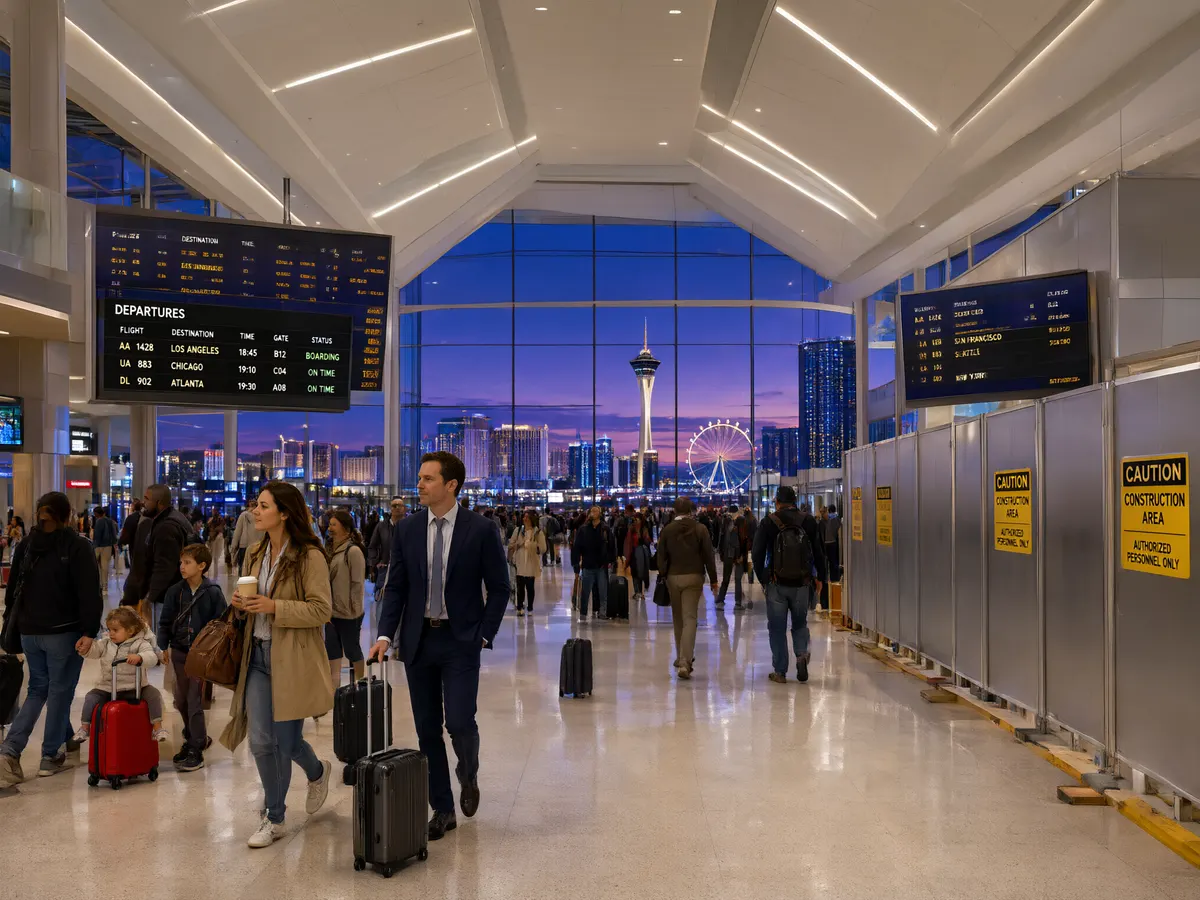
Clark County’s aviation director, James Chrisley, put it to the county commission in the least glamorous way possible: much of Harry Reid International was built for the passenger volumes and the aircraft of the 1990s and early 2000s. Out of that observation came a multibillion-dollar modernisation plan, and out of the plan came the inevitable reading that Las Vegas casino tourism growth is still accelerating. That reading is defensible. It is also the kind of claim that falls apart if you skip two checks, so here is the order in which to run them.
Check one: is it a budget or an intention?
There is no finalised budget and no complete timeline. Clark County officials expect to publish formal cost estimates next year, and they intend to pursue federal funding for a substantial share of the work. So “multibillion-dollar” is currently a scale, not a signed cheque.
That matters more than it sounds. Infrastructure announcements are the cheapest form of optimism in any tourism economy, and a plan priced next year can be re-phased the year after. The counterweight here is that aviation consultant Mike Boyd told the Las Vegas Review-Journal that Reid is in good shape to compete for discretionary FAA grant money, on the strength of its delivery record and its mix of domestic and international carriers. Good position, not guaranteed money. Treat the funding question as open until the estimates land.
Check two: which bottleneck is actually being cleared
The plan relieves a constraint that already exists rather than creating headroom for demand that someone hopes will appear. Reid is the eighth-busiest airport in the United States and the terminal it runs through was sized for a smaller, earlier version of Las Vegas. This is catch-up work, and catch-up work is a different signal from speculative expansion.
The gate programme is the clearest part of it. Terminal 1 goes from 39 gates to roughly 65, built around a new wing of about 11 gates near the old Terminal 2 site. Once that wing opens, the A and B “satellite” layout gets converted into a linear pier, taking those gate counts from 23 to about 33. The county’s own figures are rounded, which is what you would expect from a design that has not been costed yet.
| Element | Now | Planned |
|---|---|---|
| Terminal 1 gates | 39 | About 65 |
| New wing near former Terminal 2 site | None | About 11 gates |
| A and B gates | 23 | About 33 |
| A and B layout | Satellite | Linear pier |
| Terminal 3 | Terminal 3 | Renumbered Terminal 2 |
Everything else on the list reads like a facility fixing the things that annoy its own staff. A new administrative building and parking garage. New escalators and lifts at Terminal 1, so passengers moving between baggage claim and the garage no longer walk across a live taxi lane. Reconfigured taxi and ride-share staging, which frees up roughly 330 extra parking spaces at peak. New vehicles for the automated transit system, which has run about two million miles over a decade of continuous service. A new Aircraft Rescue and Firefighting station expected to break ground in November 2026, with officials hoping to have it up and running about a year later. Bigger concessions, more dining and more lavatories across the A and C gates.
Check three: who the new concrete is built for
One item gives the game away. Planners are preparing a dedicated Customs and Border Protection facility and a charter ramp on the airport’s west side, specifically to handle international private aircraft tied to major events such as Formula One.
That is not a slot-floor investment. It is a mega-event investment. Chrisley framed the whole programme around the city’s evolution into a global sports and mega-event hub, and the physical plant follows the framing: spiky, concentrated peaks of arrivals around race weekends and championship fixtures, including a meaningful share of private and charter traffic that the 1990s terminal was never designed to process.
The case for Las Vegas casino tourism growth, and the counter-case
Both readings of this announcement hold up, and they lead to different conclusions about the Las Vegas gambling economy.
The bullish reading: public bodies do not rebuild an eighth-busiest airport for a market they expect to shrink. Gates are the hard ceiling on visitation, and lifting Terminal 1 from 39 to around 65 is a bet on more bodies arriving for longer. More arrivals is the raw input for everything downstream, resorts, gaming floors, sportsbooks, conventions.
The sceptical reading: capacity catch-up is not the same as demand growth. The terminal was undersized; fixing an undersized terminal tells you about the past decade, not the next one. And the plan is explicitly described as a bridge to a two-airport system, with a proposed commercial airport in the Ivanpah Valley still at least a decade out. You build a bridge when the destination is far away and the current structure will not hold.
I come down with the sceptics on the mechanism and the optimists on the direction. The concrete here is being poured because peak-day traffic already exceeds what the building can comfortably take, not because anyone has modelled a surge in gambling spend. But the thing creating those peaks is real and it is the part worth watching: Las Vegas is increasingly filling its rooms with people who booked for a race, a fight or a game, and gambled because they were already there. That is a different growth engine from the one that built the Strip, and it changes which numbers you should track. Visitor volume and event calendars, yes. Gaming win per visitor, much less reliably.
What this changes for the iGaming reader
Practically, very little this quarter and quite a lot over five years. The work rolls out in phases so the airport keeps operating throughout, and early site work is already under way, including a 92,700-square-foot operational support warehouse that opened earlier this year to replace a building due for demolition. Three things are worth filing away.
- Expect the usual construction tax if you fly in during the build: shifted kerbsides, relocated staging areas and, at some point, a renumbered Terminal 3 that will be called Terminal 2. Check your terminal on the day rather than from memory.
- Watch next year’s cost estimate and the FAA grant outcome. That is when the plan stops being a presentation and starts being a programme, and it is the cleanest read available on how much public money is willing to back casino industry growth in Nevada.
- Read the land-based signal for what it is. Rising Las Vegas tourism and rising online play are not the same market, and airport gates do not forecast online handle. They do tell you where operator marketing budgets are likely to point, because event weekends are now the moment the city sells hardest.
Worth one practical note on the slot machines by the departure gates, which have been photographed to death and are the first thing many visitors touch in Nevada. They run on the same arithmetic as every other machine in the state: a built-in house edge, independent spins, no memory of what came before. A boarding-gate bankroll should be money you have already written off, with a limit set before you sit down.
The question the plan leaves genuinely unanswered is whether Reid gets to about 65 gates before the demand it is chasing needs 80. Ivanpah Valley is a decade away on the optimistic reading. Until the cost estimates arrive and the federal money either lands or does not, the honest summary is that Las Vegas has recognised a capacity problem caused by success, and has not yet committed the budget to solve it.