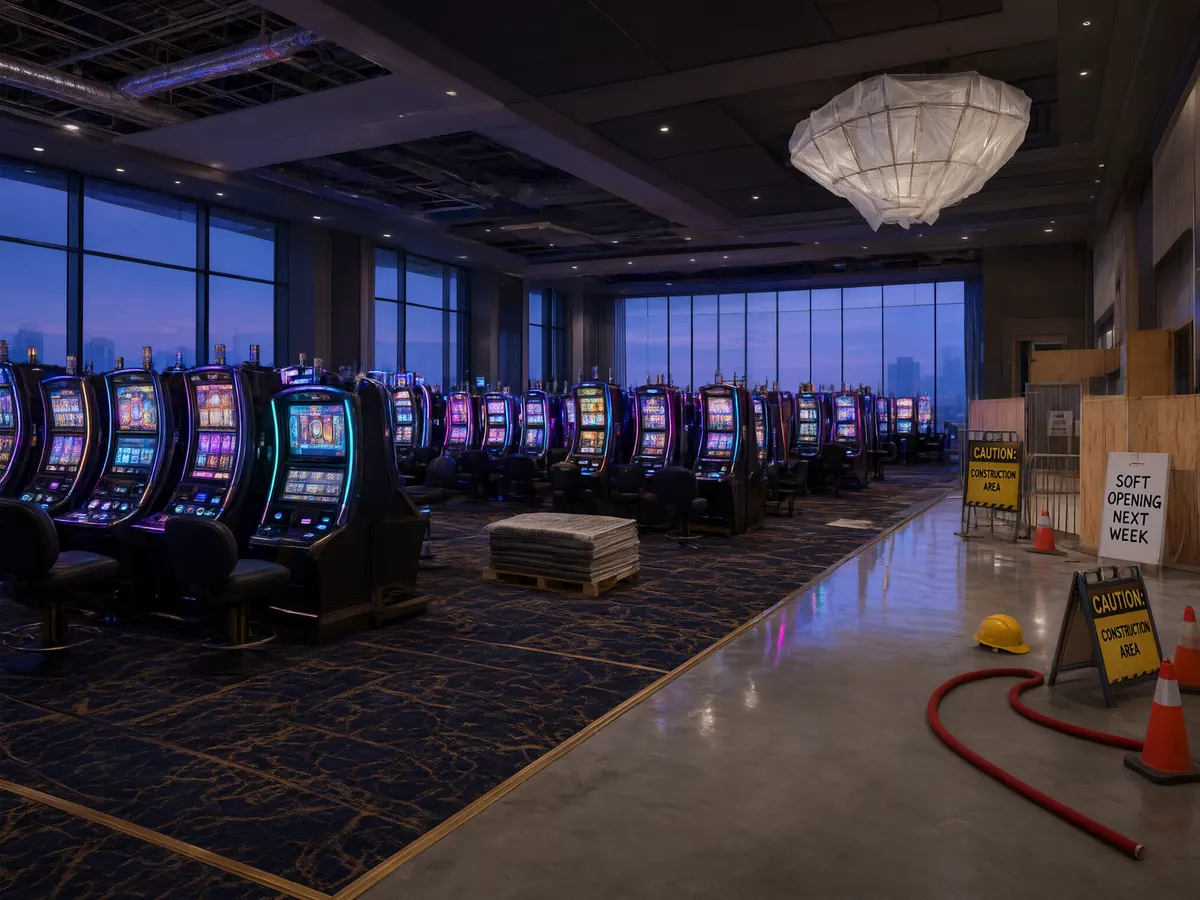
Six weeks is a long time to leave 700 slot machines switched off. Peninsula Pacific Entertainment has decided not to: Cedar Crossing Casino & Entertainment Center will open its Iowa gaming floor on November 19 rather than December 31, six weeks ahead of the original date, on a $275m build. For anyone tracking global casino industry growth, that schedule change is more informative than the construction budget, because pulling a date forward is a bet an operator makes with its own money.
The numbers on the page
Cedar Crossing is a $275m project, described as the largest gaming development in Iowa’s history. The gaming floor carries 700 slot machines and 22 table games. Alongside it sits a 1,500-capacity entertainment venue, and the formal grand opening celebration runs December 4–5, 2026, with Old Dominion performing on December 5.
| Detail | Figure |
|---|---|
| Total investment | $275m |
| Slot machines | 700 |
| Table games | 22 |
| Entertainment venue | 1,500 capacity |
| Gaming floor opens | November 19 (brought forward from December 31) |
| Grand opening celebration | December 4–5, 2026 (Old Dominion on December 5) |
| Forecast new revenue to Iowa | $80.2m (operator-commissioned study) |
Aaron Gomes, President of Peninsula Pacific Entertainment, framed the early date as a credit to the build team. Jonathan Swain of P2E called the property a transformative addition to the region and a major source of new state revenue. Those are the quotes you expect from an opening announcement; the facts around them are the part worth holding on to.
Why would an operator pull an opening date forward?
Because an unopened casino earns nothing and still costs money. Interest on the capital, payroll for a hired-and-trained staff, utilities on a finished building: all of that runs whether or not a single reel spins. Six weeks of gaming revenue against six weeks of carrying cost is the simplest arithmetic in the business, and it only works if the operator is confident the floor is ready for regulatory sign-off and staffed well enough not to embarrass itself on night one.
Read it that way and the date change is a confidence signal rather than a marketing flourish. Operators who are nervous about demand do the opposite. They slip dates, stage openings in phases, and hold back amenities. P2E has chosen to open the gaming floor first and hold the ceremonial launch two and a half weeks later, which suggests the revenue clock mattered more than the ribbon.
How much of the $80.2m is genuinely new?
Nobody outside the study can say, and that is the honest answer. The $80.2m figure comes from a market study by Convergence Strategy Group, commissioned by P2E, the company that wants the property built and open. Operator-commissioned forecasts are not worthless, but they are an input to a licensing argument, not an audited result.
Two things in that number are genuinely unresolved. First, the announcement does not make clear whether $80.2m refers to gross gaming revenue generated within the state or tax receipts flowing to the Iowa treasury. The gap between those two readings is very large, since state gaming taxes take only a slice of gross gaming revenue. Second, Iowa is not an unserved market. It has had licensed commercial casinos for decades, and a new property of this size draws some of its play from existing floors rather than conjuring it from nowhere. The release says nothing about how much of the forecast is net of that displacement. I would not treat the headline as new economic activity until the state’s own published revenue reporting shows what happened to the rest of the market.
The cost of getting this wrong is not abstract. Players and small investors who read a single forecast as a settled result end up with a picture of a market that is expanding faster than it is. Regulators in other jurisdictions, including those weighing new licences, routinely see the same style of commissioned projection. The number is a hypothesis with a date on it, and it will be checkable within a year.
Where land-based building fits into global casino industry growth
Land-based capital spending is the slowest and most committed signal in the industry, which is exactly why it is useful. Online operators can enter a market with a licence, a payments stack and a marketing budget, then exit when the economics sour. A $275m building in Iowa cannot be unbuilt. When a company commits that much to a fixed asset in a mature, already-served market, it is forecasting a decade of demand, not a quarter.
That is the part commonly misread. The growth of regulated online casino and sports betting is often described as if it comes at the expense of physical floors. The evidence does not support a simple substitution story. Most US states still have no licensed online casino gaming at all, fewer than ten do, while retail casino development continues in markets with and without online verticals. Cedar Crossing’s 1,500-seat venue and its concert-led grand opening point at the same conclusion: the physical product increasingly sells something an app cannot, and operators are capitalising it accordingly.
For readers whose own market is primarily online, the practical takeaway is about where the money goes. Slot machines, table layouts, pit staff and live-event infrastructure are the capital-heavy end of the same companies that supply and run online content. Growth in one does not announce decline in the other.
What the announcement does not tell you
Quite a lot, and the omissions are standard rather than suspicious. There is no projected first-year gross gaming revenue beyond the study figure, no hold percentage expectation on the 700 machines, no statement on how many jobs at what wage, and no breakdown of the $275m between gaming floor, venue and surrounding development. The market study is described as forecasting job creation without the release naming a number.
If you want to judge this project rather than cheer it, the things to watch are specific: the state’s monthly gaming revenue reports in the first two quarters after November 19, whether neighbouring Iowa properties report declines over the same period, and whether the 1,500-capacity venue sustains a booking calendar after the opening concert. Those are public, dated and comparable. The press release is none of those things.
What a player should take from this
Very little about your own odds, and that is worth saying plainly. A new floor with 700 slot machines and 22 table games does not come with better mathematics than an old one. Each machine still runs an RNG with a fixed long-run return to player, and the house edge on every game is set by the paytable and the rules, not by the age of the carpet. A 96% RTP slot returns around $96 per $100 wagered averaged over millions of spins, which means the remaining 4% is how the $275m gets paid back. New casinos are built because that edge is reliable.
What does change for players is choice: more table seats in a region, more live-dealer options, more competition on comps and amenities. Those are real improvements to the experience and none of them alter expected value. Set a deposit or session limit before you walk in or log in, treat the spend as entertainment cost, and use the self-exclusion and cool-off tools every licensed operator is required to offer.
The interesting test arrives early next year, when Iowa’s reported numbers either validate the $80.2m forecast or quietly fail to. Until then, Cedar Crossing is evidence of what an operator believes about the next decade, which is a different thing from evidence of what the market will actually deliver.