
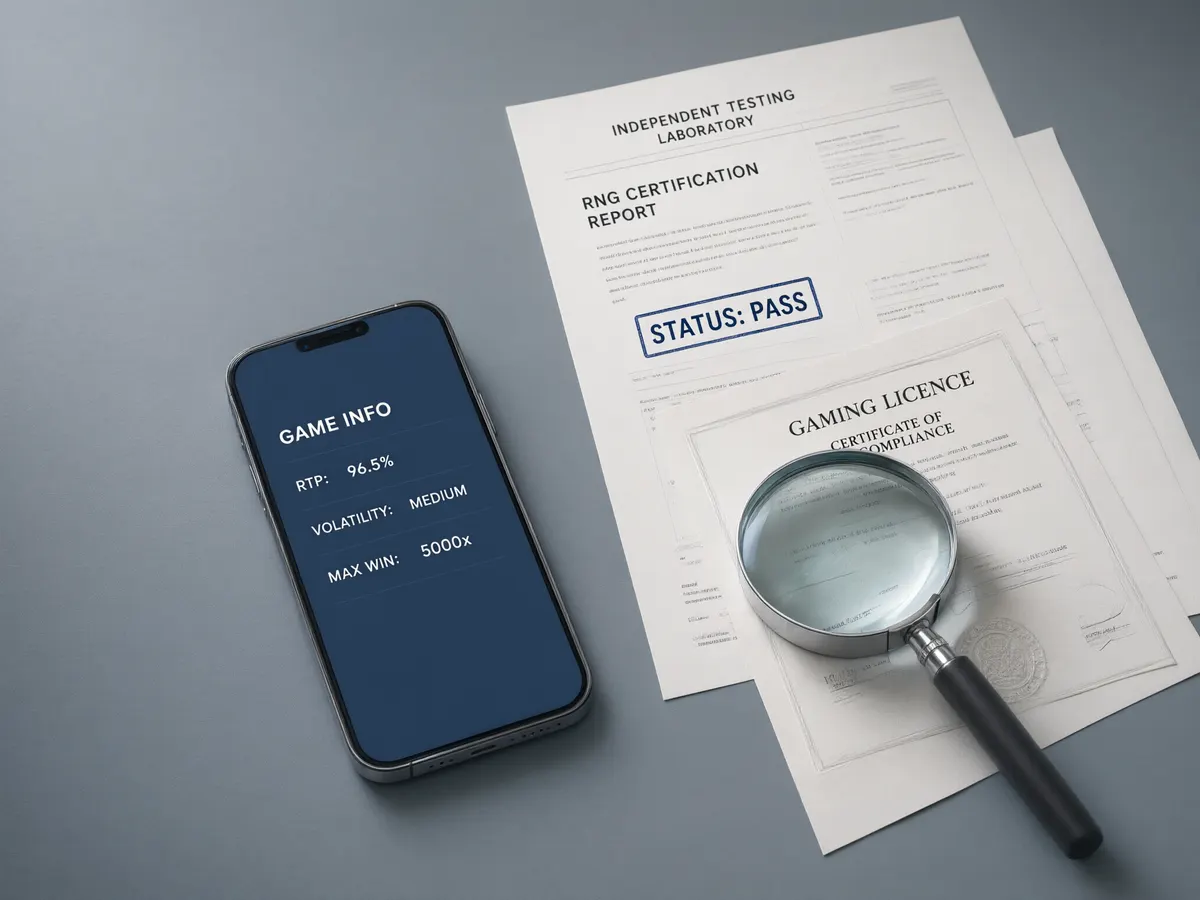
A press release lands: Peter & Sons has partnered with BingoPlus, the online gaming brand of DigiPlus Interactive Corp in the Philippines, and a selection of the studio’s titles is now live for players there. Nothing in that announcement tells you the games pay what they claim. What it does tell you is where to start looking. Before you play anything, legitimate slot game providers can be identified by four things: a licence or supplier registration in a named jurisdiction, RNG and game maths tested by an independent laboratory, an RTP figure published where you can actually read it, and a traceable history of deals with operators you can look up. Everything else is marketing.
The checks below take about five minutes per studio. Most players skip them, usually because they believe one of a handful of comfortable things that turn out not to be true.
The belief that costs the most: “the casino is licensed, so the games are fine”
An operator licence and a supplier licence are separate things, and one does not automatically guarantee the other. A regulated casino is required to source content from approved suppliers, and in mature markets it genuinely does. The problem sits with sites operating outside any regulator’s reach, where a game library is assembled from whatever a software aggregator will sell, including rebranded or cloned titles whose maths nobody has verified.
The cost of being wrong here is not abstract. With an unverified provider you are betting into payout odds that no third party has measured, which means the advertised return figure is a claim rather than a tested number. If the game underpays, there is no regulator to complain to and no lab report to point at. Disputes with an unlicensed supply chain end where they start: with an email that goes unanswered.
Trusted slot providers exist in the public record. The ones worth avoiding tend to exist only on the casino page that hosts them.
What the four checks actually involve
Licensing and jurisdiction
A game studio holds a supplier or B2B licence, not a casino licence, and it is issued by a named gambling regulator. The names you see most often are the Malta Gaming Authority, the UK Gambling Commission, the Isle of Man Gambling Supervision Commission and Curaçao, whose regime has been restructured in recent years around a single gaming authority rather than the old master-licence arrangement. In the Philippines, the market the Peter & Sons deal targets, PAGCOR is the regulator.
Holding one of these means a studio has been through corporate due diligence on its owners and finances, has submitted its games for technical testing against the regulator’s standards, and remains subject to audit and sanction. Licences also differ in weight. A UK or Malta supplier licence demands more and costs more than a Curaçao one. Neither is a fairness guarantee for any individual spin, and nobody should sell it as one, but both give you an enforcement body with a public register and a complaints route.
Independent RNG and fairness certification
RNG certification means an independent testing laboratory has examined the random number generator that decides each spin and confirmed its outputs are statistically random and not predictable from past results. The labs doing this work are Gaming Laboratories International (GLI), iTech Labs, eCOGRA and BMM Testlabs, among others. They also verify that a game’s actual simulated return matches the RTP stated in the paytable.
Here is where a second myth needs dismantling. A certificate is not a permanent seal of blessing. It covers a specific game, a specific build and a specific jurisdiction’s technical standard, issued on a date. A logo pasted into a website footer is not a certificate, and plenty of dubious sites paste them. The thing that counts is a report or certificate you can trace back to the lab or the regulator, which is exactly why rng certified slots from established studios list version numbers and test references rather than just a badge.
Published, verifiable RTP
RTP, or return to player, is the share of all wagers a game returns across millions of simulated rounds. A 96% RTP means a 4% house edge, which is the mathematical reason the operator profits over time. It is a long-run average computed over a volume of spins no human will ever play, so it says nothing about your session, and anyone presenting it as an expected outcome is misleading you.
What it does do is make a game auditable. Published RTP is a number a lab can test against. It should appear in the game’s info or paytable screen and, for many studios, on the provider’s own site. Some games ship with configurable RTP bands, in which case the operator’s chosen setting should be the one displayed. A slot with no RTP anywhere in its information panel is a slot whose maths you cannot check, and that is reason enough to leave it alone. Volatility is a separate matter: it describes how the returns are distributed, rarely and large versus often and small, and it does not change the RTP.
Track record and portfolio
Years active, the number of named operator partnerships, a registered company with an address and contact details, and a visible presence at industry level all function as trust signals. None of them is proof of fairness. Together they mean a studio has a reputation it would lose by shipping a rigged game, which is the practical deterrent that actually operates in this industry.
A studio with no traceable partnership history and no corporate footprint has nothing to lose. That asymmetry is the whole point.
Verifying a provider in five steps
This is the practical sequence for how to verify casino games before you deposit.
- Scroll to the casino’s footer and read the licence details and the list of game suppliers. Note the licence number and the regulator named.
- Open the provider’s own corporate site, not the casino’s description of it. Look for licence numbers, the registered company name and the jurisdictions it is approved in.
- Cross-check that licence number against the regulator’s public register. Malta, the UK and the Isle of Man all publish searchable databases. A number that returns nothing, or returns a different company name, is the end of the exercise.
- Launch a game in demo mode and open the info or paytable screen. Find the stated RTP and any certification references. Check the figure matches what the provider publishes.
- Search the provider’s name alongside “certification” or “test report” to see whether independent lab work is documented anywhere outside the provider’s marketing.
If steps one to three come back clean, the rest is usually formality. If step three fails, nothing after it matters.
Red flags worth walking away from
- No licence number or regulator named anywhere on the provider’s site
- No RTP disclosed in the game’s information panel, or a figure that contradicts the provider’s own published number
- No registered company name, address or working contact channel
- Games that are visibly cloned or rebranded from a known studio, down to the symbols and sound effects, under a name you cannot find in any industry record
- Certification logos that link nowhere, or that reference a lab with no matching report
- Bonus terms heavy enough that the game selection, not the wagering, becomes the real restriction, pushing you exclusively toward unaudited titles
- A game library that appears nowhere else on the internet
What a deal like Peter & Sons and BingoPlus actually signals
A named B2B partnership announced publicly into a specific regulated market is itself a structural legitimacy signal, independent of anything either party says about its own quality. The Peter & Sons announcement names the studio, names the operator, names the market and states that selected titles are now live for BingoPlus players. All of that is checkable by anyone who wants to check it.
Compare that with the alternative. Legitimate online casino game studios expand through announced agreements, trade press coverage, certification for the target jurisdiction and a supplier listing that the operator is obliged to display. The paper trail is a by-product of regulation, not a courtesy. A studio whose games simply appear on a casino site with no announcement, no prior partnerships and no regulatory footprint has skipped every one of those steps, and the absence is the information.
What the announcement does not tell you is anything about which specific certifications apply to which titles in which market. Press releases describe commercial deals, not test reports. For that, you go back to the registers and the paytables.
Quick reference: trusted signals against red flags
| Trusted provider traits | Red flags |
|---|---|
| Supplier licence number verifiable on a regulator’s public register | No licence details, or a number that returns no match |
| Independent lab testing documented (GLI, iTech Labs, eCOGRA, BMM Testlabs) | Certification logos with no traceable report behind them |
| RTP stated in every game’s info panel and on the provider site | RTP missing, vague, or inconsistent between sources |
| Registered company, named management, working contact channels | Anonymous operator with no corporate footprint |
| Named operator partnerships announced publicly and dated | Games visible only on one casino, with no partnership history |
| Original titles with a recognisable house style | Clones or rebrands of well-known studios’ games |
Slot provider licensing is the single fastest filter on that list, because it is binary and it is public. Run it first.
Before you deposit
Run the four checks on any game library you have not used before, and run them again when a casino adds a batch of unfamiliar studios. It takes minutes and it removes the category of risk you cannot do anything about once your money is in.
What it does not remove is the house edge. A licensed provider with a clean lab report and a fully published RTP is still a game you are mathematically expected to lose over time, and verification only tells you the odds are what the game says they are. Set a deposit limit before you start, treat the spend as entertainment rather than income, use the cool-off and self-exclusion tools your operator is required to offer, and play only if you are of legal age in your jurisdiction. Rules on online gambling in India differ from state to state, so check what applies where you live.
The checklist tells you whether a game is honest. Whether you should be playing it at all is a different question, and only you can answer that one.