$1.4 million, taken over 11 months. That is what Philip Lee Sullivan, 43, stole from a former employer before he became helpline director at the Florida Council on Compulsive Gambling, the nonprofit that runs the state’s 888-ADMIT-IT responsible gambling helpline. On 16 October a Bay County judge sentenced him to 118½ months in state prison. The practical lesson for players is not that support services are a scam, it is that a service wearing the right name still has to be checked before you hand it anything.
What the court actually found
Sullivan pleaded no contest to six felony charges and was sentenced to nearly 10 years by Bay County Judge Tim Register, according to Casino.org’s report of the hearing. He was arrested in March 2024 after an internal audit at Royal American, a Panama City property management company where he had been chief financial officer, flagged unauthorised transactions on a company credit card. Prosecutors said he used that position to take $1.4 million in under a year to fund his own gambling.
In March 2025, after entering recovery, he took the helpline director role. In a podcast interview published three days before sentencing he described how the addiction had wiped out his savings and pushed him into debt, and said he kept gambling hoping to win back what he had taken. The same interview credited him with helping hundreds of people through the helpline.
The defence argued the addiction had been made worse by prescription Adderall; his wife, Mallory, testified that his behaviour changed after he started the medication. Prosecutors rejected that framing. Royal American’s controller, Shannon Scribner, told the court he had used corporate cards to buy gift cards and cash cards online and had deliberately worked around the controls built to stop exactly that. He was ordered to begin the sentence immediately and has 30 days to appeal.
Two ways to read this case, and only one survives the facts
The first reading is that responsible gambling support is rotten at the top and players are better off handling things privately. It is not a stupid reading. The man running a state problem gambling line had already proven he would exploit a position of financial trust, and somebody at the hiring end either did not know or decided it did not matter.
The second reading is narrower and fits the record better. The theft was from a private employer, before the helpline job, and nothing reported suggests callers’ money, details or confidentiality were touched. What failed here was a company’s internal financial controls and, arguably, a nonprofit’s vetting. The helpline service itself was not the crime scene.
I’ll take the second, and the reason is the cost of being wrong in each direction. Treat every support service as compromised and you make no call at all, which means the losses keep running and the problem keeps growing in private. Treat anything that looks official as safe and you eventually give your bank details or ID to whoever registered a convincing domain. The first mistake costs you months. The second can cost you money you never get back.
Are gambling helplines regulated?
Not in any single, global way. Support services are usually nonprofits, NGOs or charities rather than licensed financial institutions, and their accountability comes from a mix of company or charity registration, funding agreements with regulators or operators, and in some markets a formal accreditation or commissioning process. A helpline can be entirely genuine and still have no regulator standing behind it in the way a bank does.
That gap is the whole reason verification sits with you. A licensed operator in a regulated market is normally obliged to fund and signpost independent support, which is a useful trail to follow. A number pasted into a Telegram group by a stranger has no trail at all.
How to verify a responsible gambling helpline is legitimate
Verify a responsible gambling helpline by tracing it back to an accountable organisation: a named charity or company with a public registration number, a physical address, published funding and annual reporting, and a listing on a licensed operator’s or regulator’s own site. Then reach it through contact details you looked up yourself, not a link somebody sent you.
Signs of a verified, accountable service
- It is named and linked on the website of a licensed operator or a recognised gambling regulator, not only on social media.
- It publishes a registration, charity or nonprofit number you can look up in the relevant public register.
- It says who funds it. Operator levies, regulator grants and public money all have paper trails; “donations” with no detail does not.
- It publishes annual reports, call volumes or service statistics, which is a sign someone outside the organisation is reading them.
- Counselling is delivered by named, qualified practitioners, and the service tells you what its counsellors are and are not able to do.
- It explains how your data is stored, who sees it, and what happens if you later ask for self-exclusion.
- It never needs your account password, your card number or a payment to start talking to you.
Red flags of fake or unverified gambling support
Fake support services tend to look like the real thing for about 30 seconds, which is long enough. The table below pairs each thing worth checking with the version that should stop you.
| What to check | Legitimate service | Warning sign |
|---|---|---|
| Cost | Free, or clearly priced counselling with no upfront transfer | Asks for a fee, deposit or “recovery” payment to begin |
| Data requested | Your situation, in your own words | Casino login, card number, OTP, UPI PIN or full bank details |
| How it reached you | You found it via a regulator or operator page | Unsolicited WhatsApp, SMS, DM or comment reply |
| Ownership | Named organisation, registration number, address | Only a first name, a handle, or “our team” |
| Pace | Lets you call back when you’re ready | Pressure to act now, limited slots, urgency |
| Promises | Support, tools, limits, self-exclusion | Guarantees to recover lost funds or reverse your bets |
The last row deserves emphasis. A support service helps you stop and manage the damage. Anyone offering to claw back gambling losses for a fee is running a second scam on someone already losing.
Where Indian players can look for problem gambling resources
India has historically regulated gambling at state level with no single national body, and the Promotion and Regulation of Online Gaming Act, 2025 created a National Online Gaming Commission (NOGC) to license and regulate online gaming platforms nationally, effective 2026. There is still no one official helpline attached to the sector the way there is in Britain or in individual US states. Rules differ by state, and most casino sites serving Indian players operate under offshore licences. That changes where you look, not whether support exists.
What to check before you call or message a helpline
Start with the licence your operator actually holds. Its responsible gambling or safer gambling page should name the licensing authority and the support bodies tied to it; those bodies can be checked against the regulator’s own website rather than the casino’s. Separately, general mental health and counselling services in India can handle gambling-related distress, debt stress and the depression that often travels with it, and government or hospital-affiliated services are easier to verify than a number circulating in a chat group. Confirm any name or number against an official source on the day you use it, because these change.
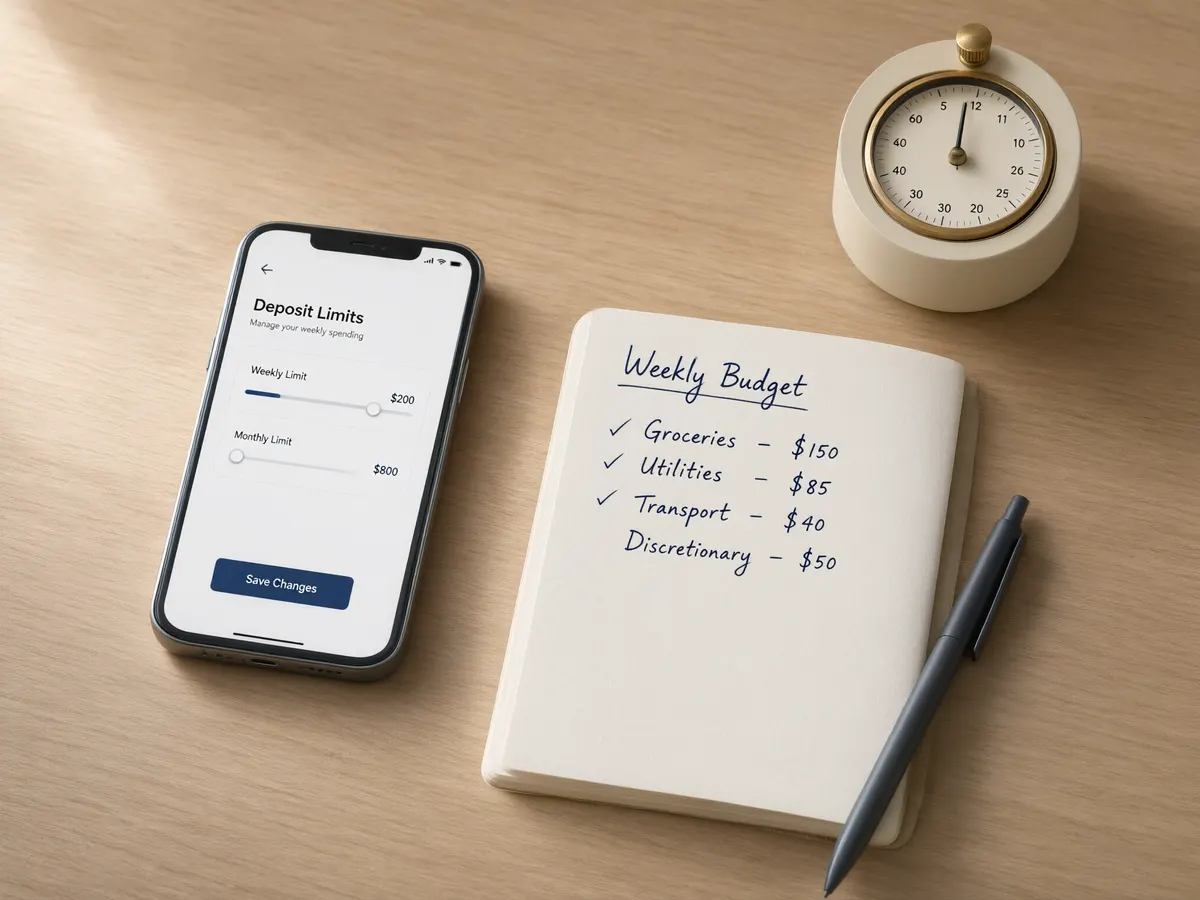
The tools you can use without trusting anyone sit inside your account: deposit limits, loss limits, session timers, cool-off periods and self-exclusion. They are enforced by the operator, they cost nothing, and they work even while you are still deciding who to talk to. If you want the mechanics of those, our responsible gambling guide covers how each one behaves in practice, and our guide to checking an operator’s licence explains how to read a licence claim rather than take it at face value.
Six checks before you trust a new RG resource
- Find the organisation’s full legal name, not just the service name.
- Look up its registration or charity number in the relevant public register.
- Confirm it appears on a licensed operator’s or regulator’s own site, not only in search ads.
- Re-enter the contact details yourself instead of tapping the link you were sent.
- Read who funds it and whether it reports publicly.
- Stop the moment anyone asks for payment, card details, an OTP or account credentials.
Six checks, maybe ten minutes. That is cheap compared with the alternative.
What this case leaves unsettled
The part no checklist fixes is the part that made this story news: how a person convicted of exploiting financial controls came to be hired into a trusted role at a problem gambling nonprofit in the first place. Lived experience of addiction is genuinely valuable in recovery work, and plenty of good counsellors have a history. Where the line sits between that and an unresolved $1.4 million fraud is a question for the organisations doing the hiring, and this sentencing does not answer it.
What you can control is narrower. Before you share anything with a service that promises help, spend the ten minutes confirming who it is. Checking the people you ask for help is not cynicism about recovery; it is the same instinct that makes you read bonus terms before clicking accept, pointed at something that matters more.