
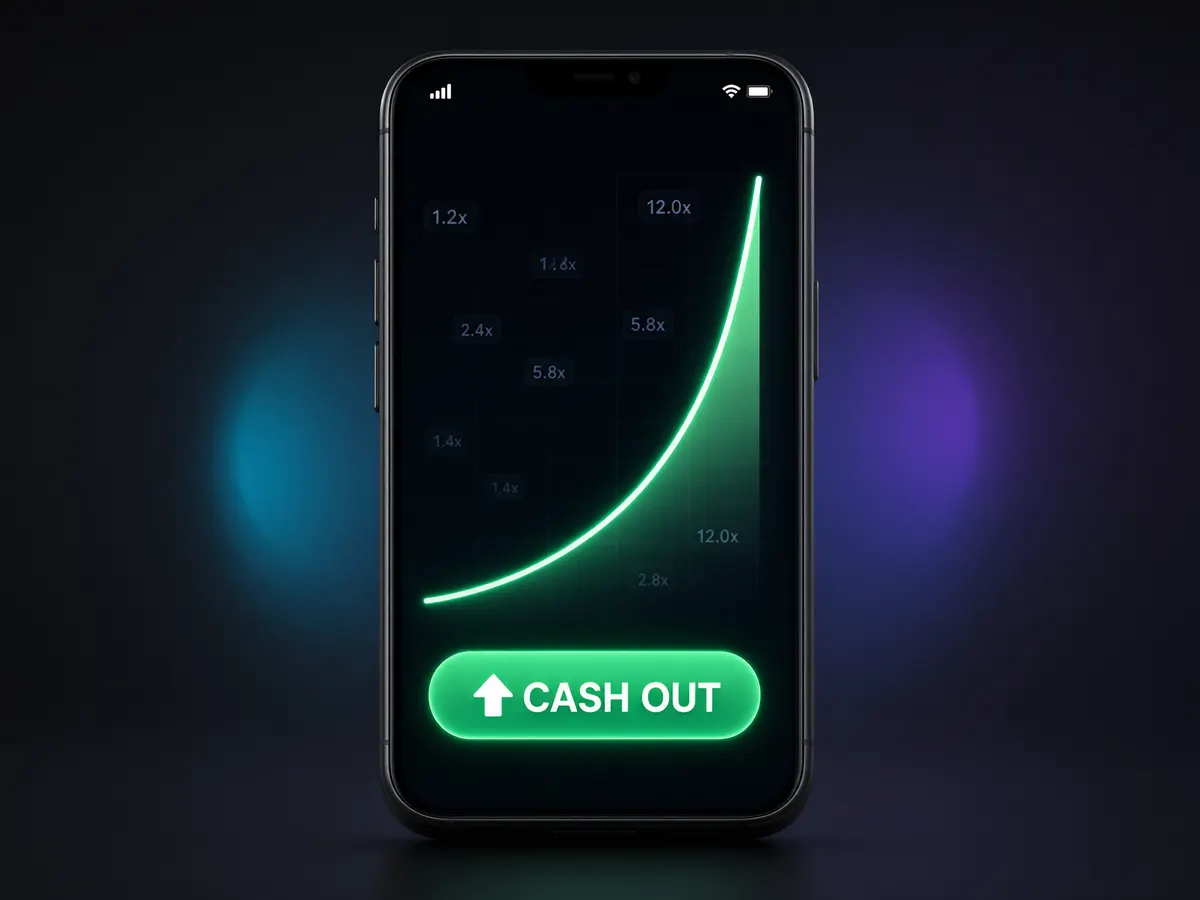
What counts as a quick round casino game
Quick round casino games are titles built around a single short wager that resolves in seconds rather than a reel spin or a hand of cards, usually with a multiplier that climbs until the round ends. Crash games are the best known version: you bet, a multiplier rises from 1.00x, and you either cash out before the round stops or you lose the stake.
That definition is tidy. The category it describes is not. “Quick round” has become a marketing bucket that now holds genuine crash games, instant-win scratch mechanics, jackpot side-games and anything else a provider wants to call fast and social. CT Interactive’s new title Flash Jack, launched exclusively on Palms Bet in Bulgaria, is a useful example of exactly that blurring, because it gets filed next to Aviator in coverage while working on a different principle altogether.
Flash Jack: what the announcement actually says
Flash Jack is a community jackpot product from CT Interactive, launched exclusively with Palms Bet in Bulgaria. According to the provider’s announcement, it uses an accumulated payout mechanic with card reveals and a multiplier ceiling of up to 10,000x, and the company states there is a win in every game. Chief operating officer Martin Ivanov framed the launch around player engagement and added value for operators, and the product is positioned to work either as a standalone game or as a promotional tool to extend session duration.
Everything beyond that is currently unconfirmed. No published RTP figure, no volatility rating, no independent review, no third-party certification detail has appeared in the launch material. Card reveals and an accumulating community pot are not the same mechanic as a multiplier curve you have to cash out of, so if you came here expecting Flash Jack to be Aviator with a different skin, the honest answer is no, not on the evidence available.
One phrase deserves attention. “A win in every game” tells you about hit frequency, not about return. A game can pay something on every round and still return less than the stake on average, because the size of those wins is what determines RTP. Hit frequency and RTP are separate numbers, and only one of them is being advertised here.
The mechanic that defines crash-style games
A crash game runs one round at a time. A multiplier starts at 1.00x and increases on a curve. At a random point the round ends, and anyone still holding a bet loses it. Cash out before that moment and you receive your stake multiplied by the figure showing when you pressed the button.
Put numbers on it. You stake ₹500 and cash out at 2.40x, so ₹1,200 comes back, ₹700 of it profit. The same ₹500 staked with no cash-out at all returns nothing the instant the round stops, whether that happens at 1.12x or 48x. The decision point is the entire game. There is no paytable to study, no symbol combination, no bonus buy logic, just one timing choice per round.
This is why crash titles feel different from everything else in a casino lobby even though the underlying randomness is identical. The outcome is generated before you can influence it, but the payout you collect depends on an action you take while the round runs. That split is unusual, and it is the whole appeal.
Round timing: seconds, not minutes
A typical crash round runs for a few seconds to perhaps half a minute, with a short betting window between rounds during which bets lock in for the next flight. Aviator set the pattern most players now recognise: place a bet, watch the plane climb, cash out or lose it, repeat almost immediately.
Betting windows and auto cash-out
Because the window between rounds is short, these games give you tools to commit in advance. Auto bet repeats a stake every round without you pressing anything. Auto cash-out closes your position the moment the multiplier hits a value you set, say 1.80x, which removes reaction time from the equation entirely. Many titles also let you run two bets on the same round, typically with one set to exit early and one left to run.
Auto cash-out is worth using, and not for the reason it is usually sold. It does not improve your odds by a fraction of a percent. It does stop you from chasing a curve you already decided to exit, which is the mistake that actually costs money in this format.
Why rounds are deliberately short
Short rounds are a design choice, not a technical limit. They fit mobile sessions measured in minutes, they produce a visible result before attention drifts, and they let a player place far more bets per hour than a slot session would. That last point is the one to internalise. The house edge is a percentage of everything you stake, so compressing rounds compresses the time it takes for that percentage to apply.
Crash games against slots and instant-win titles
The three formats get grouped together as “fast” games and then behave quite differently once you sit down with them.
| Feature | Crash games | Video slots | Instant-win titles |
|---|---|---|---|
| Round length | Seconds, with a betting window between rounds | A few seconds per spin, features can run longer | Instant, resolved on reveal |
| Player input after the bet | Cash-out timing decides the payout | None, the spin result is already determined | None, the ticket outcome is already determined |
| Outcome structure | One multiplier per round | Paylines, scatters, bonus rounds, free spins | Fixed prize table per ticket |
| Volatility control | Partly player-set via cash-out target | Fixed by game design | Fixed by prize structure |
| Social element | Shared round, other players’ bets and exits visible | Solo, aside from jackpot pools | Solo |
Player agency: cash-out against spin
A slot spin is finished the moment the RNG resolves it. The reels are animation. In a crash game the crash point is also pre-determined, but your exit is not, which means you can shift where your returns land on the distribution. Cashing out at 1.30x every round produces frequent small wins and the occasional painful miss. Holding for 10x produces long dry runs and rare large hits. The long-run return stays whatever the game’s RTP is. You are choosing variance, not expectation, and that distinction matters more than any guide claiming otherwise.
Pace and session length
Fast paced slots at least force a brief pause for animations and feature rounds. Crash games pause for the betting window and nothing else. Sessions tend to run shorter in clock time and longer in number of bets, which is the combination most likely to surprise people when they check their balance.
Why the format spread so fast
Aviator did most of the work. It proved that a single-screen, one-button game could hold mobile players who were never going to study a 243-ways paytable, and once it did, every content provider had a commercial reason to ship something in the same shape. Crash-style and Aviator-style games are now standard lobby furniture rather than a novelty category.
Three things keep the demand there. Mobile screens suit one rising number better than five reels and ten paylines. Rounds that finish in seconds suit play in gaps rather than sittings. And the shared round creates a live feel that solo games cannot copy, because you can see other players’ stakes and watch who cashed out at 1.50x while the curve carried on to 20x. Community jackpot products like Flash Jack chase that same social hook from a different direction, pooling contributions instead of sharing a multiplier curve.
What the math permits you to claim
Every outcome in these games is produced by an RNG, and each round is independent of the last. The sequence of previous multipliers displayed along the top of the screen is history, not information. A run of eight low crashes does not make a high one due, and no cash-out pattern, progression or timing system changes the expected return, because the house edge is applied to every stake regardless of when you exit.
Published RTP for crash titles generally sits in the same broad territory as slots, but the figure varies by game and in some cases by operator configuration, so read the game’s own info panel rather than a third-party estimate. Many crash implementations build the edge in as a small chance that the round ends immediately at 1.00x, which is why the very first fraction of a second matters mathematically even though it looks like nothing. Some titles, particularly on crypto-facing sites, publish provably fair seeds and hashes so you can verify after the fact that a round was not altered. Provably fair confirms the round was not manipulated. It does not mean the game has no house edge.
Volatility in this format is unusually wide, because the ceiling is high and the common outcomes are low. A 10,000x cap, wherever you see one advertised, is a maximum, not a typical result, and the probability attached to it is correspondingly tiny.
Treat the spend as entertainment cost. Set a deposit or loss limit before the first round rather than during a losing streak, use the session reminders your operator provides, and stop at a time you decided in advance. If play stops feeling optional, cool-off and self-exclusion tools exist for exactly that, and free confidential support is available through services such as BeGambleAware. Nothing in this category pays reliably, and none of it should be treated as income. 18+ only.
Judging a new title like Flash Jack
Flash Jack is one entrant in a crowded category, launched with one operator in one market, and that is genuinely all anyone can say about it yet. Whether it plays well, whether the community pot cycles often enough to matter, and what it actually returns are open questions until an RTP figure, a volatility rating and independent testing details are on the record. The provider’s own framing, that the product can double as a promotional tool to lift session duration, tells you who the initial pitch was written for, and it was not players.
What is worth watching is whether providers keep shipping true multiplier-curve crash games or keep pushing hybrids that borrow the fast, social feel while running on jackpot and reveal mechanics underneath. The two get described in identical language and behave nothing alike. Before you play any of them, find the information panel and check the RTP, the maximum multiplier and whether the win in every round is a win on your stake or a fraction of it. If a game will not tell you that, that silence is the answer.