
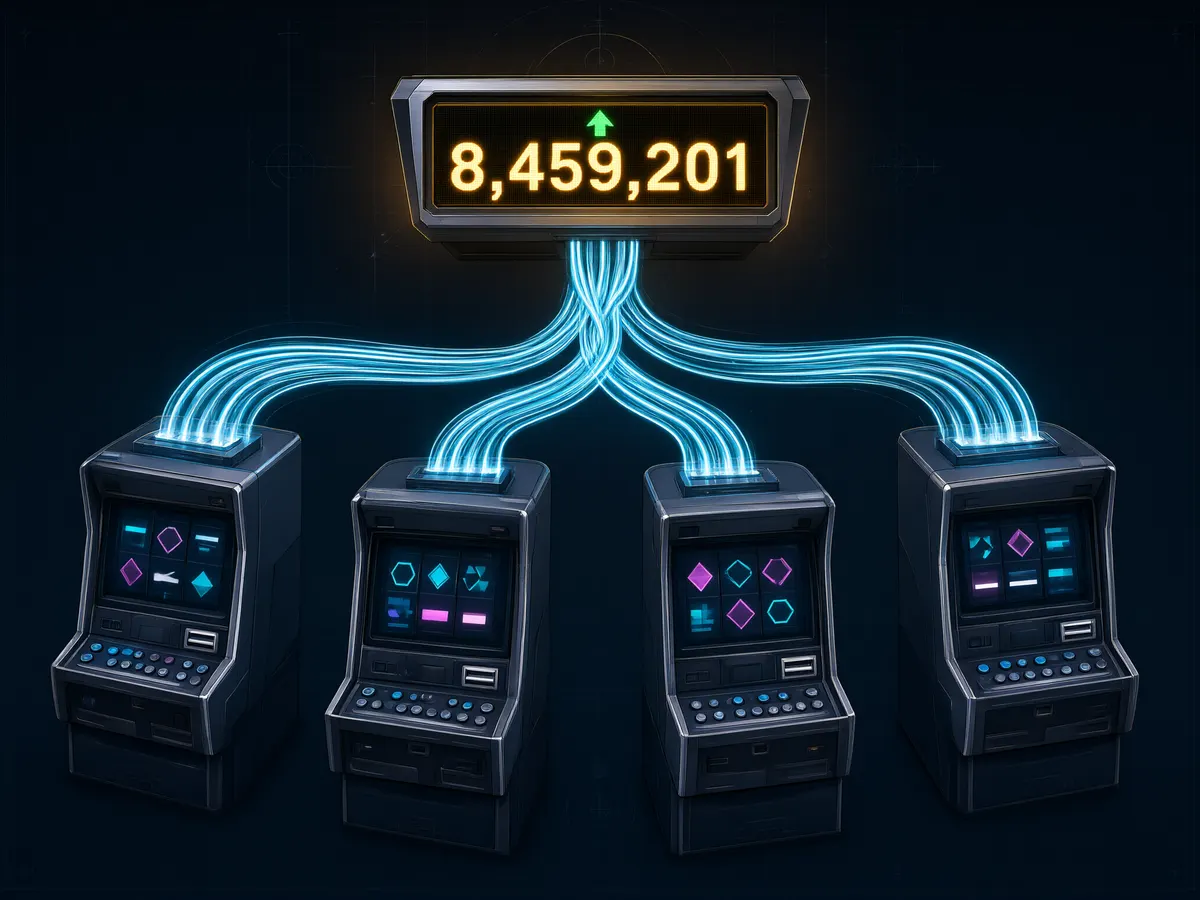
Does a bigger jackpot always mean worse odds for you? The popular answer is yes, and the popular answer is correct. The reasoning behind it usually isn’t. Most players assume the problem is simply that millions of spins are competing for one prize. The real cost sits somewhere much more boring: a slice is taken out of every stake to build that pool, and on a lot of games you only get access to the pool if you bet above a qualifying amount. Miss that condition and you are paying for a prize you cannot win.
What a linked jackpot network actually is
A linked jackpot network is a single prize pool fed by a small percentage of every stake placed on a group of connected games, which grows continuously until someone wins it and then resets to a preset starting figure. The games can be cabinets on one casino floor, cabinets across several venues owned by the same operator, or thousands of online slot sessions running on different sites through the same game studio.
A standalone fixed jackpot works the opposite way. The top prize is a fixed multiple of your stake, printed in the paytable, paid out of that one game’s own maths, and identical whether you are the first or the millionth person to hit it. Nothing accumulates. Nothing is pooled. There is no shared meter and no central counter, because there is nothing to share.
That difference in plumbing is what produces every trade-off further down this page.
Linked floors in practice: what the ReelLink rollout shows
Networked slot technology is not a theoretical thing, and a recent Swiss example makes the architecture easy to picture. According to G3 Newswire, Swiss Casinos has completed the rollout of ReelLink, its in-house platform for bringing online game content onto the physical casino floor, across all four of its venues: Casino Zurich, Casino Zürichsee in Pfäffikon, Casino Winterthur and Casino St. Gallen. The report says the platform first went live at Winterthur and Pfäffikon in December 2025, was extended to Zurich and St. Gallen in July 2026, and currently runs on 24 machines with a further 17 planned before the end of the year, taking the group total to 41.
Worth being precise here, because the distinction matters for understanding jackpots: ReelLink as described is a content-delivery platform, not a jackpot pool. It separates the game content from the physical cabinet so certified online titles can be pushed to approved machines in seconds and updated cabinet by cabinet, and it plugs into the casino’s existing management system so player tracking, accounting and regulatory reporting stay in place.
That last detail is the part that explains linked jackpots. Every machine in a networked jackpot has to be in constant two-way conversation with a central server: reporting stakes, receiving the current meter value, and being told when a win has been validated. Once a floor is wired for centrally managed content and accounting, the same backbone is what a pooled progressive runs on. Linked jackpots are an application of that architecture, not a separate miracle.
How the pooling works, from seed to payout
Contribution rate and seed value
The jackpot is funded by a contribution rate: a disclosed slice of every qualifying stake that is diverted away from normal prize payouts and into the shared pool. On a game with a 1% contribution, ₹1 of every ₹100 wagered goes to the meter rather than to regular line wins.
The pool does not start at zero. When a jackpot is won, the operator or game studio reseeds it at a preset seed value, funded either from reserves built during the previous cycle or from the game’s own margin. That seed is why you never see a progressive sitting at ₹0 after someone collects. Both numbers, contribution rate and seed, are normally stated in the game’s help or info screen. If a game will not tell you either, that is information in itself.
The central jackpot controller
Every eligible game reports its qualifying turnover to a single jackpot controller, which keeps one authoritative counter. The meter you see spinning upward on screen is a display of that counter, not a local calculation. Ten cabinets in Winterthur, or ten thousand online sessions on a studio’s wide-area network, all increment the same number.
The controller is also the referee. When a game signals a jackpot event, the controller validates it against its own records, locks the meter, pays the amount recorded at that instant, and reseeds. That is why two players cannot win the same pool at the same moment, and why the figure on screen can lag the true total by a second or two on a busy network.
What actually triggers the win
Two mechanisms dominate, and neither is predictable.
The first is a symbol-based or feature-based trigger: you land the jackpot combination or reach a bonus wheel, exactly as the paytable describes, with the outcome produced by the game’s RNG. The second is a random trigger, where the RNG can award the jackpot on any qualifying spin independently of what the reels show, often weighted by stake size.
A variant you will see advertised is the must-hit-by or must-drop jackpot, where the game guarantees the prize will be awarded before the meter passes a stated ceiling. People read that as a countdown. It is not one. The game selects a hidden trigger point within the range using the RNG, so the jackpot can land immediately after the previous reset or a rupee short of the ceiling, and nothing about a high meter tells you a hit is overdue. Each spin remains independent of every spin before it.
Fixed, local and wide-area jackpots side by side
The trade-off is consistent: the wider the network, the bigger the headline prize and the rarer the hit.
| Feature | Fixed jackpot | Local progressive | Wide-area / networked progressive |
|---|---|---|---|
| Prize size | Set multiple of stake, unchanging | Moderate, grows within one venue or one site | Largest, grows across many venues or operators |
| Funding | Game’s own paytable maths | Contribution from a limited pool of players | Contribution from a very large pool of players |
| Hit frequency | Highest of the three | Lower | Lowest, often extremely rare |
| Effect on base-game RTP | None deducted | Small deduction | Larger deduction |
| Volatility | Normal for the game | Raised | Highest, long dry stretches are the norm |
What this means when you pick a progressive jackpot slot
The contribution rate comes out of your base game, so a networked progressive pays smaller and rarer ordinary wins than an equivalent slot without one. If a game advertises 96% RTP and routes 1% of stakes to the jackpot, roughly 95% is being returned through normal play and the remaining 1% only reaches players through jackpot wins. That is a redistribution, not a loss on paper, and the published RTP figure is honest. But it is an average spread over the entire network across millions of spins, and it assumes you are in the group that can win the pool.
Which brings us back to the condition nobody checks. Many progressive jackpot slots require a minimum qualifying bet, or scale your eligibility with stake size, or restrict the top tier to max-bet spins only. Bet below that threshold and you can still be contributing to the meter while having no realistic claim on it. You are then playing a slot with the reduced base RTP of a jackpot game and the payout profile of a non-jackpot one. That is the worst seat in the house, and it is entirely avoidable by reading one screen.
My own view, stated plainly: if you are not willing to bet at the qualifying level, do not play the networked jackpot version. Pick the fixed-jackpot or plain slot instead and keep the full base RTP working for you. If you do want a shot at a pooled prize, treat the stake as the price of a lottery ticket attached to a slot, size it accordingly, and expect long losing stretches, because high variance is not a bug in these games, it is the design.
Checks worth doing before you spin
Short list, and it applies whether you are playing from Mumbai or anywhere else on a licensed international site:
- Open the game info screen and confirm the stated RTP and, where disclosed, the jackpot contribution rate.
- Find the minimum qualifying bet and whether eligibility for each jackpot tier depends on stake.
- Check whether the jackpot is local to the site or shared across a studio’s wide-area network, since that changes the realistic hit frequency.
- Verify the operator’s licence and the regulator that issued it, and read how jackpot wins are verified and paid, including any instalment or cap terms.
- Confirm the withdrawal and KYC requirements before depositing, not after a win.
- Set a deposit or loss limit in the account tools first, while you are still thinking clearly.
Keep the variance in perspective
Pooled jackpots are low-probability, high-variance events, and a networked prize is large precisely because almost nobody wins it. The house edge does not disappear because a meter is climbing, and no amount of understanding the controller, the seed or the trigger mechanism changes the outcome of your next spin. Never chase losses, never stake money you need for anything else, and use the deposit limits, cool-off and self-exclusion tools your licensed operator is required to offer. This article is general information about how the technology works, not financial advice. If gambling has stopped being a cost you chose to pay, stop and talk to a support service.