
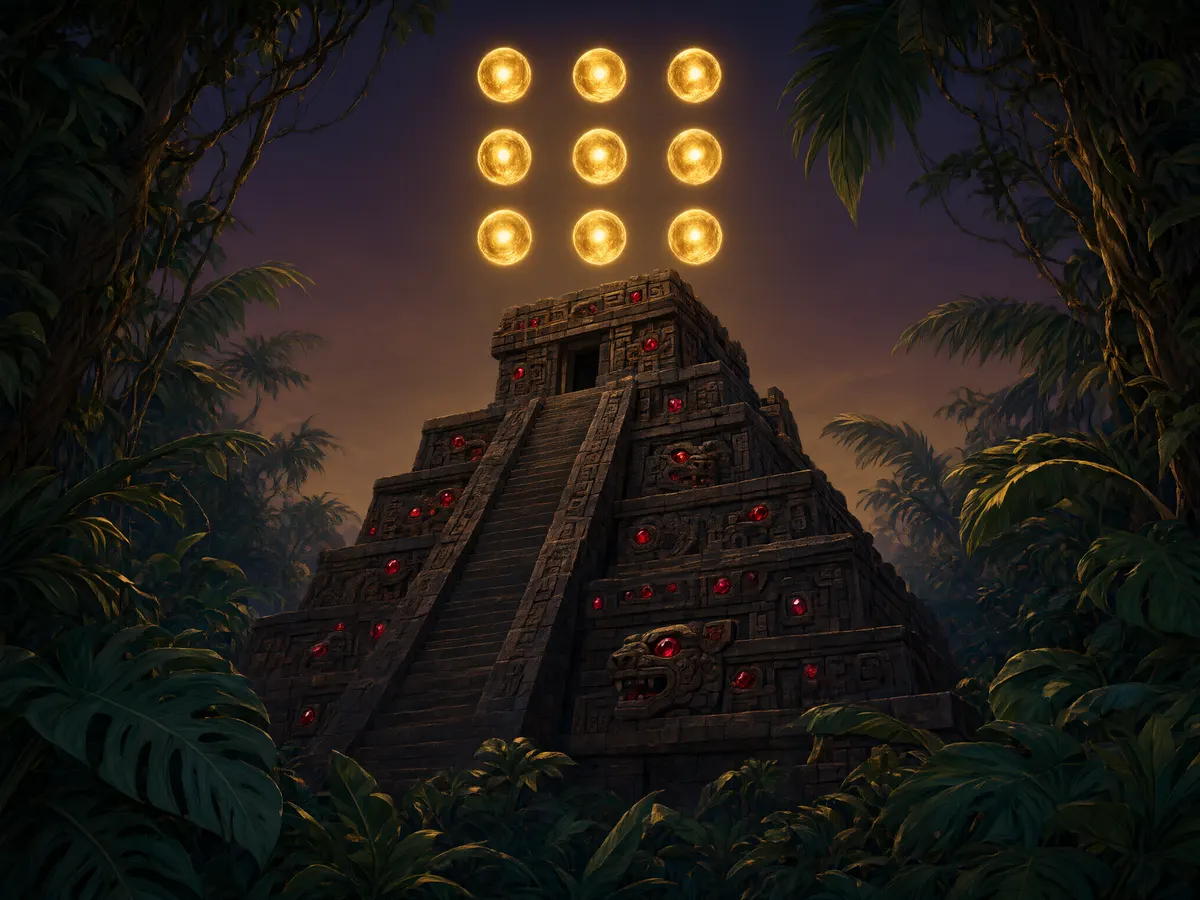
Three scatters land on reels 2, 3 and 4. In most slots that is the moment you pick a bonus round from a menu. In the new Suits and Royals slot, 9 Orbs of Gold, the game flips a Coin of Fate instead and decides for you: unlimited Free Spins, or a Hold & Win round with sticky Gold Coins worth up to 2,000x the bet. You don’t get a vote.
That single design choice is the most interesting thing about the release, which Suits and Royals put out on 14 October 2026. The studio sits inside Yggdrasil’s YGG Champions programme, and 9 Orbs of Gold is a treasure hunt set in a forgotten Mesoamerican temple, with gold and ruby loot buried in overgrown ruins.
The temple is Mesoamerican, not Egyptian
9 Orbs of Gold is a jungle temple game, not an ancient Egypt themed slot, even though it will inevitably be shelved next to every Book of Ra clone in casino lobbies. The studio’s marketing team said they drew on “Mesoamerican architecture, patterns and visual richness” to build something “mysterious and distinctive”, and the distinction matters more than aesthetics: Egypt slots have trained players to expect expanding symbols and a high-variance free spins round. This game is built on a different idea entirely.
The hook is the orb. Three to nine Orbs landing anywhere on the 5×3, 20-payline grid pay an instant win of up to 2,000x the bet, with no payline involvement at all. All nine filling the board is the signature hit the game is named after. Wilds also pay on their own, and five of them award up to 2,500x. So the base game has two separate ways to produce a large result before you ever reach a bonus round, which is unusual, and it shapes how the rest of the maths has to be balanced.
Free Spins or Hold & Win: which one you actually want
Based on what the studio has published, Hold & Win carries the clearer ceiling and Free Spins carries the clearer upside, and the Coin of Fate decides which you get. Here is how the two rounds differ on the facts available:
| Feature | Free Spins | Hold & Win |
|---|---|---|
| Trigger | Coin of Fate after 3 scatters on reels 2, 3, 4 | Coin of Fate after 3 scatters on reels 2, 3, 4 |
| Spin count | No set limit | Standard respin structure |
| Core mechanic | Every win raises the Orb values | Sticky Gold Coins lock in place |
| Published cap | Not stated separately | Up to 2,000x the bet |
| Who it suits | Players chasing a build-up | Players who want a visible target |
“Free Spins with no set limit” is the phrase the studio used, and it is doing a lot of work. An unlimited round has to end somehow, and nothing published explains what that condition is. It could be a collapse-style mechanic that stops when a spin fails to contribute, or a collection target. Until the paytable is public, treat the round as open rather than infinite.
If I had to take one, I’d take the Free Spins. An escalating orb value compounds against a base-game mechanic that already pays up to 2,000x for orbs alone, so the two systems multiply each other rather than sitting side by side. Hold & Win is the safer read, though, and it is a defensible preference: you can see the coins you have locked, you know what the round is worth as it develops, and the 2,000x figure is a stated number rather than an inference. Players who hate ambiguity will prefer it. The honest answer is that neither preference buys you anything, because the Coin of Fate does not care which one you wanted.
The suits and royals slot spec sheet, read honestly
9 Orbs of Gold runs a 94% RTP, a 38% hit frequency, low-medium volatility and a default max multiplier of 6,010x. The RTP sits at the bottom of the typical slot range of roughly 94% to 97%, which means a 6% house edge over the long run, averaged across millions of rounds and never across your session.
| Specification | Value | What it means in play |
|---|---|---|
| RTP | 94% | 6% house edge; below the slot average |
| Hit frequency | 38% | Roughly 3 in 8 spins return something |
| Volatility | Low-medium | Smaller, steadier returns than a high-variance game |
| Max multiplier | 6,010x (default) | The published ceiling on a single round |
| Grid | 5×3, 20 paylines | Compact, traditional layout |
Two of those numbers argue with each other, and this is the trade-off worth thinking about before you load the game. A 38% hit frequency with low-medium volatility describes a gentle, grinding session: frequent small returns, few long dry stretches, a balance that keeps you spinning. But the 2,000x orb hits, the 2,500x five-wild line and the 6,010x ceiling describe a game with a genuine tail.
Both readings are defensible. The one I’d commit to is that the volatility label describes the base game, where the 38% hit rate lives, while the bonus rounds carry almost all the distribution’s weight at the top end. That is not a contradiction so much as a split personality, and it has a practical consequence: the frequent small wins are mostly returning part of your own stake, and the 94% RTP means that over a long enough grind, the bottom-of-range figure is the one you actually feel. Low volatility does not make a game cheaper. It makes the cost arrive more smoothly.
Note the word “default” attached to that 6,010x figure. Studios commonly ship games with more than one configuration, and the wording implies the shipped settings can vary by operator. Check the in-game information panel rather than any review, including this one, for the number on the version you are playing.
Why a Yggdrasil-backed studio ships a 94% game
Suits and Royals describes itself as a premium studio making heritage-driven games, and the YGG Champions route gives smaller studios distribution through Yggdrasil’s network rather than requiring their own operator relationships. For a new name, a recognisable mechanic matters more than a headline RTP, which is probably why 9 Orbs of Gold leans on two things lobby browsers already understand: orb collection and Hold & Win.
The Coin of Fate is the part that could travel. Randomising which bonus a player receives is not new, but pairing it with two rounds that reward genuinely different play styles gives the same trigger two separate feelings, which stretches the content budget without building a third feature. Expect the mechanic to show up elsewhere if the game performs.
What nobody can tell you yet is the thing players will want first: which of the two rounds pays better on average. The studio has published one cap and not the other, and until the full paytable is out, the split between them is guesswork. Play it for the temple and the orb mechanic, set a deposit limit before you start, and treat the 94% as the price of admission rather than something the bonus rounds will quietly make up for.